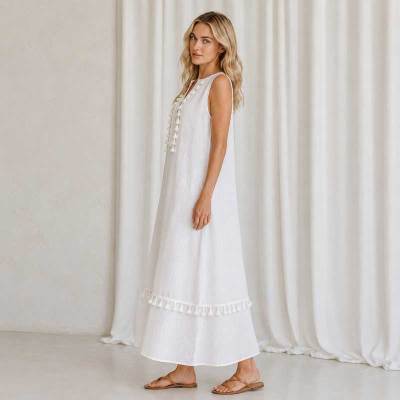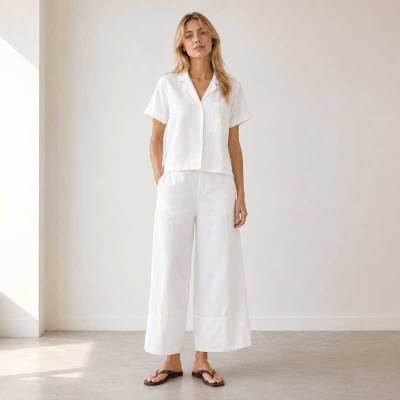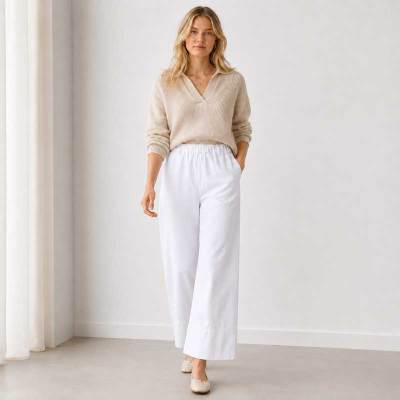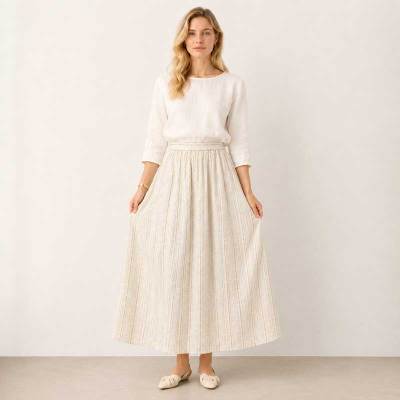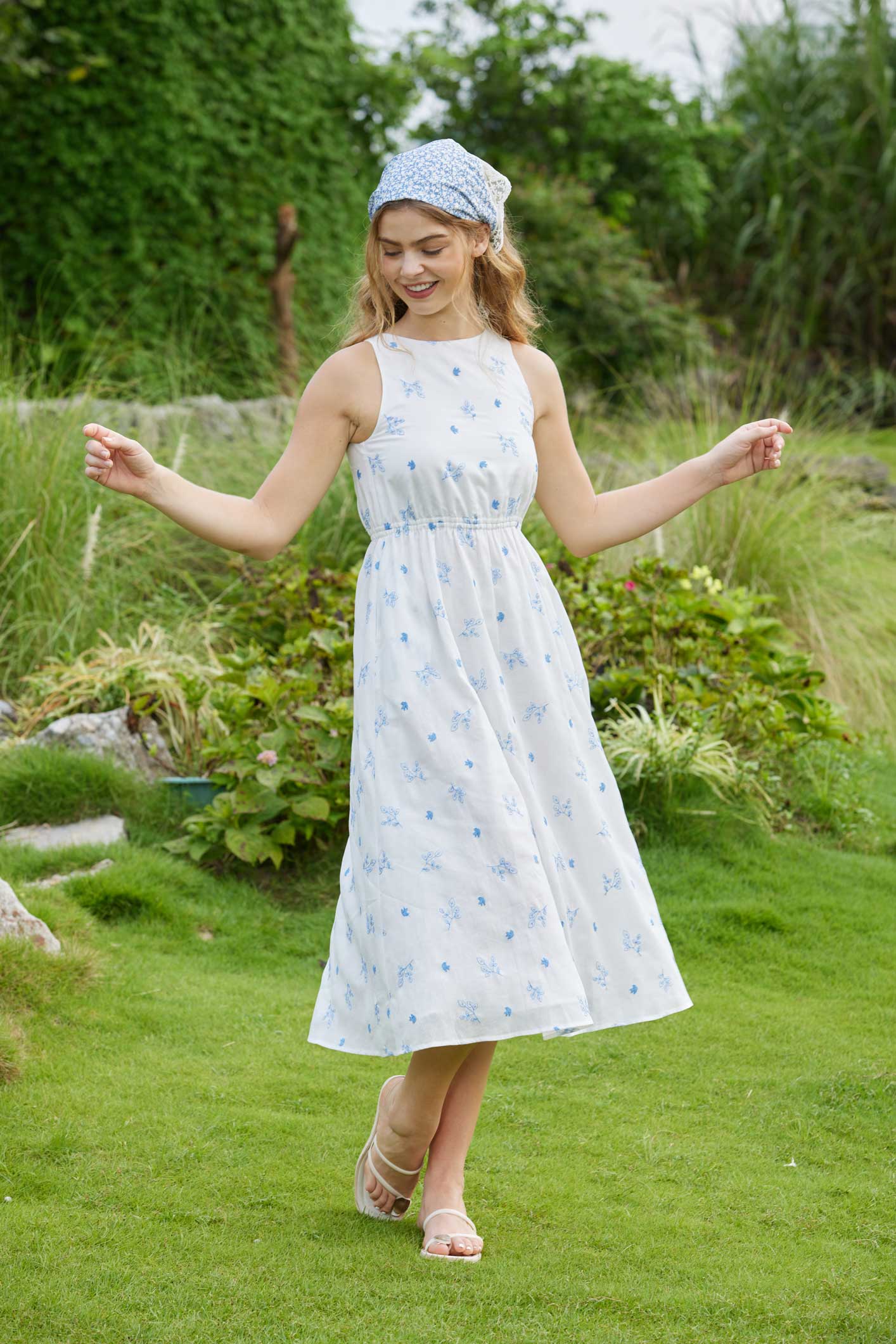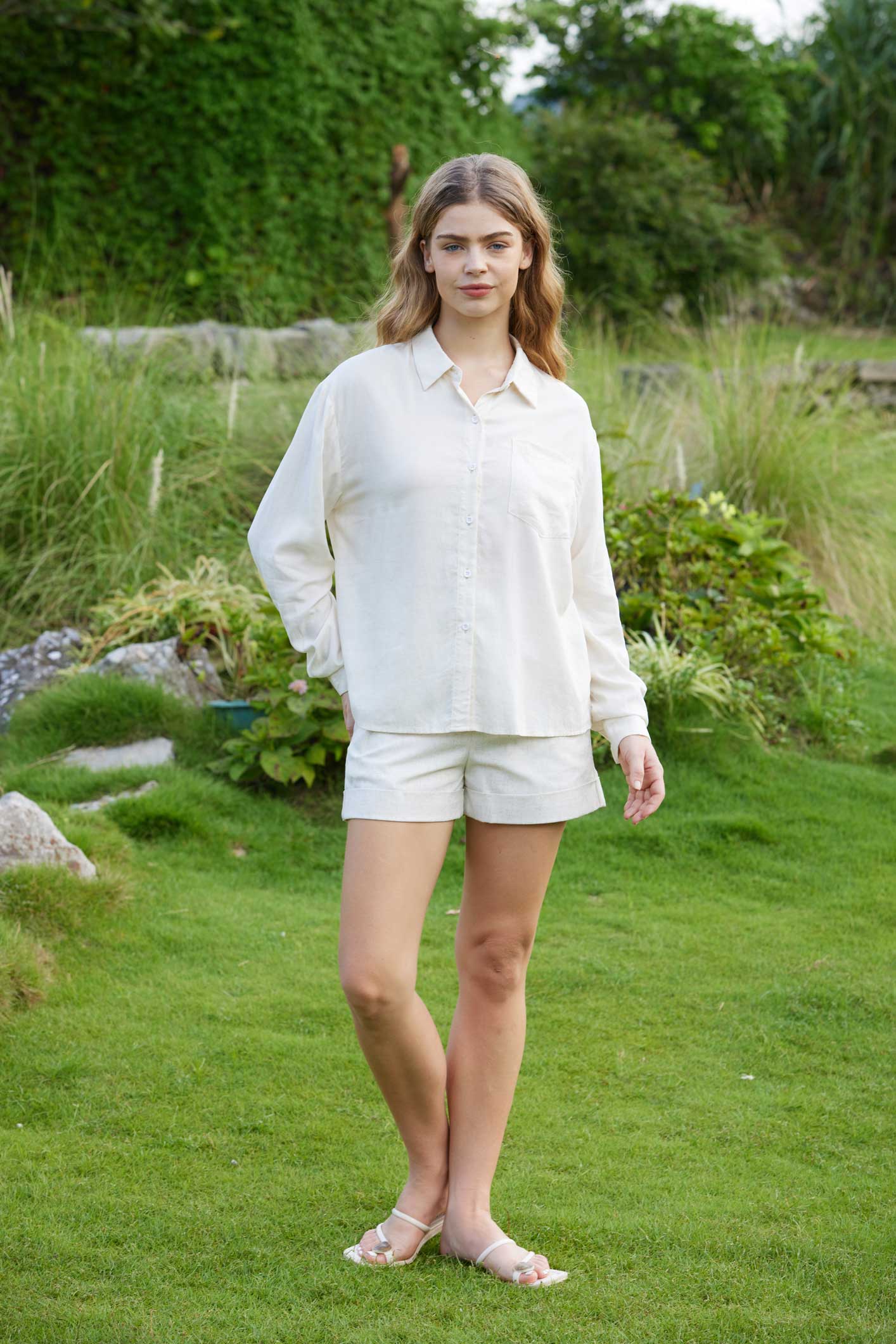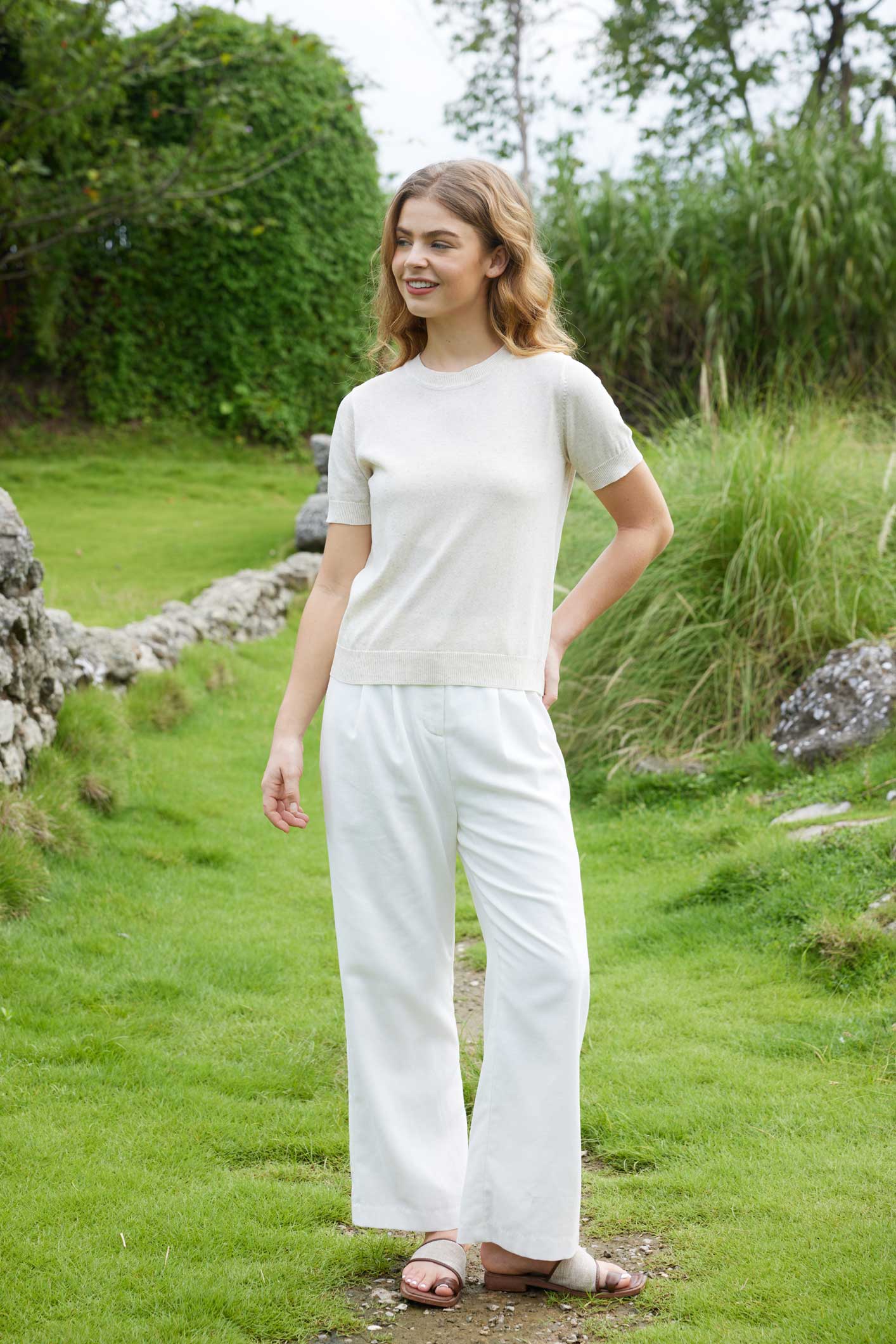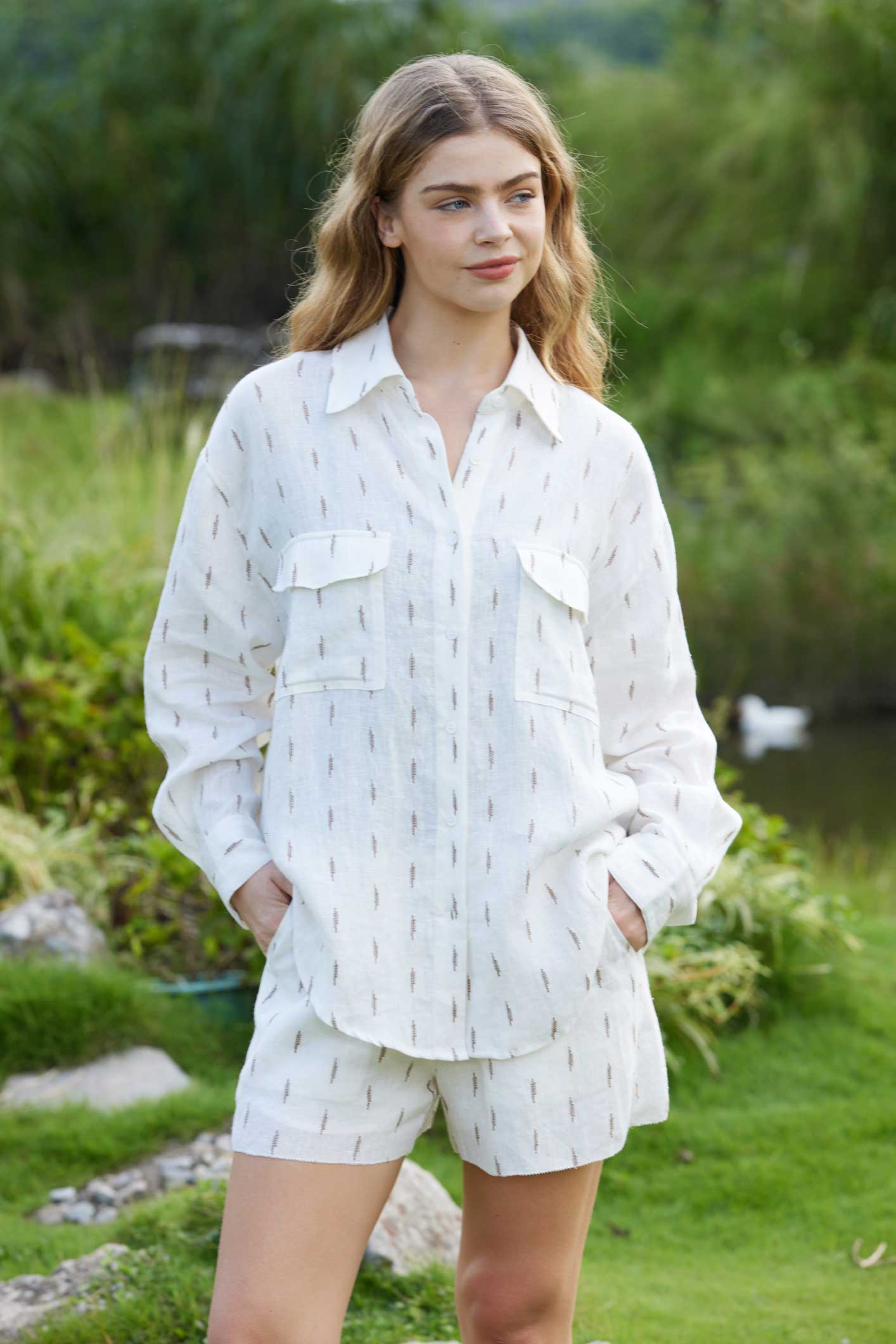
From Flax Field to Finished Garment: How KOSSR Makes Linen
From Flax Field to Finished Garment: How KOSSR Makes Linen
Direct answer: A KOSSR linen garment is made in seven visible stages. European flax is sown in spring and grown for roughly 100 days, harvested in mid-summer, then retted in the field for two to six weeks so the woody stem releases the fibre. The straw is scutched and hackled into long line fibre, spun into yarn, woven into cloth, and dyed. The finished cloth is cut and sewn, then garment-washed so the piece arrives soft and pre-shrunk. The raw material is 100 percent European Flax, and every product page states the composition, the fabric weight in gsm, and the pre-washed finish. This guide walks through each stage in order, explains what the process changes about how the garment feels and wears, and states plainly what we can and cannot verify.
1. What "How KOSSR Makes Linen" Actually Covers
When people ask how linen is made, they usually expect one answer. In practice linen is not made in one place or one step. Four different industries handle four different stages, and each stage has its own quality decisions. A flax field decides fibre length and fineness. A scutching line decides how much woody shive survives. A spinning mill decides yarn evenness. A weaving mill decides how dense and how stable the cloth will be. A cut-and-sew unit decides how the garment sits on the body. KOSSR works across all four stages, but we only control the final specification choices, so the honest version of this article separates what happens in the field from what happens at the machine.
The purpose of publishing the sequence is practical, not decorative. If you know that garment washing shrinks the cloth before it is cut, you understand why a washed linen shirt keeps its size after three years. If you know that retting length changes fibre colour, you understand why two natural linen pieces can differ slightly in tone without either being defective. Process knowledge turns vague brand promises into checks you can run yourself on any product page.
- Stage 1 to 2: agriculture and field retting, where fibre quality is largely decided.
- Stage 3 to 4: mechanical fibre preparation, scutching and hackling.
- Stage 5 to 6: spinning and weaving, where yarn and cloth structure are set.
- Stage 7: dyeing, garment washing, cutting, sewing and final inspection.
Everything below follows that order. If you want the material background first, the KOSSR explainer on what linen is made from covers the fibre itself. Each stage here ends with a check you can repeat: what the fibre should look like, what the cloth should weigh, and how the finished garment should behave after the first wash.
2. Why We Publish the Process at All
Shoppers in Europe and North America have learned to distrust adjectives. "Premium", "eco" and "luxury" cost nothing to print. A process description is different because it is falsifiable. If we say the flax is European and the fabric is garment-washed, you can check the label, weigh the cloth against a kitchen scale, wash it at 30 °C and see whether it shrinks. Transparency is only useful when it produces a testable claim, so this article is written to be checked rather than admired.
There is also a commercial reason. Linen costs more than cotton at every stage, from field to final press. A linen shirt uses long-staple fibre that must be pulled from the stem without breaking, spun on slower machinery, and woven at lower speed to avoid abrasion. When a buyer understands that sequence, the price stops looking arbitrary. That is the same argument that runs through the brand note on why KOSSR chooses linen for daily life.
How to use this article: read section 3 to 10 for the sequence, section 11 to 13 if you want the origin and label facts, and section 15 if your real question is what a brand can and cannot prove. The final section gives the short version in five sentences.
One caution before we start. Fibre classification varies by country of sale, and terms such as "pure linen", "100 percent flax" and "European Flax" are not interchangeable in every market. Where a term matters legally we use the version printed on the KOSSR product page, and we do not extend it beyond what the page states.
3. Stage 1 - Growing Flax: The 100-Day Field
Flax for textile use, Linum usitatissimum, is an annual plant grown for its stem rather than its seed. In the European maritime belt, sowing usually happens between late March and mid-April, when soil temperature is stable and there is enough moisture for even germination. The crop then grows fast. In roughly 100 days it reaches between 80 and 120 centimetres, and growers deliberately sow densely so the plants grow tall and thin rather than branching. Branches create short, coarse fibre; a dense stand produces the long, straight bundles that spin into fine yarn.
The plant flowers for about two weeks, usually in June, with small pale blue flowers that open in the morning. After flowering the stem hardens and the fibre bundles inside the stem thicken. Harvest timing is a genuine judgement call. Cut too early and the fibre is fine but weak; cut too late and the fibre becomes woody and coarse. Most European crops are pulled rather than cut in the traditional system, because pulling keeps the full stem length including the root end, and stem length is directly related to fibre length.
[IMAGE_PLACEHOLDER] img prompt: A field of tall flax plants in pale blue bloom in the European maritime belt, rows stretching to the horizon under soft morning light, documentary agricultural photography, natural muted tones, wide landscape compositionWater and inputs are lower than most people assume for a textile crop. Flax grown in the European maritime belt is largely rain-fed, because the growing season coincides with normal rainfall, and the plant is relatively resistant to pests, which reduces the number of spray passes compared with cotton. Flax also fits a rotation: it is usually grown after a cereal and followed by another crop, which helps interrupt disease cycles without heavy chemistry. We describe the plant side in more detail in the KOSSR guide to what makes flax a sustainable plant.
- Sowing window: late March to mid-April in the European belt.
- Growing period: about 100 days to harvest readiness.
- Target height: 80 to 120 cm, grown dense to keep fibre long.
- Flowering: roughly two weeks, typically June.
- Irrigation: mostly rain-fed in the maritime growing belt.
4. Stage 2 - Harvest and Retting: Where Fibre Quality Is Decided
Retting is the least visible and most consequential step in the whole chain. Inside the flax stem there are fibre bundles glued to a woody core, called shive, by pectin and other natural binders. Retting is a controlled partial decomposition that dissolves those binders so the fibre can later be separated without breaking. If retting is too short, the fibre tears away with shive attached and the yarn turns rough. If it is too long, the fibre weakens and the yield collapses.
Field retting, also called dew retting, is the method used for most European textile flax. The pulled stems lie on the field in parallel rows while dew, sun and naturally occurring microorganisms work through them. It typically takes two to six weeks depending on temperature and humidity, and growers turn the rows to keep the retting even. Because weather drives the process, no two seasons give exactly the same tone. That is why natural, undyed linen from different batches can sit slightly apart on the grey-to-gold spectrum without anything being wrong with the cloth.
Water retting, where stems are submerged in tanks or slow-moving water, works faster and gives a more uniform result, but it consumes more water and needs careful waste treatment. It survives mainly in specialised production. For KOSSR, the practical outcome matters more than the label: retting decides whether the fibre will be long and supple enough for a fine yarn or short and only suitable for heavier cloth such as towelling and industrial fabric.
Why tone varies: retting is biologically driven and weather dependent. A difference of one or two shades between two natural linen pieces is a sign of a natural process, not a quality fault. Dyed and printed pieces are matched to a reference swatch, so tone variation there is controlled separately.
After retting the stems are dried, gathered and baled. At this point the material is straw, not fibre. It contains roughly 20 to 30 percent fibre by weight, and the rest is shive, dust and short tow that will be separated mechanically in the next stage.
5. Stage 3 - Scutching and Hackling: From Straw to Silver
Scutching is a mechanical beating process. Dried retted stems are passed through fluted rollers that break the brittle woody core, then rotating blades strike the straw and knock the shive away from the fibre. The long fibre that survives, called line fibre, is the valuable part. The short, tangled material that falls out is tow, which is spun into coarser yarns for heavier cloth, twine and non-apparel uses. Nothing is wasted, but the split matters commercially because long line fibre is what makes a fine shirt-weight cloth possible.
Hackling follows. The line fibre is drawn through a series of combs with progressively finer pins, aligned into parallel strands and cleaned of remaining shive. The output is a soft, silver-grey ribbon called a sliver or, in traditional terms, flax silver. Alignment is the entire point. Yarn strength comes from fibres lying parallel to each other, so a well-hackled sliver produces a smooth, strong yarn with very little surface hairiness.
- Breaking: fluted rollers crush the woody core inside the stem.
- Scutching: rotating blades strike out the broken shive.
- Separating: long line fibre is split from short tow.
- Hackling: fine combs parallelise and clean the line fibre.
- Drawing: slivers are blended and drafted to a consistent weight.
The result is measurable. A good line fibre sliver is consistent in length and low in residual shive, which is why the cloth from it feels smooth against the skin instead of scratchy. If you have ever worn a cheap linen garment that felt rough and shed fibres for weeks, the cause is usually upstream of the loom: short fibre, incomplete retting, or aggressive scutching that broke the fibre before spinning.
6. Stage 4 - Spinning: Wet-Spun and Dry-Spun Yarn
Flax can be spun two ways, and the choice changes the cloth more than almost any other decision. Dry spinning drafts the sliver in normal air, producing a slightly hairier yarn that is cheaper and well suited to medium and heavy weights. Wet spinning passes the drafted roving through a warm water trough just before twisting. The water softens the pectin still present in the fibre, so the fibres slide past one another and the resulting yarn is finer, smoother and stronger. This is the route used for fine linen shirting and lightweight dresses.
Yarn is classified by count, and the count determines how fine the cloth can be woven. A finer count gives a lighter, smoother fabric but takes more fibre and more machine time per metre, which is why lightweight linen costs more per square metre than a heavy canvas. Twist also matters. More twist gives a cleaner surface but a stiffer hand; less twist gives a softer cloth that wrinkles more readily. Linen naturally has low elasticity compared with wool, so the spinner works within a narrow band before the yarn becomes either weak or wiry.
| Yarn route | Typical use | Surface | Relative cost |
|---|---|---|---|
| Wet-spun, fine count | Shirting, lightweight dresses, blouses | Smooth, low hairiness | Highest |
| Wet-spun, medium count | Tops, midi dresses, trousers | Smooth with visible character | Medium to high |
| Dry-spun, medium count | Tunics, relaxed pants, overshirts | Slightly textured | Medium |
| Dry-spun, heavy count | Outerwear, bags, home textiles | Pronounced texture | Lower |
Because KOSSR orders are specified by end use, the yarn count is chosen against the target garment rather than against a single house standard. A shirt dress and a pair of wide-leg trousers can both be 100 percent linen and still be spun from different counts, which is why they feel different in the hand. That difference is intentional, and it is stated on the product page through the fabric weight and the product description.
[IMAGE_PLACEHOLDER] img prompt: Close-up of a spinning frame in a linen mill, fine flax yarn running from a warm water trough onto bobbins, shallow depth of field, industrial detail photography, neutral warm lighting7. Stage 5 - Weaving: Turning Yarn into Cloth
Most linen apparel is woven in a plain weave, the simplest interlacing where each weft thread passes alternately over and under each warp thread. Plain weave is not a compromise; it is the structure that gives linen its characteristic balance of airflow and stability. The density of the warp and weft, measured in threads per centimetre, sets how open or closed the cloth becomes. A looser sett lets more air through and feels cooler in heat. A tighter sett gives a denser, more opaque cloth that drapes heavily and resists distortion.
Weaving linen is slower than weaving cotton because the yarn has low elongation. It does not stretch to absorb loom tension, so the loom runs at reduced speed and the humidity in the weaving hall is controlled to keep the yarn supple. Every broken thread becomes a visible fault, so warp preparation and sizing, the temporary starch coating that protects yarn during weaving, have to be precise. Sizing is removed afterwards in a washing step, which matters for the final feel: residual sizing makes cloth stiff and slightly tacky.
The structure also determines how the cloth ages. In a plain weave with a well-balanced sett, wear is distributed across many interlacing points, so the fabric abrades evenly and thins rather than tearing. That even wear pattern is why a good linen shirt can go through years of washing and still hold together, provided the fibre was long and the weave was sound to begin with.
- Plain weave: the standard for most apparel linen, balanced airflow and stability.
- Sett: threads per centimetre, the main control on openness and opacity.
- Sizing: temporary protective starch, removed after weaving.
- Loom speed: reduced, because linen yarn has little stretch to absorb tension.
8. Stage 6 - Dyeing and Garment Washing: Why KOSSR Linen Arrives Soft
Linen straight off the loom is crisp and stiff, partly because of natural pectin and partly because of residual sizing. The traditional fix is repeated washing, and KOSSR uses that route rather than a chemical softener. Garment washing means the finished garment, already cut and sewn, is washed and tumbled under controlled conditions before it is packed. The process does three things at once. It removes sizing and surface pectin, it pre-shrinks the cloth so the size you receive is close to the size it will keep, and it breaks the fibre surface slightly so the hand becomes soft from the first wear.
Temperature control is the critical variable. A gentle programme around 30 °C with mild detergent lifts the sizing without stripping the fibre or driving excess shrinkage. Hotter washing can shrink a plain linen garment by several percent in the first cycle, which is exactly what pre-washing is designed to prevent. After washing, the garment is dried under tension or laid flat depending on the construction, so that seams and hems do not distort before pressing.
Colour is handled separately. Piece dyeing colours the cloth before cutting, which gives the most even result on plain styles. Garment dyeing colours the sewn piece afterwards, which produces slightly softer, more variable tones and works well for relaxed pieces. Natural, undyed linen is not dyed at all, so its colour comes entirely from the retting and the fibre itself. The practical consequence for the customer is that natural and garment-dyed pieces may shift slightly in tone between production lots, while piece-dyed and printed pieces are matched against a reference swatch.
What pre-washing means in practice: a garment-washed KOSSR piece has already been through a wash cycle, so the shrinkage you would normally see in the first home wash has largely happened before shipping. Continue to wash at 30 °C and line dry, and the garment should hold its size. Hot water and tumble drying are the two things that will still move it.
Softening is a gradual process rather than a finish that is applied once. Linen continues to soften with every wash because the fibre surface smooths and the cloth relaxes. The KOSSR guide to washed linen versus regular linen covers the difference in more depth, and the linen care guide explains the home routine that keeps that softening curve going.
9. Stage 7 - Cutting, Sewing and Finishing
Cutting is where a woven cloth becomes a garment, and linen is a demanding material on the cutting table. Because the cloth can shift slightly on the bias, pattern pieces are laid with the grain carefully aligned and left to relax before cutting. Linings and interfacings at collars, plackets and waistbands are chosen with compatible shrinkage so that the garment does not pucker after its first home wash. Seam allowances on linen are usually a little more generous than on cotton, because the fibre has less give and a narrow allowance can pull open under stress.
Sewing uses a slightly larger stitch and a suitably sized needle, because a dense stitch line perforates linen yarn and creates a tear line under tension. Seams are usually finished so that the raw edge does not fray, and stress points at armholes, side seams and pocket openings are reinforced. Buttons are attached with a short shank so the fabric can move without straining the thread. Hems are pressed and top-stitched to hold the cloth flat, which also gives the hem a clean line after washing.
Finishing ends with inspection. Each garment is checked against the specification: measurement against the size chart, seam integrity, button security, hem level, labelling and, where relevant, print or embroidery placement. Only after that does it go to pressing and packing. The purpose of this stage is not decoration but predictability: two garments in the same size should behave the same way and measure the same way, and that is what the final check is for.
[IMAGE_PLACEHOLDER] img prompt: A person measuring the hem of a clean linen garment laid flat on a cutting table, tape measure and finish details visible, soft workshop daylight, craft production photography, calm neutral palette- Relax and lay: cloth rests, then pattern pieces are aligned to the grain.
- Cut: pieces are cut with slightly generous seam allowances.
- Sew: larger stitches, reinforced stress points, secured buttons.
- Finish: hems pressed, seams cleaned, garment pressed.
- Inspect: measurement, seam, button, hem and label check before packing.
10. What Quality Control Actually Measures
Quality control in linen is mostly measurement, not opinion. Fabric weight is checked in grams per square metre against the specification. Width and length are checked after washing, because a cloth that relaxes inconsistently will cut into inconsistent panels. Shrinkage is checked by washing a sample and re-measuring. Colour is checked against a reference under standard lighting, because colour judged under warm indoor light will not match colour judged in daylight.
Construction checks are equally concrete. Seam strength is tested by pulling a seam to a defined load. Stitch density is counted. Button attachment is tested by tension. For prints and embroidery, placement is checked against the technical drawing and the surface is inspected for distortion after washing. Any batch that fails a check is corrected rather than passed with a note, because defects in linen tend to appear after the first wash, not before.
The checks that matter most to a customer are simple and repeatable at home. Weigh the garment if you want to confirm the stated gsm on a kitchen scale, check the composition label against the product page, wash one piece at 30 °C before a full load, and compare the measurement afterwards with the size chart. The KOSSR guide on how to tell if linen is good quality turns those checks into a short routine you can run on any brand, not only ours.
11. Where Linen Is Made: Fibre, Yarn, Cloth and Garment
"Where is linen made" has four different answers, and confusing them is the most common source of misunderstanding in the category. The plant grows in one country or region. The fibre is extracted nearby, because retted straw is bulky and uneconomical to ship far. The yarn may be spun in a different country from the one that wove the cloth. The garment may be cut and sewn somewhere else again. A single product can therefore involve three or four countries, all of them legitimate.
For KOSSR the raw material is European Flax, meaning the flax fibre originates in the European growing belt. That is the claim the product pages make, and it is the claim we can state without extending it. Spinning, weaving, dyeing and cut-and-sew take place across established linen supply chains that serve the European apparel market. We do not publish a mill-by-mill map on every listing, because those relationships are commercial and change with capacity, but we do disclose the composition and the finish on every product page so the material claim is verifiable.
If origin transparency is important to you, the working method is to read the composition field, check whether the fibre is described as European flax, and treat any claim that cannot be checked as a marketing statement rather than a fact. The KOSSR note on linen certifications explained sets out what the main fibre and testing labels actually cover, and what they do not.
| Stage | What happens | What sets quality |
|---|---|---|
| Fibre | Flax grown and retted in the European belt | Stem length, retting consistency, fibre fineness |
| Yarn | Line fibre spun into yarn | Wet or dry spinning, count, twist level |
| Cloth | Yarn woven and finished | Weave structure, sett density, sizing removal |
| Garment | Cut, sewn, washed and inspected | Grain alignment, seam finish, wash programme |
12. How to Read a KOSSR Label
The label and the product page are designed to answer four questions before you buy. What is it made of, how heavy is the cloth, has it been pre-washed, and how should it be cared for. Composition is stated as 100 percent linen where that is the case, with no blending language added. Weight is given in grams per square metre, and that single number predicts a lot: below roughly 150 gsm the cloth is light and airy, between 150 and 190 gsm it is the everyday middle, and above 190 gsm it is substantial and structured.
Pre-washed status tells you whether the garment has been through the garment-washing programme described above. A garment-washed piece should hold its size from the first wear. A piece that is not pre-washed will usually shrink noticeably on the first hot wash, which is one reason we pre-wash. Care guidance then follows the same logic: a gentle machine wash around 30 °C, mild detergent, no bleach, line dry in shade, and a warm iron while slightly damp if you want a crisp finish.
- Composition: the fibre content, stated as a percentage.
- Weight: grams per square metre, the best single guide to how the cloth behaves.
- Finish: whether the piece is garment-washed and pre-shrunk.
- Care: wash temperature, drying method and ironing guidance.
Reading those four fields takes less than a minute and tells you more than any front-of-page adjective. It also lets you compare two brands objectively: two shirts can both say "100 percent linen" and still be 140 gsm and 210 gsm, which are entirely different garments for entirely different weather.
13. Weight and Weave: Choosing the Right Cloth
Once you know the stages, choosing linen becomes a matter of matching weight to use rather than matching a mood to a description. Lighter cloth moves more, wrinkles more visibly and feels cooler. Heavier cloth hangs straighter, creases less sharply and holds structure such as a collar or a wide leg. Neither is better; they simply behave differently, and the table below is the quickest way to align weight with purpose.
| Weight band | Feel | Typical pieces | Best season |
|---|---|---|---|
| 110 to 140 gsm | Very light, high airflow | Camisoles, tank tops, slip dresses | Peak summer |
| 140 to 170 gsm | Light and soft | Shirts, blouses, midi dresses | Warm weather |
| 170 to 200 gsm | Everyday mid weight | Shirt dresses, trousers, tunics | Spring to autumn |
| 200 to 240 gsm | Substantial and structured | Outerwear, structured pants, sets | Cooler shoulder seasons |
A practical rule is to pick the lightest cloth that still does the job. If a garment must hold a shape, choose weight and structure; if it must move and breathe, choose lightness. Because KOSSR states the gsm on each product page, you can apply that rule directly instead of guessing from photos, and you can compare a light linen maxi dress with a structured pair of trousers on the same scale even though they are very different garments.
14. What the Process Changes in Daily Wear
Every stage above leaves a trace you can feel. Good retting shows up as a soft hand from the first wear instead of a scratchy break-in period. Long line fibre and wet spinning show up as a smooth surface that does not shed lint onto dark clothing. Garment washing shows up as a garment that keeps its size after the first home wash. A balanced plain weave shows up as cloth that thins evenly rather than tearing at one stress point. None of this is visible in a product photograph, which is exactly why the process is worth describing.
Care habits then extend or shorten the life of the piece. Washing at 30 °C with a mild detergent protects the fibre and the dye. Line drying in shade prevents the sun from weakening the cloth and fading colour. Ironing while slightly damp relaxes the weave and gives a crisp finish without high heat. Storing folded rather than hanging prevents shoulder distortion on heavier pieces. These are small choices, but over five years they decide whether a linen garment looks cared for or worn out.
Sustainable daily wear is mostly a function of keeping garments in use, which is why slow fashion argues for fewer, better pieces rather than constant replacement. Linen fits that model well because it is durable and improves with washing. The KOSSR article on why linen is a slow fashion essential develops that argument, and the practical side of keeping pieces in rotation is covered in the linen care and storage guides.
15. What We Can Verify - and What We Cannot
Honesty about limits is part of transparency. We can verify what is on the product page, because we set it: composition, fabric weight, the garment-washed finish and the care instructions. We can verify the general facts about how linen is grown and processed, because they are standard textile practice rather than proprietary claims. We cannot, and do not, invent certifications, factory audits or customer case studies that do not exist. If a claim is not printed on a product page or supported by a recognised testing scheme, we treat it as unverified.
The same standard applies to environmental language. Linen has genuine advantages in water use, pesticide load and durability relative to many conventional fibres, but "sustainable" is not a synonym for "no impact". Flax cultivation, retting, spinning, weaving, dyeing and transport all use resources. The useful comparison is relative and specific, which is why we prefer to state water use, fibre origin and expected wear life rather than a broad green adjective. The KOSSR sustainability notes and the fibre background material cover the material side of that comparison in more detail.
A fair test of any linen brand: does the product page state composition, weight and finish? Does the brand describe the process in checkable terms rather than adjectives? And does it accept that its material has an impact? Two yeses and honest limits are a better signal than any badge.
16. Common Questions About How KOSSR Linen Is Made
Is KOSSR linen 100 percent linen, or a blend?
KOSSR apparel is 100 percent linen where the product page states it, and no blend is described as pure linen. Composition is listed on each product page and on the garment label, so the two can be checked against each other.
Why is some natural linen a different shade from another piece?
Natural, undyed linen takes its colour from retting and the fibre itself, and retting is weather dependent. A slight shade difference between undyed pieces is normal and is not a defect. Dyed and printed pieces are matched to a reference swatch instead.
Does garment washing mean the linen will not shrink at home?
Garment washing pre-shrinks the piece so the size you receive is close to the size it keeps. Most of the first-wash shrinkage has already happened. Washing at 30 °C and line drying keeps it stable; hot water and tumble drying can still shrink it.
How many times do I need to wash linen before it feels soft?
Garment-washed KOSSR pieces already start soft. From there, linen continues to soften gradually with each gentle wash, with the biggest change usually in the first three to four home washes, provided you wash cool and avoid high heat.
Where does the flax come from?
The flax is European Flax from the European growing belt, as stated on the product pages. Spinning, weaving, dyeing and cut-and-sew take place within established linen supply chains, which is why the origin answer has more than one layer.
17. The Short Version
Linen goes through seven visible stages: growing, retting, scutching and hackling, spinning, weaving, dyeing and garment washing, then cutting and sewing with a final inspection. Quality is set early, mostly by retting and fibre length, and it is protected later by gentle washing and careful construction. KOSSR uses 100 percent European Flax, states composition and weight on every product page, and garment-washes the finished piece so it arrives soft and pre-shrunk.
If you want to test those claims, the method is simple. Read the composition and gsm, wash one piece at 30 °C, line dry it, then compare the measurement against the size chart. That single routine verifies more than any description, and it works on any brand in the category.
Bottom line: the flax field decides the fibre, the spinning mill decides the yarn, the loom decides the cloth, and the wash programme decides how the garment feels on day one. Knowing the order is what turns a purchase from a guess into a decision.
Ready to see how the process looks in a finished piece? Browse the full linen dresses collection and check the composition, weight and pre-washed finish on each product page.