Linen Guides
Linen Certifications Explained: OEKO-TEX, European Flax & Masters of Linen
Direct answer: Linen certifications fall into three different families, and each one answers a different question. OEKO-TEX STANDARD 100 answers “is this fabric safe to put against skin?” by testing the finished textile for harmful substances. European Flax answers “where did the fibre come from?” by tracing flax back to the rain-fed fields of France, Belgium and the Netherlands. Masters of Linen answers “where was it spun and woven?” by requiring that 100% European flax is also transformed inside Europe. A single garment can carry all three, one of them, or none — so the label only means something if you know which question it is answering. This guide breaks down what each certification covers, what it does not cover, how long it stays valid, and how to read a certification claim before you buy linen shirts or any other linen piece.
Written for shoppers who keep seeing OEKO-TEX, European Flax and Masters of Linen on linen labels and want to know which claims are about chemical safety, which are about fibre origin, and which are about manufacturing location.
What Linen Certifications Actually Verify
A certification is not a quality score. It is a defined test, applied to a defined scope, by an independent body, with a defined expiry date. That structure is what makes a certificate useful and also what makes it easy to misread. Two garments can both say “certified” on the hangtag while proving completely different things, because the word is doing different work in each case.
When you look at linen clothing, the claims you meet nearly always sit in one of three layers. Keeping those layers separate is the single most useful habit you can build as a buyer, because it stops you from assuming that a fibre-origin label also guarantees chemical safety, or that a chemical-safety label says anything at all about where the flax was grown.
- Chemical safety layer. Tests the finished textile for substances that could harm the wearer — things like formaldehyde, certain azo colourants, heavy metals, chlorinated phenols and pesticide residues. This layer is about what is in the fabric. OEKO-TEX STANDARD 100 is the best-known example in this group.
- Fibre origin layer. Traces the raw material back to a growing region and a farming method. This layer is about what the fabric is made from and where the plant was grown. European Flax belongs here.
- Manufacturing location layer. Requires that the fibre is not only European but also spun, woven or knitted inside a defined region, with the chain of custody documented at each step. Masters of Linen belongs here, and it is the layer most shoppers have never heard of.
There is a fourth layer that often gets confused with the other three: organic fibre standards such as GOTS. Those combine a fibre requirement with chemical and social criteria, which is why they are strict, expensive and comparatively rare in linen. We cover where they fit later in this guide.
The practical consequence is simple. If your priority is skin comfort and you have sensitive skin, the chemical-safety layer is the one you should read first. If your priority is supporting a specific farming region and a traceable supply chain, the fibre-origin and manufacturing layers matter more. If you want both, you need to see two labels, not one — which is exactly why the most transparent linen brands show more than a single badge. For a closer look at how fibre choice feeds into perceived quality, see is linen fabric good quality.
OEKO-TEX: The Chemical Safety Layer
OEKO-TEX is an association of independent textile testing institutes, and its best-known product is STANDARD 100. The certificate means the tested article — not the farm, not the factory, but the finished item including threads, buttons, zips, prints and coatings — has been screened against a published list of harmful substances and stayed inside the limit values.
Two details make STANDARD 100 more informative than a generic safety claim. First, the test criteria are updated at least once a year, so limits tighten as scientific and regulatory understanding develops. Second, the limit values are not invented by the association: they are built on legal requirements such as EU REACH and the US Consumer Product Safety Improvement Act, then extended with additional substances that regulation does not yet cover.
Crucially, STANDARD 100 is graded by product class, because a fabric worn against a baby's skin should not be judged by the same thresholds as a cushion cover. Knowing which class applies tells you how stringent the testing was.
| OEKO-TEX product class |
What it covers |
Why it matters for linen |
| Class I |
Articles for babies and toddlers up to three years old |
Strictest limits; relevant for linen baby blankets and children's wear |
| Class II |
Articles worn close to the skin over a large area |
The class that usually applies to linen shirts, dresses, pants and tops |
| Class III |
Articles worn away from the skin |
Relevant for linen jackets, coats and outer layers |
| Class IV |
Furnishing and decoration materials |
Applies to linen curtains, table linen and upholstery fabrics |
Read the class, not just the logo. A STANDARD 100 certificate for class II tells you the garment was tested against the thresholds for textiles worn next to skin. The same logo on a product tested at class IV tells you almost nothing about skin safety, because the thresholds are looser. If a brand shows the logo without the class, ask which one applies.
How an OEKO-TEX STANDARD 100 Certificate Is Actually Tested
Understanding the mechanics removes most of the mystery. The process is deliberately boring, which is the point: a laboratory receives the article, runs a fixed battery of tests, and issues a certificate with an expiry date. Nothing about it depends on how the brand describes itself.
- Submission of the finished article. The applicant sends the actual product, including every component — fabric, sewing thread, interlining, labels, buttons, zips, prints and any coating or finish.
- Laboratory testing against the published criteria. The accredited institute runs the tests for the applicable product class, covering regulated and non-regulated substances on the criteria list.
- Evaluation and certificate issue. If every tested parameter sits inside the limit values, a certificate is issued to the applicant and remains valid for one year for that specific article and class.
- Renewal and annual criteria updates. Because the criteria list is revised at least annually, keeping a certificate current means re-testing against the newest version rather than resting on an old result.
- Scope discipline. The certificate covers the named article. A new colourway, a new supplier or a changed finishing process can fall outside it, which is why careful brands refresh testing when the product changes.
Two related OEKO-TEX programmes sometimes appear next to STANDARD 100 and are worth recognising. Made in Green combines the chemical-safety testing with a verified sustainable production system and a traceable product ID, so a shopper can look up where the item was made. STeP is a certification aimed at production facilities rather than garments, assessing environmental management, chemical management and working conditions at the factory level.
The honest limit of all this: STANDARD 100 is a chemical-safety screen, not a fibre-origin claim and not a durability claim. It says nothing about whether the flax was grown in Europe, nothing about how long the garment will last, and nothing about whether the dye will fade after thirty washes. It answers one question very well. Use it for that question only.
European Flax: A Fibre-Origin Label, Not a Chemistry Label
European Flax is a mark administered by the European Confederation of Flax and Hemp, the industry body for the European flax sector. It is a traceability claim about the raw material: the flax fibre comes from European cultivation, concentrated in the coastal belt running through Normandy in France, through Belgium, and into the southern Netherlands. That belt has the particular combination of rainfall, mild temperatures and soil that makes high-quality fibre flax viable without irrigation.
What the label communicates, when it is used correctly:
- European origin. The fibre was grown inside the European flax-growing area, not shipped in from another continent.
- Rain-fed cultivation. Flax in this belt is a rain-fed crop that does not depend on artificial irrigation, which is one of the characteristics that distinguishes it from highly irrigated fibre crops.
- No genetically modified seed. European flax seed varieties used for fibre production are non-GMO by the standards of the sector.
- No defoliant at harvest. The crop is pulled rather than cut, and the fibre is released by field retting, the natural action of dew and micro-organisms on the stalks.
- Traceable from field to fibre. The mark depends on documented flow of fibre from grower through scutching, so the origin claim can be audited rather than asserted.
What it does not communicate is just as important. European Flax says nothing about chemical residues in the finished garment, nothing about the working conditions of the people who spun or sewed it, and nothing about durability. It is a statement about a plant and a place. For the farming side of the story in more detail, see what makes flax a sustainable plant.
This is why the origin label pairs so naturally with the chemistry label. European Flax tells you the fibre is traceable to a specific agricultural system. OEKO-TEX tells you the finished textile was screened for harmful substances. Neither one substitutes for the other, and a garment that carries both is making two separate, checkable statements.
Masters of Linen: When Origin Extends to Manufacturing
Masters of Linen is the mark most shoppers have never encountered, and it is the strictest of the three origin-related claims. Where European Flax certifies the fibre, Masters of Linen requires that the entire transformation happens in Europe: the flax is grown in Europe, and it is also spun, and woven or knitted, within the European Union. The chain of custody is documented at each stage, so a Masters of Linen product is traceable from the field through to the greige fabric.
The distinction matters because fibre and manufacturing are frequently separated. It is entirely possible for a garment to be made from European flax that was then shipped elsewhere for spinning and weaving, and that is a perfectly legitimate supply chain — it simply is not what Masters of Linen certifies. The mark is a European-manufacturing guarantee layered on top of the origin guarantee.
| Claim |
Fibre grown in Europe |
Spun and woven in Europe |
Chemical safety tested |
Certifies the finished garment |
| European Flax |
Yes |
No |
No |
No — fibre level |
| Masters of Linen |
Yes |
Yes |
No |
No — yarn and fabric level |
| OEKO-TEX STANDARD 100 |
No |
No |
Yes |
Yes — the tested article |
| Made in Green |
No |
No |
Yes |
Yes — plus traceable production |
| GOTS |
No — organic fibre requirement |
No |
Yes — stricter chemistry criteria |
Yes — along the certified chain |
The useful takeaway from this comparison is that no single mark covers everything. A linen garment can be European-grown, European-woven and chemically tested, and each of those three facts will come from a different certificate. When a brand is genuinely transparent, you will usually see more than one label, plus statements on the product page about fibre composition and weight.
GOTS: Where Organic Linen Fits
The Global Organic Textile Standard is the reference standard for organic textiles, and it works differently from the three marks above because it combines requirements that are usually kept apart. It sets a fibre threshold — a defined minimum share of certified organic fibre — and then adds chemical restrictions, wastewater treatment obligations, and social criteria along the certified processing chain.
That combination is why GOTS sees far more organic cotton than organic linen. Flax is typically grown in rotation as a rain-fed crop in Europe, where the agricultural pressure that drives organic cotton programmes is less acute, and the volume of certified organic flax is correspondingly smaller. A linen garment that carries a recognised organic certification is therefore doing something genuinely difficult, and the price usually reflects it.
For most linen shoppers this means organic certification is a bonus rather than a baseline. The question worth asking is not “is it organic?” but “what exactly is being certified here, and does it address the thing I care about?” If your concern is skin contact, read the chemistry label. If your concern is farming practice, read the origin label. If your concern is the whole chain including labour, look for a combined standard and expect to pay for it.
One more distinction is worth keeping straight. Organic certification is about agricultural inputs and processing. It is not the same as a chemical-safety screen on the finished garment, and a garment can carry an organic fibre claim without having been tested as an article. When you care about what touches your skin, the article-level test is the one that answers the question directly. That is why the two labels are complementary rather than competing.
How to Read a Linen Certification Claim in Five Steps
Most certification confusion happens at the point of purchase, in the few seconds you spend looking at a product page. A short, repeatable routine fixes that. Run these five checks in order and you will know more about the garment than the marketing copy tells you.
- Identify which family the claim belongs to. Chemical safety, fibre origin or manufacturing location. If you cannot place the claim in one of the three families, you do not yet know what it is promising.
- Check the scope. Is the certificate for the finished article, for the yarn, or for the fibre? OEKO-TEX certifies the article and its components; European Flax certifies the fibre; Masters of Linen certifies fibre plus European transformation.
- Look for the class or the level. OEKO-TEX STANDARD 100 has product classes I to IV, and the class changes how strict the testing was. A logo without a class is incomplete information.
- Check the date and the identity of the holder. Certificates have expiry dates, and a STANDARD 100 certificate is valid for one year. Old certificates are not lies, but they are not current evidence either.
- Compare the claim against the product page basics. A credible linen listing states fibre composition and weight. If the page lists the exact composition — for example 100% European Flax — and explains the finishing process, the certification claim sits inside a story that can be verified. See what linen is made from for the fibre basics behind those numbers.
A quick sanity check. If a brand shows a certification logo but cannot tell you the class, the scope or the certificate year, treat the logo as decoration rather than evidence. Certifications are verifiable by design; the details are supposed to be available on request.
What Certifications Do Not Prove
The limits of each certification are as instructive as its coverage, and being precise about them is what separates an informed buyer from a hopeful one.
- They do not predict durability. No certification measures how many washes a garment survives before the seam goes or the fibre thins. Durability comes from fibre length, yarn count, weave density and construction quality — the things you assess by looking at the fabric and reading the weight specification.
- They do not measure comfort. Breathability, drape, softness and temperature regulation are properties of the fibre and the weave, not of a certificate. Linen is breathable and moisture-wicking because of its hollow-core structure and its ability to absorb and release moisture quickly; the label neither adds nor removes that.
- They do not cover every colourway or every batch. A certificate is tied to what was submitted. If a brand adds a new dye lot or changes a supplier without refreshing testing, the older certificate no longer describes the current product.
- They do not replace care information. How you wash, dry and store linen has a far larger effect on its lifespan than which mark is on the tag. A certified garment washed at the wrong temperature and tumble-dried hot will age faster than an uncertified one treated properly.
- They are not a ranking. A certificate tells you a threshold was met. It does not tell you that one garment is better than another, only that a specific test was passed for a specific scope.
Keeping these limits in view protects you from the most common mistake in sustainable-fashion shopping: treating a single badge as a summary of everything you care about. It is not. It is one answer to one question.
Where KOSSR Stands on Linen Claims
Being honest about what a brand does and does not claim is more useful than another logo wall, so here is the plain version. KOSSR makes clothing from 100% European Flax linen, the fibre grown in the European flax belt described above. The fabric is garment-washed — pre-washed and mechanically softened before cutting — which is why the pieces arrive with the relaxed hand-feel and dimensional stability that untreated linen only develops after several home washes.
Product pages state the fibre composition, the fabric weight and the pre-wash treatment, because those three facts are what customers actually need in order to judge a linen garment. We do not invent certification numbers, customer counts or performance statistics, and we do not describe a garment as chemically certified when the relevant testing is not in place. Where a claim is made, it should be specific enough to check.
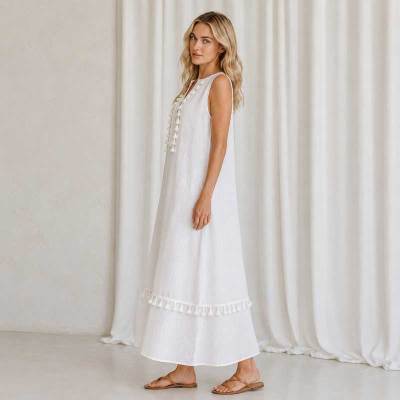
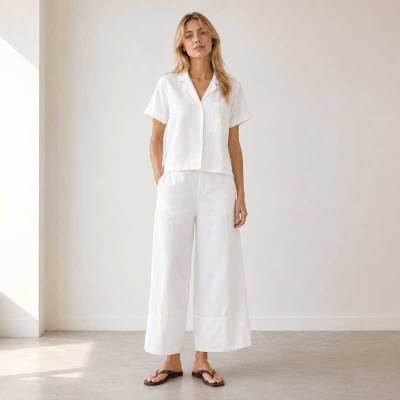
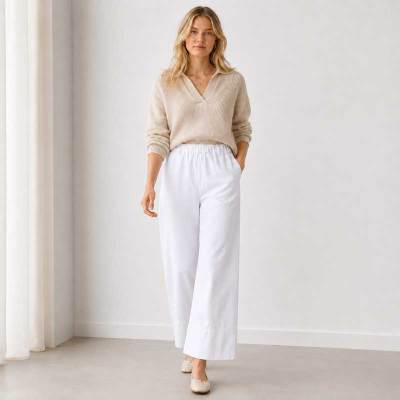
This is the same standard we apply to the rest of the range. Whether you are looking at linen dresses, linen pants or linen sets, the description should tell you what the fabric is, how heavy it is and how it was finished — and nothing should be dressed up as proof that it is not. That approach connects directly to how we describe slow fashion: fewer, better-understood pieces, worn for years. See how KOSSR supports slow fashion for how buying decisions, fibre choice and garment lifespan fit together.
Questions to Ask Before You Buy Certified Linen
Walk into any linen purchase with these questions and you will get a clear picture quickly, whether you are buying in a shop or reading a product page.
- Which certification family is this claim from — chemical safety, fibre origin or manufacturing location?
- If it is OEKO-TEX, which product class, and is the certificate current for this year?
- If it is European Flax or Masters of Linen, does the brand also state the fibre composition in percentages on the product page?
- What is the fabric weight, and what does that mean for the season and the drape I want?
- Has the fabric been pre-washed or garment-washed, and what shrinkage should I expect?
- How should this piece be washed and dried to keep it in good condition for years?
A brand that answers these plainly is easier to trust than one that answers with adjectives. It also gives you something to compare across products, which is what turns a purchase into a decision rather than a guess. For the care side of the same discipline, see how to wash linen clothing, and for the cost side, why linen clothing costs more.
Frequently Asked Questions About Linen Certifications
Is OEKO-TEX the same as organic certification?
No. OEKO-TEX STANDARD 100 tests the finished article for harmful substances and is about chemical safety. Organic certification is about agricultural inputs and processing along a certified chain. A linen garment can carry one, the other, both or neither, and the two claims answer different questions.
Does European Flax mean the garment is safe for sensitive skin?
Not on its own. European Flax traces the fibre to European cultivation and does not test the finished textile for chemical residues. If sensitive skin is your concern, look for article-level chemical testing such as OEKO-TEX STANDARD 100 at the appropriate product class, and check that the piece is garment-washed rather than heavily finished.
How long does an OEKO-TEX certificate last?
A STANDARD 100 certificate is issued for one year for the specific article and product class that was tested, and the criteria behind it are revised at least annually. That is why the certificate year matters when you are evaluating a claim.
Can a linen garment be certified for chemical safety but not for fibre origin?
Yes, and it happens often. The two verifications are independent. A garment can be tested for harmful substances without any claim about where the flax was grown, and a garment made from European flax can carry no finished-article chemical testing at all.
Does a certification change how I should wash my linen?
Not fundamentally. Care advice follows the fibre and the finish, not the certificate. Wash linen in cool water on a gentle cycle, avoid high heat, and air-dry or tumble-dry on low with the piece slightly damp. A garment-washed piece has already been stabilised, so it starts softer and shrinks less to begin with.
The Short Version
Linen certifications are three different tools, not three grades of the same thing. OEKO-TEX STANDARD 100 tests the finished article for harmful substances, graded by product class, renewed annually. European Flax traces the fibre to rain-fed European fields. Masters of Linen adds the requirement that the flax is also spun and woven in Europe. Organic standards such as GOTS combine a fibre threshold with chemical and social criteria and remain relatively rare in linen.
Read the claim, identify its family, check the scope and the date, and compare it against the composition and weight on the product page. Then make your decision on the things the label cannot measure: how the fabric feels, how heavy it is, how the garment fits, and whether you will actually wear it often enough to justify the price. Certification is a useful filter. It is not a substitute for knowing what you want.
Choose Linen You Can Trace and Understand
KOSSR makes 100% European Flax linen clothing, garment-washed for softness and stability from the first wear. Every product page states the fibre composition, the fabric weight and the pre-wash treatment, so you can judge the garment on facts rather than badges.
Explore the range: linen shirts · linen dresses · linen pants · linen tops