Style & Outfit Ideas
Wearing Linen Indoors in Heated Rooms: What Actually Works
Heated rooms are dry, still, and often too warm, which is the opposite of the conditions linen is usually sold for. It still works, and often better than cotton, because it moves moisture away and hangs clear of the skin. The rules change: lighter weights, looser cuts, fewer layers than outdoors.
What a Heated Room Actually Does
A room heated to 22 °C in January is not a summer room at 22 °C. The temperature is similar; the humidity is not. Indoor heating drops relative humidity, often to 30 percent or below, and still air means moisture evaporates from skin and fabric more slowly than it would outdoors. The result is a specific set of problems: dry skin, static, a sensation of stuffiness, and the small chill that arrives when you move from a warm desk to a cooler corridor.
Most winter indoor discomfort is not caused by temperature. It is caused by moisture management. A garment that holds moisture against the skin, whether from a warm commute or a stuffy meeting room, will feel cold the moment the air moves. A garment that lets moisture pass through and dry quickly will feel neutral, which is the condition you want at a desk.
This is where linen's reputation becomes useful rather than decorative. The fibre absorbs moisture quickly, releases it to the air, and does not felt or cling in the process. In a dry heated room, that combination produces a fabric that feels dry against the skin even after several hours of wear, which is more than can be said for cotton jersey or a synthetic blend.
The catch is that linen only does this at the right weight and cut. A 240 gsm overshirt in a 23 °C office is a sauna. A fitted 160 gsm shirt with no ease is a damp patch by lunchtime. The fabric is not the problem; the specification is.
Why Linen Works Better Indoors Than People Expect
Three properties explain the behaviour, and each one is easy to check on a garment you already own.
- Moisture moves along the yarn, not into it. Linen absorbs water at the surface and releases it quickly, so sweat from a warm train does not sit in the fabric. Cotton absorbs more slowly and holds longer, which is why a cotton tee feels damp for an hour after a commute.
- It does not cling when it is dry. Linen has little static and no loft, so a loose cut hangs away from the body. That gap is what allows air to move and moisture to evaporate, and it is the main reason linen feels cool in still air.
- It does not felt or pill in the wash. The fibre is smooth and long, so repeated washing at 30 °C does not create the surface fuzz that makes cotton jersey feel warm and damp over time.
The practical effect is that linen behaves like a light, breathable layer in conditions where other fabrics behave like insulation. In a heated room, that is exactly what you want: something that keeps you from feeling chilled by your own moisture without adding warmth you cannot remove.
There is a limit, and it is worth stating plainly. Linen does not wick as aggressively as a technical base layer, and it does not insulate when wet. If you are physically active indoors, a linen shirt will be comfortable; if you are sweating heavily, no natural fabric will stay dry. The advantage is in ordinary conditions, not extremes.
The counter-intuitive part
Linen often feels cooler in a warm room than a lighter cotton shirt, because it hangs clear of the skin and lets moisture evaporate from the fabric surface. The cooling is not from the fibre touching you; it is from the air gap the cut creates.
The Weights That Work Indoors
Indoor temperature decides weight more than the season does. The table below assumes a heated room between 19 and 24 °C, ordinary activity, and a wearer who is not sitting directly against a radiator.
Indoor weight guide for heated rooms
| Indoor temperature | Best weight | Garment | What to avoid |
|---|
| 24 °C and above | 110 to 130 gsm | Loose shirt, tank, wide trousers | Anything with a closed collar or long sleeve |
| 22 to 24 °C | 130 to 160 gsm | Shirt, shirt-dress, relaxed trousers | Heavy overshirts, layered knits |
| 20 to 22 °C | 160 to 190 gsm | Shirt, midi dress, 190 gsm trouser | Sheer pieces that cling, tight cuffs |
| 18 to 20 °C | 190 to 220 gsm | Heavy shirt, wide trousers, overshirt | Summer-weight linen as a single layer |
| Below 18 °C indoors | 190 to 240 gsm plus a knit | Overshirt over a thin knit | Light linen alone, which reads cold |
The pattern is that indoor linen is usually one weight lighter than outdoor linen on the same day. A 220 gsm overshirt that is right for the street is too much at a desk; a 160 gsm shirt under that overshirt is the indoor piece. This is why layering matters more than buying: the same wardrobe covers both conditions if the weights are spread across the range.
For trousers, the indoor rule is softer. A 200 to 220 gsm wide-leg trouser is comfortable at 22 °C because the legs are not usually in contact with a warm surface, and because a heavier trouser does not cling. The upper body is where weight has to be light; the lower body can carry more.
If you own only summer linen, you can still dress for a heated room. A 140 gsm shirt worn loose over a linen tee is comfortable at 22 °C, provided the shirt is not fitted. The limitation appears below 19 °C, where light linen alone stops being enough and the answer is a heavier piece, not more light ones.
Linen Next to Cotton, Wool and Synthetics Indoors
The comparison that matters indoors is not linen versus nothing; it is linen versus the other things in the wardrobe. Each fibre behaves differently in dry, still, warm air, and the differences are practical rather than ideological.
How fibres behave in a heated room
| Fibre | Moisture behaviour | Feel after two hours | Best indoor role |
|---|
| Linen, 130 to 190 gsm | Absorbs and releases quickly | Dry, slightly crisp, hangs clear | Shirt, dress, trouser as the main layer |
| Cotton jersey | Absorbs slowly, holds longer | Can feel damp and cool at the back | Casual wear in short bursts |
| Fine merino | Absorbs vapour, insulates when damp | Warm and dry, but warm | Base layer under linen below 20 °C |
| Polyester blend | Repels water, traps heat | Clammy, static, odour builds | Outdoor shell only, not next to skin |
| Viscose or modal | Absorbs well, dries slowly | Soft but can cling when warm | Evening piece, not all-day |
The useful conclusion is not that linen is best. It is that linen occupies a specific role: the visible layer that stays dry in a warm room. Merino does the insulating job underneath, cotton is fine for short wears, and synthetics are for the outdoors. A wardrobe that mixes them by job works better than one that tries to solve every condition with a single fibre.
This is also why the linen-and-wool combination is so effective in winter. The wool handles warmth and vapour, the linen handles structure and surface dryness, and neither has to do the other's job. The notes on mixing linen with wool and cashmere cover the proportions, and the question of whether linen and wool work together answers the obvious objection about texture.
Four Indoor Outfits, by Room Temperature
Outfit formulas are more useful when they are tied to a number. The four below assume a heated home or office, sedentary work, and a normal commute. Each uses the same principle: light upper layer, heavier lower layer, and one piece that can be removed when the room is warmer than expected.
At 23 to 24 °C: the warm office
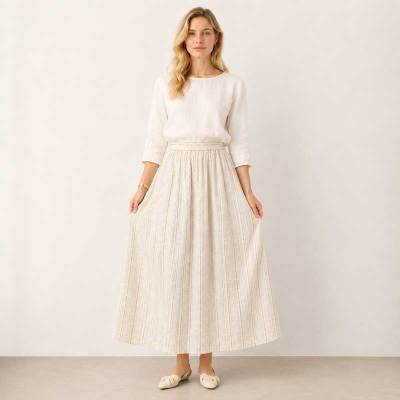
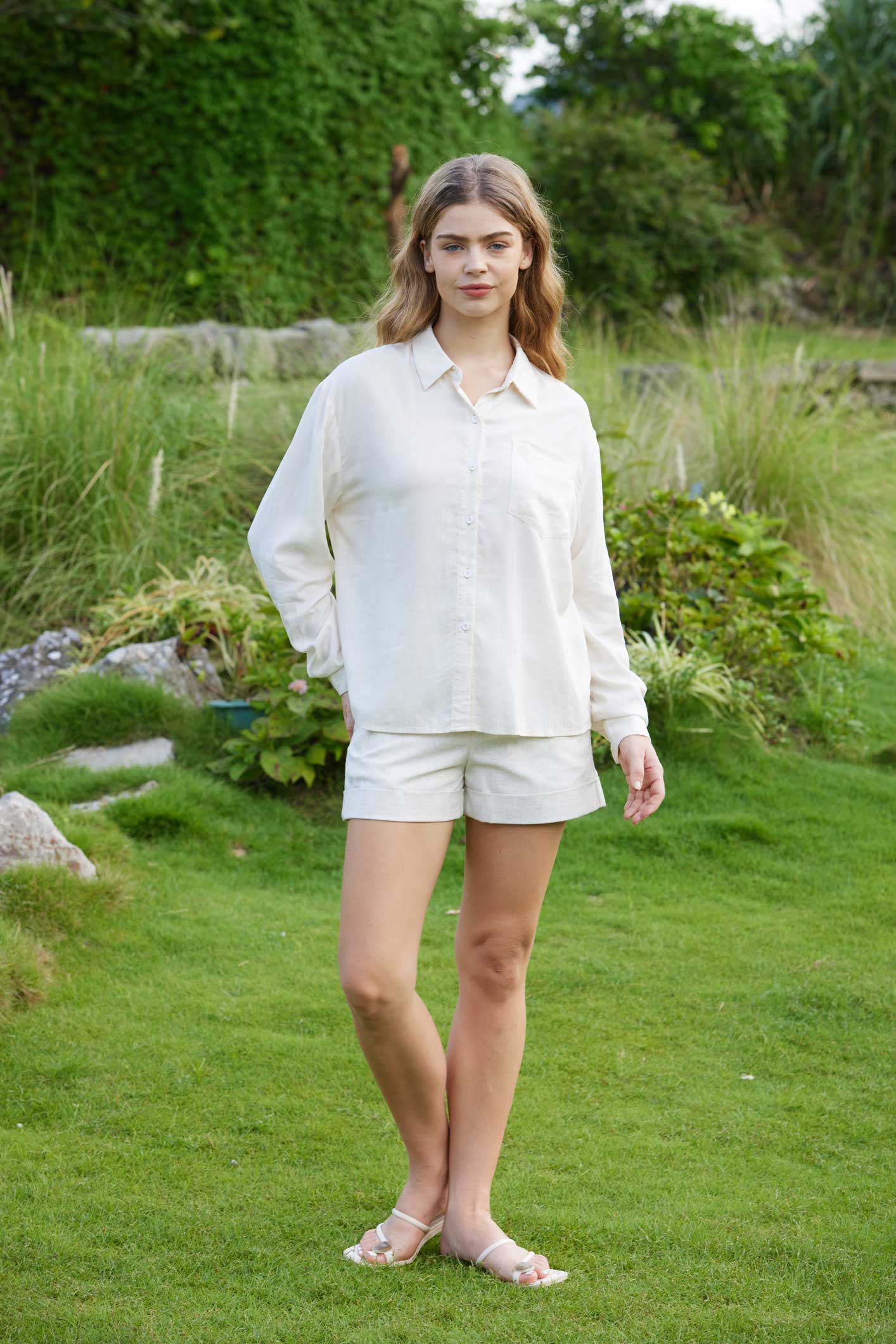
A 130 to 150 gsm linen shirt worn loose, with 200 gsm wide trousers and flat shoes. The shirt is unbuttoned at the collar and the sleeves are pushed to the elbow, which is the indoor equivalent of ventilation. Avoid a blazer; if you need one for a meeting, choose an unlined linen jacket at 200 gsm and take it off afterwards.
The trousers carry more weight than the shirt here, and that is deliberate. Legs are less affected by still warm air than the torso, and a heavier trouser keeps the outfit from reading as summer. It also means the shirt can be genuinely light without the whole look becoming holiday clothing.
At 21 to 23 °C: the normal heated room
A 160 gsm shirt or shirt-dress, 190 to 200 gsm trousers, and a thin knit nearby for the corridor. This is the range where linen is at its easiest: the shirt is opaque, the fabric hangs, and no layer is needed unless you leave the room. A midi dress at 160 to 180 gsm works here with tights if the room is cooler at floor level.
The knit is the important accessory. Not worn, but present. Corridors, stairwells, and meeting rooms are usually two to four degrees cooler than the desk area, and a thin merino cardigan solves that without adding bulk to the outfit.
At 19 to 21 °C: the cool room
A 190 gsm shirt over a 130 gsm linen tee, with 220 gsm trousers. The tee is the moisture layer, the shirt is the visible layer, and the combination is warm enough to sit still for an hour without a jacket. This is also the range where a 220 gsm overshirt works open over a shirt, which is a better look indoors than a closed jacket.
Below 19 °C: the underheated room
A 220 gsm overshirt over a fine merino crew neck, 220 gsm trousers, and socks. At this temperature linen stops being the warm layer and becomes the structure: the merino insulates, the linen blocks draughts and holds the shape. If the room is below 17 °C, add a scarf indoors; it is more effective than another layer on the torso.
Where Linen Fails Indoors
Linen is not automatically the right choice for a heated room. Five conditions make it the wrong one, and all five are specifications rather than faults in the fibre.
- Too heavy. A 240 gsm overshirt at 23 °C is a portable radiator. The weight that makes winter outdoor wear possible makes indoor wear unbearable.
- Too fitted. A slim linen shirt with no ease traps moisture at the back and under the arms, because there is no air gap to evaporate into. The fabric is dry by nature; the cut removes the advantage.
- Too sheer. A 110 gsm shirt in dry air clings and shows every underlayer. Sheer linen belongs in humid heat, not a heated room.
- Too dark in a hot room. Deep colours absorb light and read warmer; in a bright, warm office a charcoal shirt feels heavier than the same weight in sand.
- Too many layers. The commonest failure is not the fabric but the count. Three light linen layers indoors behave like one heavy one, and none of them can be removed without undressing.
The corrections are equally specific. Drop one weight band, choose a cut with two fingers of ease at the chest, keep the colour in the light-to-mid range for warm rooms, and limit the outfit to two layers. Those four adjustments solve most indoor discomfort without buying anything new.
There is one more failure that is not about the garment: sitting directly against a radiator or under a desk heater. No fabric manages that well, and linen's dry hand makes the contrast more noticeable when you move away. A chair pulled thirty centimetres forward is a better fix than a different shirt.
Fabric softener is the last indoor trap, and it is the one people reach for most often when linen feels stiff in January. Softener coats the fibre with a film that reduces absorbency, which is the exact property doing the work in a dry room. The garment feels smoother for one wear and then behaves like a synthetic blend: warmer, damper, and less able to release moisture. If stiffness is the complaint, the fix is a longer, gentler wash and a slower dry, not a conditioner.
Static, Dryness and the Small Fixes
Static is the indoor problem people notice first, and it is usually blamed on the fibre. In practice it is a function of weight, humidity, and what the garment is worn over. Linen generates less static than polyester, but a very light linen dress over synthetic tights in 25 percent humidity will still crackle and climb.
- Increase the weight. A 160 gsm dress hangs; a 110 gsm dress clings. The heavier fabric has more mass to resist the charge.
- Change the underlayer. Cotton or wool tights generate less static against linen than nylon ones. This is the single most effective fix for dresses in winter.
- Add moisture to the air. A humidifier, a bowl of water near a radiator, or drying laundry indoors raises relative humidity enough to reduce static across the whole room.
- Use a metal hanger trick. Running a metal hanger or a pin along the inside of a garment discharges it temporarily; it is a stopgap, not a solution.
- Avoid over-washing. Repeated washing strips natural oils and increases dryness; linen that is aired between wears stays supple longer.
Dry skin is the other half of the problem, and it is not a textile issue. Heated air pulls moisture from skin as well as fabric, and the sensation of rough linen on dry skin can read as scratchiness when the fabric is fine. A heavier, garment-washed linen is gentler in this condition, because the surface has been mechanically softened rather than chemically coated.
If a linen garment feels rough indoors in winter, the cause is often the water. Hard water leaves mineral deposits in the fibre that feel like stiffness. A half cup of white vinegar in the rinse once a month removes them, and the fabric returns to its normal hand. The winter care guide covers the humidity and storage side of the same problem.
The Indoor Care Rhythm
Linen worn indoors needs less washing than linen worn outdoors in summer. The garment is not absorbing sweat in the same volume, and the dry air means it dries quickly between wears. A shirt worn at a desk for a day can usually be aired overnight and worn again, which halves the wash load and extends the fabric's life. Use a mild detergent without optical brighteners; if you want to check what a testing standard actually covers on dyes and finishes, the OEKO-TEX site lists the categories in plain language.
- Air after every wear. Hang on a wide wooden hanger near a window for an hour; the dry air does most of the work.
- Wash after two or three wears for shirts, four to six for trousers, and at the end of the season for overshirts.
- Skip the iron indoors. A garment hung in a steamy bathroom for twenty minutes loses most creases; ironing dry linen in dry air creates shine that shows under office lighting.
- Keep a rotation of three. Three shirts in rotation wear evenly and wash less often than one shirt worn daily, which is the fastest way to thin a collar.
The freshness question is worth answering directly. Linen resists odour because the fibre is smooth and does not hold bacteria the way a rougher surface does, and because it dries quickly. That is why airing works. It is not a substitute for washing after heavy wear, but it is enough for a desk day, and it is the reason a small linen wardrobe can run on two loads a week. The notes on keeping linen fresh between washes cover the details, including what to do with a garment that has been worn in a warm room all day.
Desk, Commute and Sleep
Three indoor environments account for most winter linen wearing, and each has a different requirement.
At the desk
The priority is the back and the seat, not the chest. A shirt that is comfortable standing can be damp across the shoulder blades after two hours of sitting against a padded chair. A loose cut and a mid-weight trouser solve most of it; a chair with a breathable cover solves the rest. If you wear a dress, choose one with enough width at the hip that it does not press against the chair.
On the commute
The commute is the hardest part of an indoor day because it combines a warm carriage, a cold platform, and a heavy coat. Linen works here as the middle layer: a 190 gsm shirt under a coat, with a 130 gsm tee underneath. The tee absorbs the first sweat of the carriage, the shirt stays dry, and the coat comes off at the destination without leaving you in something transparent.
At night
Heated bedrooms are usually 18 to 21 °C, which is warmer than the human body prefers for sleep. A 110 to 140 gsm linen pyjama is comfortable in that range because it moves moisture and stays dry; a 190 gsm set is too warm for most bedrooms. Linen sheets behave the same way: dry and cool to the touch, which is why they are popular in heated homes in winter as well as in summer. The loungewear range at linen loungewear covers the weights that work for both.
Building an Indoor Linen Layer Set
If the goal is comfort in heated rooms rather than a new wardrobe, four pieces cover almost every indoor situation and cost far less than a seasonal overhaul.
Four pieces that cover indoor winter wearing
| Piece | Weight | Job | Works at |
|---|
| Loose shirt | 130 to 160 gsm | Main visible layer | 21 to 24 °C |
| Heavy shirt or overshirt | 190 to 220 gsm | Structure, cool rooms, corridor | 18 to 21 °C |
| Wide trousers | 200 to 220 gsm | Lower-body weight, no cling | All indoor ranges |
| Thin knit or cardigan | Merino, light | Warmth that can be removed | Below 21 °C |
With those four, the indoor outfit is a combination rather than a decision: shirt plus trousers above 21 °C, overshirt added below it, knit added below 20 °C. The weights do the work, and the number of possible outfits is larger than the number of pieces suggests.
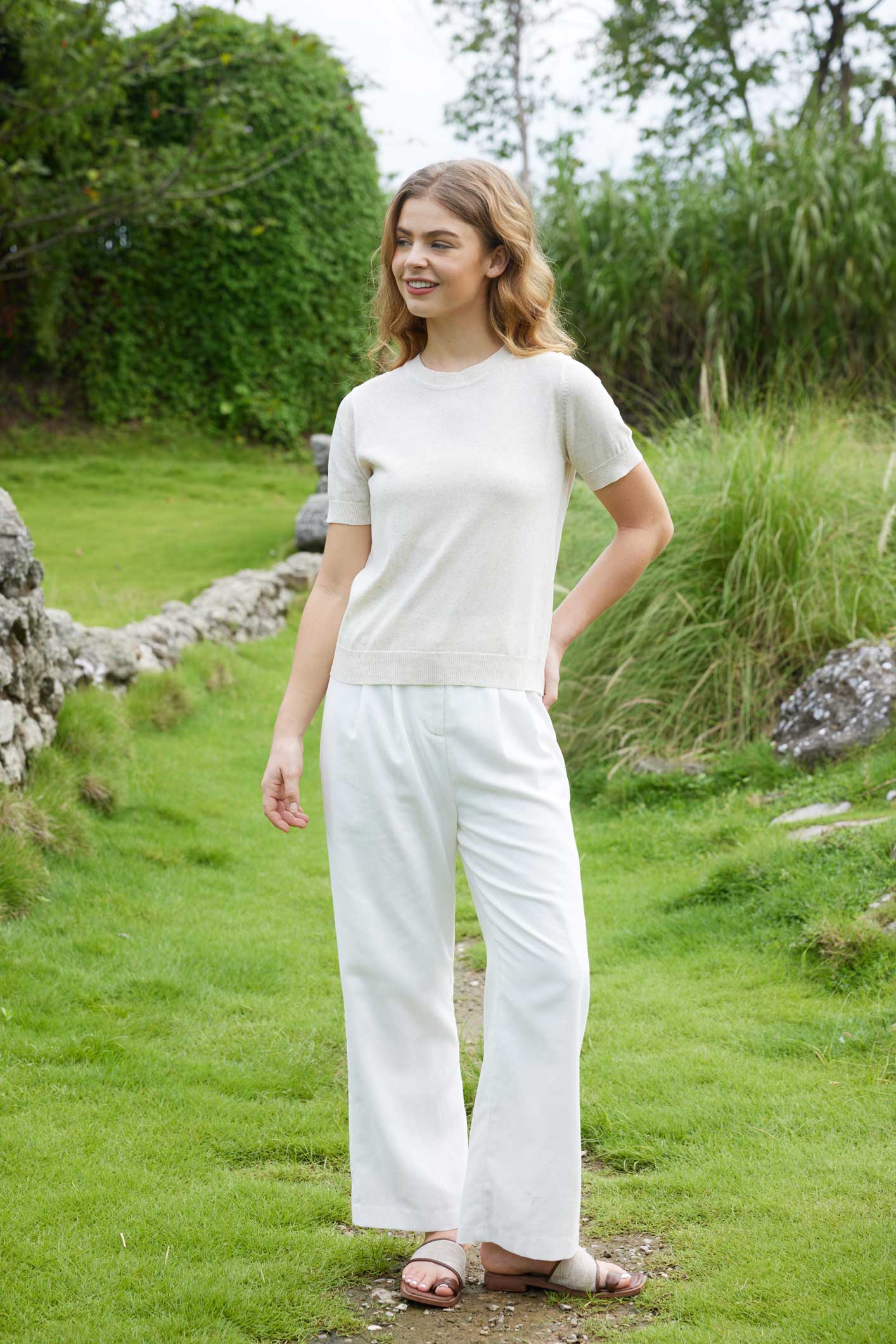
If you are adding one piece this winter and your main complaint is heated rooms, add the loose 140 to 160 gsm shirt rather than a heavier layer. Most people already own enough warmth; what they lack is a light, opaque, loose layer that looks intentional indoors. The linen tops range is the place to start, and the guide to winter-weight linen explains how the heavier bands fit around it.
Questions About Linen Indoors
These four come up most often from people who already own linen and find it behaves differently in winter than it did in July. The answers are short, and each one points at a specification rather than at the fibre.
Does linen feel cold when you come in from outside?
It feels cool for the first minute, because the fabric is dry and conducts heat away from the skin. Unlike cotton, it does not stay cool and damp; it warms with the body and stays dry. The initial sensation is not a sign of inadequate warmth.
Is linen too wrinkly for an office?
At 160 gsm and above, the creases read as folds and are accepted in most workplaces. The risk is the very light weights, which crease sharply and look slept in. A mid-weight shirt pressed once, worn loose, looks deliberate rather than untidy.
Can I wear the same linen shirt indoors and outdoors in winter?
Yes, if the weight is 190 gsm and the cut has room for a base layer. It works as a middle layer outdoors under a coat and as the visible layer indoors. A 220 gsm overshirt is the piece that most often makes this transition, worn open indoors and closed outside.
Why does my linen dress cling in winter but not in summer?
Dry air and synthetic tights. The fabric is picking up static from the underlayer, not from the linen itself. Change to cotton or wool tights, or move up one weight band, and the cling stops.
Indoors Is a Different Climate
A heated room is dry, still, and warm, and linen's advantages there come from moisture movement and an air gap rather than from the fibre's reputation. Wear one weight lighter than you would outdoors, choose a loose cut, keep the layers to two, and let the trousers carry the weight. The result is a fabric that feels dry at four in the afternoon, which is the only test that matters.
Start With the Loose Mid-Light Shirt
If heated rooms are the problem, the answer is usually a 140 to 160 gsm shirt with room to move, worn over a light base. Browse linen tops for that layer, linen bottoms for 200 to 220 gsm trousers that keep the outfit grounded, and linen loungewear for the 110 to 140 gsm pieces that make warm bedrooms bearable.