Buying Guide
Winter-Weight Linen: How 190–240 GSM Changes Everything
Above 190 gsm, linen stops behaving like summer fabric. The weave closes, the drape gains body, creases read as folds rather than wrinkles, and the same fibre becomes a legitimate winter layer over a knit or under a coat. The change is not stylistic; it is structural, and it starts earlier than most labels admit.
The Weight Scale, in Plain Numbers
Grams per square metre is a simple measure: the mass of one square metre of fabric. It is not a quality score, and a high number is not automatically better. It is a description of behaviour, and behaviour is what decides whether a garment is wearable in February. The table below is the working range for linen clothing, with what each band actually does on a body.
Linen weights and what each one is for
| Weight | Hand | Typical garments | Season |
|---|
| 110 to 130 gsm | Sheer, dry, almost weightless | Summer shirts, scarves, beach cover-ups | Hot months only |
| 140 to 160 gsm | Light but opaque, soft drape | Shirts, summer dresses, relaxed trousers | Late spring to early autumn |
| 170 to 190 gsm | Substantial, holds a crease, still fluid | Shirt-dresses, wide trousers, overshirts | Three seasons |
| 200 to 220 gsm | Firm, structured, minimal transparency | Winter trousers, heavy shirts, midi dresses | Autumn to early spring |
| 230 to 240 gsm | Dense, canvas-like, sculptural | Jackets, chore coats, heavy overshirts | Winter outer layer |
Two things follow from the table. First, the jump from 160 to 190 gsm is larger than the numbers suggest, because it crosses the point where the weave becomes opaque and the fabric stops collapsing against the body. Second, the jump from 220 to 240 gsm is smaller in wear than in hand: both are outerwear, and the difference is mostly stiffness and wind resistance rather than warmth.
Most labels do not print weight. When they do, it is often the weight before washing, which can be ten to fifteen percent heavier than the finished garment. A stated 200 gsm that feels thin in the hand was probably washed down to something closer to 180. That is not dishonesty; it is a specification that predates the finishing step. Judge by hand and by opacity, and use the printed number as a starting point rather than a guarantee.
Why Weight Changes Warmth More Than Fibre Does
Linen has a reputation as a cooling fabric, and the reputation is accurate for the weights most people own. The mechanism is straightforward: the fibre conducts heat away from the skin and moves moisture along the yarn, so a light fabric in moving air feels cooler than cotton of the same weight. None of that stops working at 220 gsm. What changes is the amount of still air the fabric can hold.
Warmth in clothing comes mostly from trapped air, not from the fibre itself. A dense weave at 220 gsm holds a thin, stable layer of air against the body and blocks the movement that would strip it away. A sheer weave at 120 gsm holds almost nothing, which is why it feels cool even when the air is still. The fibre is identical; the architecture is not.
This is why the phrase "linen is for summer" is a statement about the linen most shops sell, not about the fibre. A 230 gsm linen overshirt worn over a merino tee is warmer than a 300 gsm cotton sweatshirt in still air, because the linen blocks wind and the merino manages moisture. The combination is not a compromise; it is a layering system that happens to use a summer fabric in a winter role.
The counter-intuitive part
Heavier linen often feels cooler in a heated room than light linen, because it does not cling. A 220 gsm shirt hangs away from the body, so moisture evaporates from the fabric surface rather than sitting against the skin. The same property that makes it warm outdoors makes it comfortable at 22 °C indoors.
110 to 140 gsm: The Inner Layer, Not the Winter Layer
Light linen has one useful winter role, and it is not the one people expect. It works as a base layer under a heavier shirt or a knit, where its job is to move moisture rather than to provide warmth. A 120 gsm linen tee under a 220 gsm overshirt is comfortable in a heated office and does not become damp the way a cotton tee does after a warm commute.
As an outer layer in winter, light linen fails for three reasons. It is transparent in low sun, it creases sharply at the elbow and hip, and it has no body to hold a line over another garment. A 120 gsm shirt over a knit looks like a shirt that has given up; a 200 gsm shirt over the same knit looks deliberate. The difference is not styling, it is structure.
- Use light linen for: base layers, sleepwear, scarves, travel pieces that pack flat.
- Do not use light linen for: an outermost winter layer, a trouser that must hold a crease, anything worn without a warm underlayer in winter.
- Watch for: transparency against dark underlayers, and the way a light shirt bunches under a fitted coat sleeve.
There is an exception worth naming. Very light linen works well as a summer-weight layer in overheated interiors, which is a real winter condition in offices and apartments. If the problem is 24 °C indoors rather than 4 °C outdoors, a 120 to 140 gsm shirt is the right answer, and the winter weight is the wrong one.
160 gsm: The Hinge Weight
If one weight deserves to be called versatile, it is 160 gsm. It is opaque enough to wear alone, light enough to layer under a jacket without bulk, and heavy enough to hold a soft shape rather than cling. Most of what people describe as "good linen" in a shop is somewhere in the 150 to 170 band.
The hinge quality comes from a specific combination: the weave is closed enough that light does not pass through in a window, but open enough that air moves when the fabric is worn loose. That combination is why 160 gsm works in June and in October, with different layers underneath, and why it is the weight most often recommended for a first linen purchase.
Its limit is winter as an outer layer. A 160 gsm shirt over a knit in January reads as underdressed in a way that is hard to fix with accessories, because the fabric does not have enough body to sit over the knit cleanly. It works as a middle layer under an overshirt or a coat, where the outer layer provides the structure and the linen provides the moisture management.
For dresses, 160 gsm is the lower edge of winter-viable. A 160 gsm midi with boots, tights, and a heavy cardigan is a reasonable winter outfit indoors and in mild cold; the same dress with no layer is a summer outfit. Weight sets the range, and layers move the garment within it.
190 to 220 gsm: The Winter Workhorse
This is the band that changes the argument. At 190 gsm and above, linen becomes opaque, holds a fold, and stops looking like a fabric that belongs at a picnic. It is also the band where the difference between a good and a mediocre garment is easiest to see, because a heavy weave has nowhere to hide a loose seam or an uneven yarn.
Shirts and overshirts
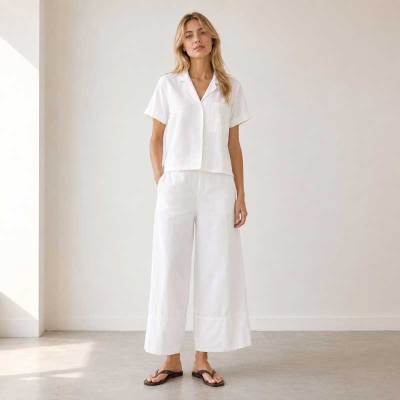
A 190 to 210 gsm shirt worn as a shirt is a winter piece: it stands away from the body, closes at the collar, and takes a knit underneath without strain. A 220 to 240 gsm overshirt worn open over a tee is the single most useful winter linen garment, because it works in a heated room and outdoors, and it reads as a jacket without the weight of one.
Look for a chest pocket, a two-piece collar, and a hem that falls below the hip. Those three details separate an overshirt from a shirt worn open, and they matter more at this weight because the fabric has enough body to show the difference.
Trousers
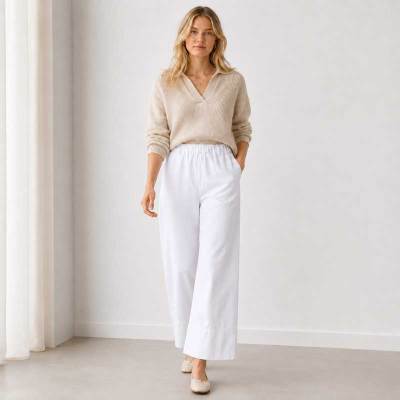
Trousers are where weight earns its keep. A 200 to 220 gsm wide-leg trouser holds a vertical line, does not cling at the knee, and resists the seat abrasion that thins a 160 gsm trouser within a season. With tights underneath it is a winter trouser; without them it is a three-season trouser. A deep hem matters at this weight, because a heavy trouser is more likely to be let down than replaced.
Dresses
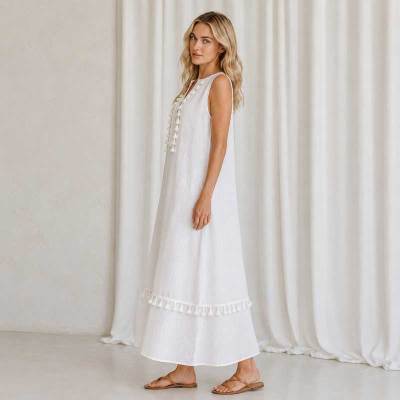
A 190 to 200 gsm midi dress is a genuine winter dress, not a summer dress with a cardigan. It hangs from the shoulder without clinging, takes tights without static, and looks intentional with boots. The weight also changes the neckline options: a heavier linen holds a stand collar or a wide boat neck, which a 120 gsm fabric cannot do without interfacing.
230 to 240 gsm: Outerwear Territory
At the top of the range, linen behaves like a soft canvas. A 240 gsm chore coat or field jacket has enough rigidity to hold a shoulder line, enough weight to hang straight from the body, and enough density to block a light wind. It is not a substitute for a wool coat in freezing weather, and it is not meant to be. It is the layer for 8 to 14 °C, for dry days, and for the indoor-outdoor rhythm of a normal working day.
The construction details that matter at this weight are different from the ones that matter on a shirt. Look for a two-piece sleeve, a back yoke with a centre pleat, patch pockets attached with a second row of stitching, and a hem that is faced rather than turned. Those details exist because the fabric is heavy enough to pull on its seams, and a light construction will distort at the shoulder within a season.
Heavy linen jackets also age differently. Where a light shirt softens into a limp hand, a 240 gsm jacket softens at the elbow and the pocket edge while keeping its overall shape. After two years it looks broken in rather than worn out, which is the behaviour people mean when they say linen improves with age. It only improves at this weight; at 110 gsm the same ageing reads as thinning.
One caveat: heavy linen is harder to alter. Letting out a seam leaves a visible line in a dense weave, and shortening a sleeve can leave a ridge at the cuff. If you are buying a 240 gsm jacket, buy the shoulder and the chest correctly, because those are the two things a tailor cannot fix invisibly.
Drape, Crease and the Linen Look at Each Weight
The visual character of linen changes with weight as much as the warmth does. The same crease that looks charming on a summer shirt looks sloppy on a winter trouser, and the same fold that reads as structure on a jacket reads as stiffness on a dress. The table below is a guide to what to expect, and to what is a fault rather than a feature.
How each weight behaves in wear
| Weight | Drape | Crease behaviour | Reads as |
|---|
| 110 to 130 gsm | Floaty, collapses against the body | Sharp creases at every fold; slow to recover | Holiday, heat, ease |
| 140 to 160 gsm | Soft, follows the body | Soft creases that relax after an hour of wear | Everyday summer into autumn |
| 170 to 190 gsm | Fluid but with direction | Folds rather than creases; holds a pressed line briefly | Considered, three-season |
| 200 to 220 gsm | Structured, stands away from the body | Broad folds at the hip and elbow; recovers overnight | Winter, deliberate |
| 230 to 240 gsm | Sculptural, holds a shape | Creases concentrate at stress points and stay | Outerwear, workwear |
Two practical readings follow. First, if you dislike the crumpled look, buy heavier. The creases do not disappear, but they become fewer and larger, which reads as folds in fabric rather than wrinkles in a shirt. Second, if you want the fabric to move, buy lighter: a 120 gsm dress has a movement that a 200 gsm dress cannot imitate, and no amount of styling replaces it.
There is a middle option that is often overlooked: a 170 to 190 gsm garment pressed once and then worn. It holds a soft edge for the first hour and relaxes into a fold by afternoon, which is the compromise most people actually want. The trick is to press it damp, not dry, and to avoid steam on the fold line, which sets a sharp crease that will not relax.
How to Judge Weight Without a Label
Most product pages do not list grams per square metre, and many that do are quoting a pre-wash number. The five checks below take under a minute and are more reliable than the specification, because they measure the finished garment rather than the loom-state fabric.
- Hold it to a window. If you can read text through a single layer, it is under 140 gsm. If light passes as a warm glow without shapes, it is 150 to 180. If it blocks the window almost completely, it is 190 or above.
- Lift a hem. A heavy fabric falls back with a thud and holds a fold; a light one flutters. The sound and the fall are more informative than the feel alone.
- Pinch and release. A 200 gsm weave springs back with a faint stiffness; a 120 gsm weave collapses immediately and shows the pinch mark.
- Look at the seam allowance. Heavier garments usually carry wider allowances and stronger edge finishing, because the fabric demands it.
- Weigh the garment in your hand against a known piece. A 200 gsm shirt in a medium weighs noticeably more than a 140 gsm shirt of the same cut, roughly in proportion to the difference.
The window check is the most useful single test, and it is also the one that predicts how the garment will look in winter light. A fabric that lets shapes through will look underlayered in January no matter what is worn beneath it. A fabric that blocks light will look substantial even in a pale colour.
If you are buying online and the weight is not stated, ask. A seller who knows the product can usually tell you the finished weight, and the answer itself is informative: a vague response about "premium quality" is a different signal from a number. The question of whether linen is lightweight is worth reading for the vocabulary to use when asking.
Washing, Shrinkage and Softening by Weight
Weight changes how a garment responds to water. Light linen shrinks more in percentage terms, creases harder when wet, and softens faster. Heavy linen shrinks less because it has usually been washed more during finishing, dries more slowly because there is more mass, and softens more gradually because the yarn is thicker.
What to expect from the first five washes
| Weight | Shrinkage on a 30 °C wash | Softening | Care note |
|---|
| 110 to 140 gsm | 2 to 4 percent if not pre-washed | Noticeable by wash three | Hand wash or gentle cycle; never tumble |
| 150 to 180 gsm | 1 to 3 percent | Gradual, steady | Gentle cycle, low spin, hang damp |
| 190 to 220 gsm | Under 2 percent | Slow; the hand changes at the surface first | Gentle cycle, reshape while damp |
| 230 to 240 gsm | Under 1 percent if garment-washed | Very slow; elbow and pocket edges first | Wash rarely, air often, press damp |
The care rule that matters most is the same at every weight: no tumble drying. A dryer does not shrink linen evenly; it shrinks the areas that stay damp longest, which are the seams, the hems, and the waistband. The result is a garment that still fits at the chest and no longer hangs straight. Line drying in shade avoids the problem entirely and costs nothing. Detergent matters only at the margin: choose a mild liquid without optical brighteners, and if you want to know what a testing standard covers on dyes and finishes, the OEKO-TEX site lists the categories in plain language.
Heavy linen benefits from being dried flat rather than hung, at least for the first hour. A wet 240 gsm jacket on a hanger will stretch at the shoulder under its own weight, and that stretch does not come back. Lay it flat on a towel, reshape the collar and the pockets, and hang it when it is barely damp.
Softening is the reward for patience. A 220 gsm shirt that feels stiff in the shop becomes comfortable after about ten washes, and continues to improve for years. The mistake is to try to accelerate this with softener or hot water, both of which coat or abrade the fibre and shorten its life. The guide to winter care for linen covers the dry-air problems, static and brittleness, that appear in heated homes.
Three Winter Outfits Built on Weight, Not Style
The outfits below are not fashion suggestions; they are weight combinations that work in specific temperatures. Each one uses the same principle: a light inner layer for moisture, a mid or heavy linen layer for structure, and a wool or knit outer layer for warmth where needed.
Indoors, 20 to 23 °C: the heated-room outfit
A 160 gsm shirt over a 120 gsm linen tee, with 200 gsm wide trousers. The tee manages moisture during a commute, the shirt provides structure for a meeting, and the trousers hold a line while sitting for hours. No jacket, because the room is warm; the weight of the trouser does the visual work that a jacket would do outdoors.
Outdoors, 8 to 14 °C: the dry-day outfit
A 220 gsm overshirt over a fine merino crew neck, with 220 gsm trousers and boots. The overshirt blocks wind, the merino provides warmth, and the linen moves moisture away when you go from street to shop to train. This is the combination that most convincingly disproves the summer-fabric assumption, and it works because each layer has a different job.
Cold and damp, 2 to 8 °C: the layered outfit
A 240 gsm linen jacket over a 190 gsm shirt over a merino base, with heavy trousers and tights underneath if needed. The linen is not the warmest layer here; it is the wind-blocking and shaping layer, and the wool coat goes over the top when stationary. Linen's role in real winter is structural and moisture-managing, not thermal.
If you want to see how linen sits next to wool without competing, the notes on mixing linen with wool and cashmere go further into proportion and texture, and the comparison of linen and wool for cooler weather explains which job each fibre does best.
[IMAGE_PLACEHOLDER] img prompt: A flat lay of a winter outfit on a pale linen surface, heavy charcoal linen trousers, olive 220 gsm overshirt, cream merino knit, leather boots, wool scarf, soft daylight from the left, top down styling, no text
What to Buy First If You Are Converting to Winter Linen
A conversion does not need many pieces, but it needs the right order. The sequence below is based on which garment unlocks the most combinations at the lowest risk of being wrong.
- A 220 gsm overshirt in olive, charcoal, or sand. It works over a tee in September and over a knit in January, and it is the piece that proves the fabric can be winter clothing.
- 200 to 220 gsm wide-leg trousers. The most-worn winter linen garment for most people, because it replaces denim without losing warmth when worn with tights.
- A 190 gsm shirt in off-white. The middle layer that makes the overshirt and the trousers into outfits rather than separates.
- A 190 to 200 gsm midi dress, if dresses are part of your week. Boots, tights, a heavy cardigan, and the same dress works from October to March.
- A 240 gsm jacket, last. The most expensive and least flexible piece; buy it once the other four have shown you which colours and cuts you actually wear.
The order matters because each piece should be tested in real weather before the next is chosen. A 220 gsm overshirt worn for two weeks will tell you whether you want the trousers in the same weight or lighter, and whether the colour you chose works with the coats you own. Buying the jacket first tends to produce a wardrobe built around a garment rather than around a week.
One last note on colour at this weight. Heavy linen shows colour differently from light linen: the same dye reads deeper and more saturated, because there is more fibre per square centimetre. A sand that looks washed-out at 120 gsm can look rich at 220, and an olive that looks bright at 140 can look almost black at 240. If you are ordering online, judge the colour from a photograph of the heavier weight, not from the lighter version of the same name.
Questions That Come Up When Buying Winter Linen
Is 190 gsm warm enough on its own?
Not outdoors in winter. On its own it is a three-season weight; with a knit underneath and a coat over it, it is a winter layer. Warmth in linen comes from the system, not from the single garment.
Does heavier linen feel rougher?
Initially, yes, because the yarn is thicker. Garment-washed heavy linen softens at the surface within a few wears, and it does not become limp the way light linen does. The stiffness at the collar and cuff is structure, not roughness.
Can heavy linen be worn in summer?
In the evening, yes, and in a dry climate it is comfortable in shade. In humid heat, a 220 gsm garment is too much, because it holds still air that the body is trying to shed. Weight and climate have to match, not just taste.
Why is winter linen more expensive?
More fibre per metre, slower weaving, and heavier finishing. A 240 gsm garment uses roughly twice the yarn of a 120 gsm garment of the same cut, before the extra washing and pressing are counted. The storage guide explains how to protect that investment through the off-season.
The Number on the Label Is a Season
Weight is the most useful specification in linen and the least discussed. Under 140 gsm you are buying heat-weather clothing; 160 gsm is the hinge; 190 to 220 gsm is real winter wear; 230 to 240 gsm is outerwear. Once you know the band, most of the confusion about "can linen be warm" disappears, because the question was never about the fibre. It was about the grams.
Start With the 220 gsm Layer
The fastest way to test winter linen is an overshirt in the 200 to 240 gsm range, worn over what you already own. Browse linen outerwear for jackets and heavy overshirts, linen tops for the 190 gsm middle layer, and linen bottoms for the 200 to 220 gsm trouser that makes the rest wearable in January.