Year-End Linen Wishlist: Pieces to Add Before 2027
Year-End Linen Wishlist: Pieces to Add Before 2027
The shortest useful answer: before 2027, add one mid-weight layer, one long-sleeve or heavy shirt, one bottom in 180 to 220 gsm, and at most one occasion piece. Four additions, chosen for the twelve months after purchase rather than the four weeks before it. A year-end wishlist fails when it is written as a list of things you like; it works when it is written as a list of gaps in what you already wear. Late October is the right moment to make that list, because the pieces that sell out before December are the mid-weight ones, not the summer linens, and because the discount window in November rewards a list you made in advance rather than one you improvise in a sale. This guide sets out the seven pieces worth considering, the fabric weights that make each one work in cold weather, the four pieces to leave until spring, the ordering calendar from late October to mid-December, and the checks that keep a wishlist from turning into another three garments you never wear. If you are still deciding what belongs in the wardrobe at all, start with the starter order guide and come back here once the basics are covered.
The Year-End Wishlist in One Table
A wishlist is only useful if it is ranked. The table below ranks seven linen pieces by how many days you can realistically wear them between November 2026 and October 2027, then notes the weight that makes each one work in cool weather and the window in which it is worth buying. The ranking is deliberately unfashionable: the pieces at the top are the ones that disappear into outfits, and the pieces at the bottom are the ones that get photographed.
| Rank | Piece | Working weight | Plausible wear days | Buy window |
|---|---|---|---|---|
| 1 | Shirt-jacket or overshirt | 200 to 240 gsm | 60 to 100 | Late October to mid-November |
| 2 | Long-sleeve linen shirt | 160 to 190 gsm | 70 to 110 | Late October to mid-November |
| 3 | Trousers, wide or straight leg | 180 to 220 gsm | 60 to 100 | November |
| 4 | Heavy shirt, overshirt or tunic | 180 to 220 gsm | 40 to 70 | November |
| 5 | Occasion dress or set | 180 to 240 gsm | 5 to 15 | Early November, before party season |
| 6 | Loungewear set | 140 to 180 gsm | 100 or more | December, if budget remains |
| 7 | Accessories: scarf, pouch, cap | 160 to 240 gsm | 30 to 80 | December, as a gift or filler |
Two things in that table are worth arguing about. First, the shirt-jacket outranks the trousers, which is not true in summer but is true from November to March: a heavy linen layer converts three existing outfits into six, while a new pair of trousers only replaces a pair you already own. Second, the occasion piece is on the list at all. It earns a place because December is the one month when most people actually need it, and because a dark, heavy linen dress or set is genuinely different from the summer versions most wardrobes already contain.
Wear-day figures are estimates for a temperate climate with a real winter, not promises. If you live somewhere with a long, mild autumn, move the layer down and the bottom up. If your winter is severe and indoor heating is aggressive, weight the list toward pieces you wear indoors, because that is where you will spend the season. And if you already own a heavy layer from last year, skip rank one entirely rather than buying a second version of it in a slightly different shade.
First Addition: A Heavy Linen Layer You Can Wear in January
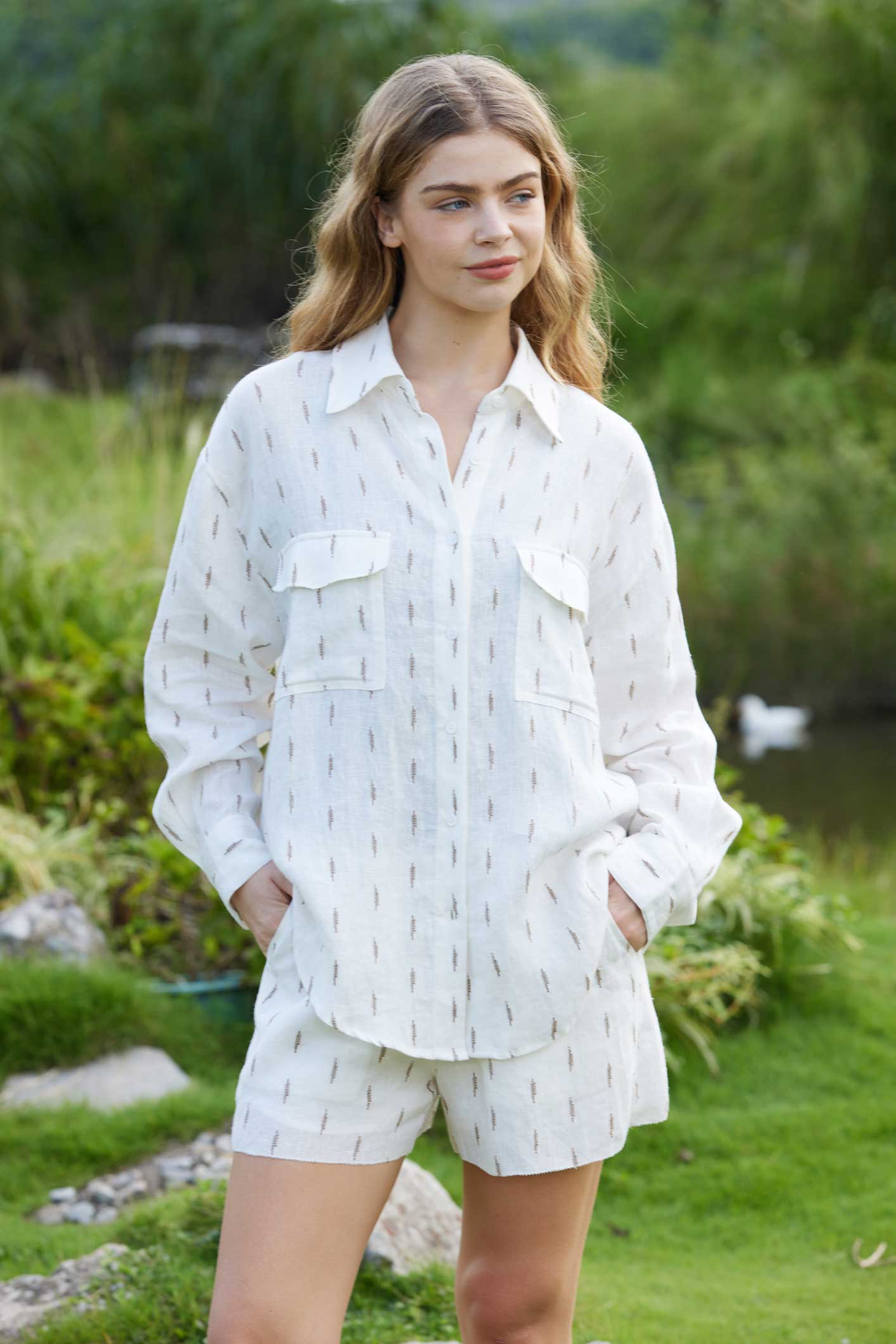
The highest-value addition in late autumn is not a new shirt. It is a layer heavy enough to be worn as outerwear indoors and as a mid-layer outdoors. Linen at 200 to 240 gsm behaves quite differently from the 130 gsm shirt you bought in June: it holds a shoulder line, it hangs instead of clinging, it blocks a light wind, and it softens into something closer to a light canvas after ten or twelve washes. That combination is why the linen outerwear collection is the right place to start a year-end list rather than the dresses.
A shirt-jacket, an overshirt or a boxy chore jacket in that weight range covers three distinct situations. Indoors, over a t-shirt or a fine knit, it is warm enough for a heated room without the bulk of wool. Outdoors in a mild autumn, it works as a light jacket down to roughly 12 to 14 degrees Celsius, especially with a scarf at the neck. Travelling, it layers under a coat without adding a second sleeve of bulk at the shoulder, which is the usual reason layering fails. Few garments in any fibre cover all three, and almost none do it while remaining machine washable.
What to check on a heavy linen layer
- Weight stated, not implied. Look for a number between 200 and 240 gsm on the product page. A layer described only as "heavy" is usually 180 gsm, which is a shirt weight in disguise.
- Shoulder seam placement. A dropped shoulder reads relaxed and layers badly under a coat; a seam at your actual shoulder point reads sharper and slides under outerwear without bunching.
- Pocket construction. Patch pockets should be bar-tacked at the corners. On a heavy linen jacket the pocket is the first thing to tear, because the fabric has no give.
- Button placket depth. A placket of 3 to 4 cm holds its shape after washing. A narrow placket rolls, and a rolled placket on a heavy fabric looks like a manufacturing fault rather than a style.
- Colour depth. Deep olive, charcoal, navy, cocoa and black hide winter marks and read as clothing rather than holiday wear. Pale stone is beautiful and shows every splash of rain.
Fit is the deciding factor. A heavy linen layer should close over a fine knit without pulling at the second button, and it should still sit cleanly over a t-shirt with the front open. If it only works one way, it will be worn one way. Try it on over the thickest thing you actually wear, not over the shirt you wore to the shop. The same principle applies when you are layering it under a coat: if the sleeve lining catches on linen, the coat is too tight at the armhole, not the jacket too big.
One practical note about indoor heating. Central heating dries the air, and dry air makes linen feel crisper and generate more static against wool. A heavy layer worn over a wool jumper will crackle in a dry room; worn over cotton or a cotton-linen blend, it will not. That is a small detail that decides whether a piece becomes a daily habit or stays on the hook.
Second Addition: A Long-Sleeve Shirt That Works Twelve Months
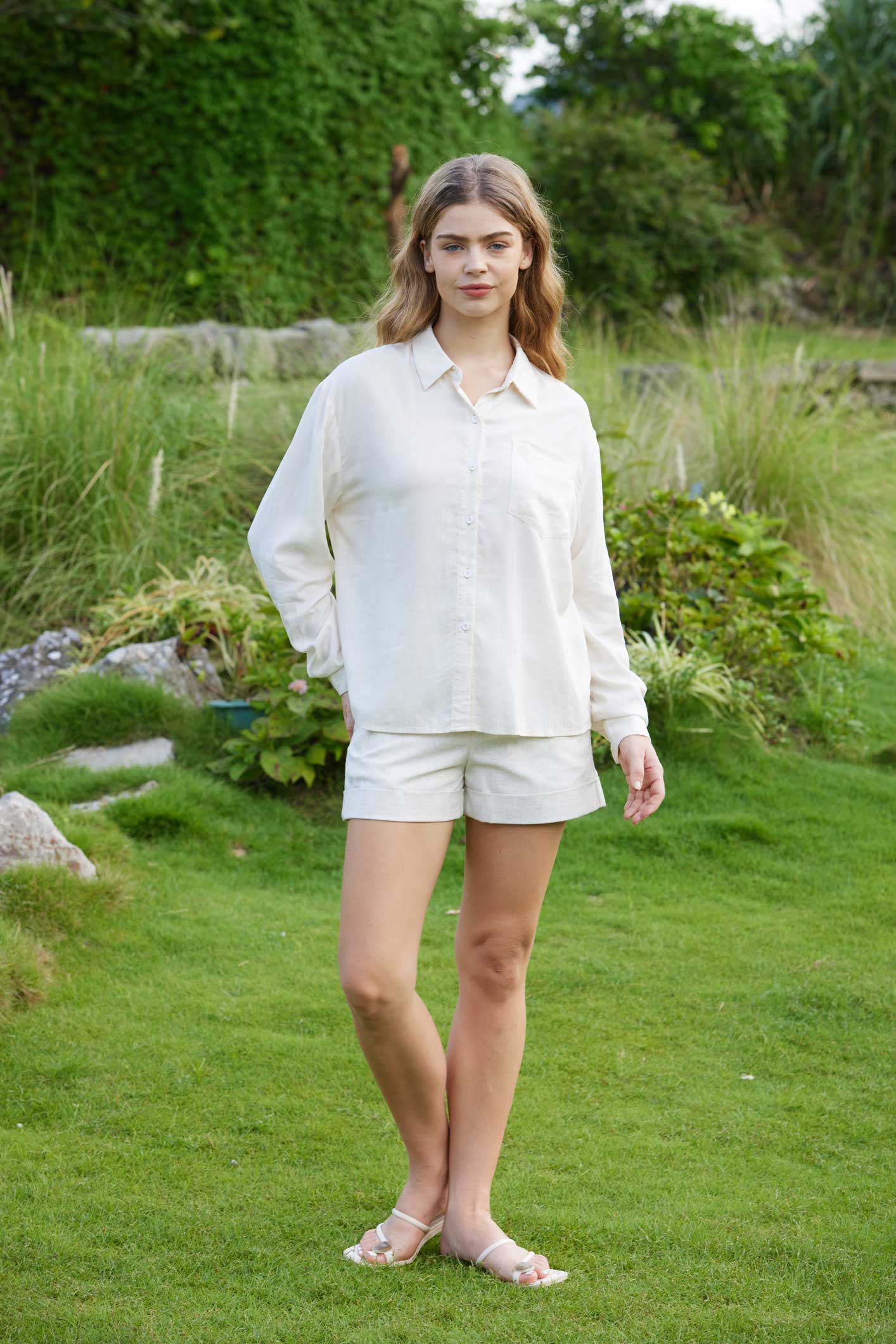
If your wardrobe already has a heavy layer, the next gap is usually the middle: a long-sleeve linen shirt in the 160 to 190 gsm range. This is the piece that extends linen from a summer fabric into a three-season fabric, and it does so without looking like an attempt to dress linen up as wool. It sits under a jumper without adding bulk at the cuff, it works untucked over trousers, and it is comfortable in a heated office where a 240 gsm layer would be too much.
Three details separate a long-sleeve shirt that earns its place from one that hangs unused. The first is cuff depth: a 6 to 7 cm cuff with two buttons lets you tighten it under a knit sleeve and loosen it when you push the sleeves up, and it keeps its shape after washing. The second is the collar: a soft, unfused collar in a heavier linen rolls naturally and looks intentional open; a stiff fused collar on heavy linen looks like officewear from a decade ago. The third is length. A shirt that ends at the hip bone tucks without ballooning and also works untucked; a shirt that ends mid-hip will bunch the moment you tuck it into high-waisted trousers.
Colour is where most wishlists go wrong. A year-end shirt should be chosen against the three jackets or knits you already own, not against a photograph. If your outerwear is charcoal, navy or black, an oatmeal or ecru shirt does most of the work. If your outerwear is camel, brown or olive, a white or pale blue shirt separates the layers more clearly. A dark shirt in winter is practical in a different way: it hides the crease lines that show up under a coat and it photographs better in low indoor light, but it also shows lint from wool, which means a lint roller becomes part of your routine.
Sleeve length deserves a check that most people skip. With your arm bent at 90 degrees, the cuff should sit at the wrist bone, not above it. Straight-arm measurement flatters a shirt that is actually too short, and a short sleeve on a linen shirt is obvious the moment you reach for a steering wheel or a keyboard. The linen tops collection lists weight and composition for each style, which makes it possible to compare a 160 gsm shirt against a 190 gsm one without ordering both.
If you wear knitwear often, consider how the shirt behaves at the neck. A shirt with a slightly wider collar band sits flat under a crewneck; a narrow band bunches and creates a visible ridge. That ridge is the single most common reason people decide linen "does not work" under a sweater, and it is a fit problem rather than a fibre problem. The layering logic is set out in more detail in the guide to mixing linen with wool and cashmere, which covers the order of layers and the weights that stop a linen base from feeling cold against the skin.
Third Addition: One Bottom That Survives Winter Indoors
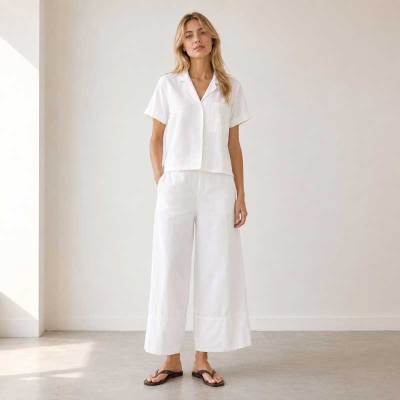
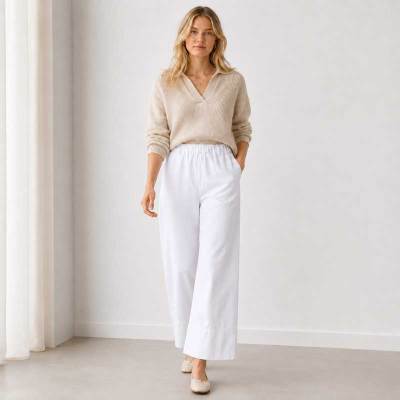
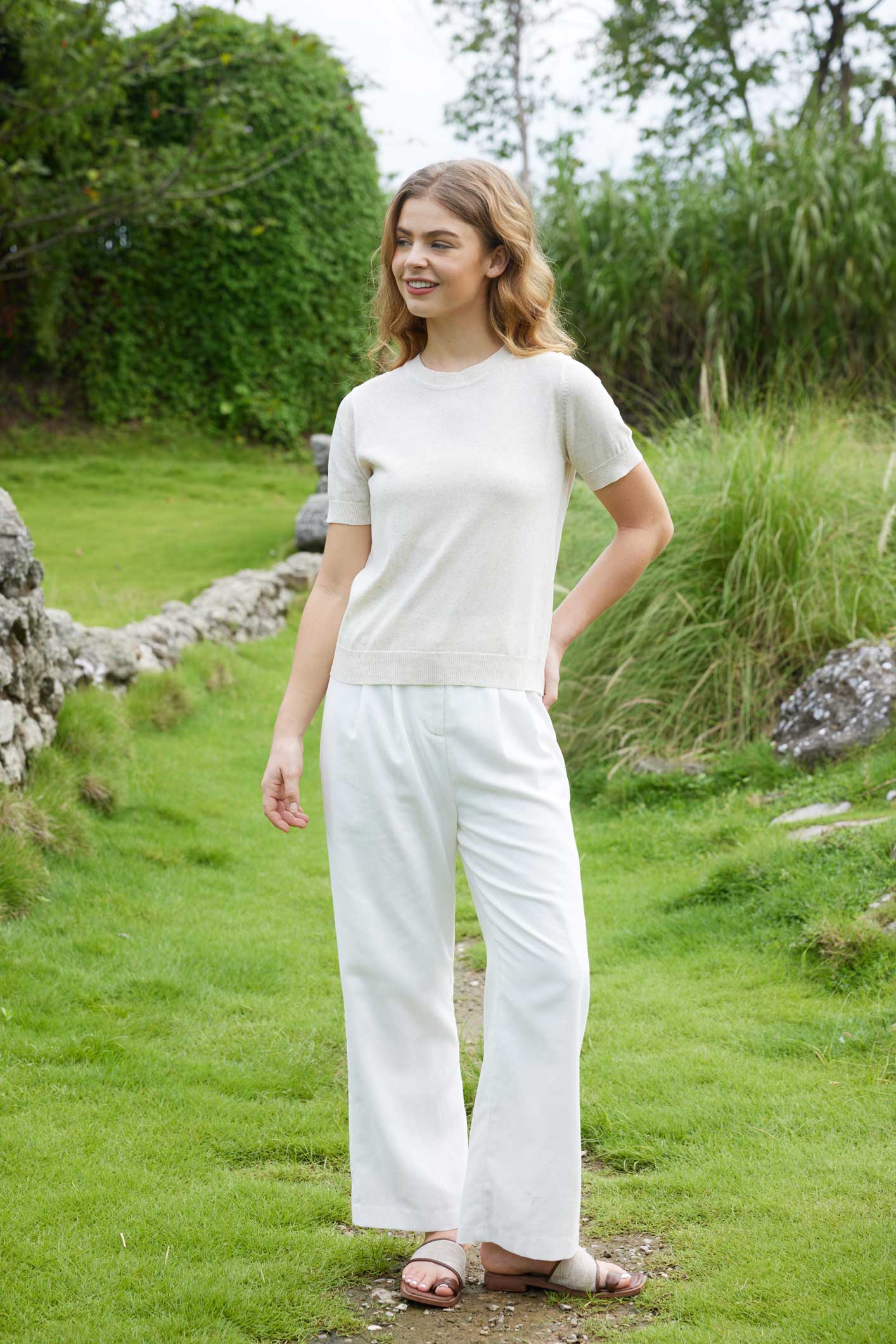
Linen trousers in 180 to 220 gsm are the most underrated winter piece in the fibre. They are not warm outdoors in January, and they are not supposed to be. They are comfortable in the specific conditions most people actually live in from November to March: a heated room, a commute of twenty minutes, a long day of sitting. In those conditions heavy linen trousers breathe better than denim, crease less than a lightweight cotton chino, and soften into something that feels closer to a favourite pair of pyjama bottoms than to tailored clothing.
The weight has to be right. Below 170 gsm, linen trousers crease into a crumpled look within an hour of sitting and show the shape of whatever you sat on. At 200 gsm and above, the fabric holds a line through a working day and drapes without clinging. A wide leg with a defined waistband and a full-length hem is the most forgiving shape: the vertical line does the work, and the width means the fabric does not have to stretch across the thigh. Straight-leg cuts in the same weight are sharper and work better with boots.
Construction checks matter more on trousers than on any other linen piece, because the failures are structural rather than cosmetic.
- Waistband. It should be interfaced and stitched, not just folded. An unfused waistband rolls and stretches after ten wears, and no amount of ironing fixes it.
- Pocket bags. Anchored into the side seam and the waistband. Loose pocket bags pull the hip out of shape and show through the front of the trouser when you sit.
- Seat seam. Double-stitched with a generous seam allowance. Linen has no elastane in most cuts, so the seat takes the full strain of sitting and standing; a single-stitched seat seam is where the first hole appears.
- Hem depth. At least 3 cm of turn-up so the length can be let down if it is wrong. A shallow hem cannot be altered.
- Lining or facing. A partially lined waistband or a cotton facing at the front stops the linen from chafing and helps the trouser hold its shape at the zip.
Fit test: sit down before you decide. If the fabric pulls tight across the front of the thigh or the hip when you are seated, size up rather than assuming it will relax. Linen relaxes slightly with wear, roughly 1 to 2 percent across the width, but it does not stretch enough to fix a seat that is genuinely too small. The linen bottoms collection lists weights per style, which is the fastest way to separate the 160 gsm summer cuts from the 210 gsm ones that will carry you through winter.
One care note specific to winter: static. Heavy linen trousers worn with wool socks and a wool coat in dry air will cling at the ankle. A quick pass with a damp hand or a light spray of water at the hem solves it for the day, and a humidifier in the room solves it for the season. It is not a fabric fault, and it is not a reason to avoid linen in cold weather.
Fourth Addition: One Occasion Piece, Bought Before Party Season
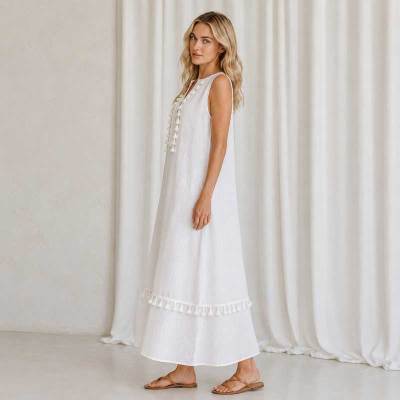
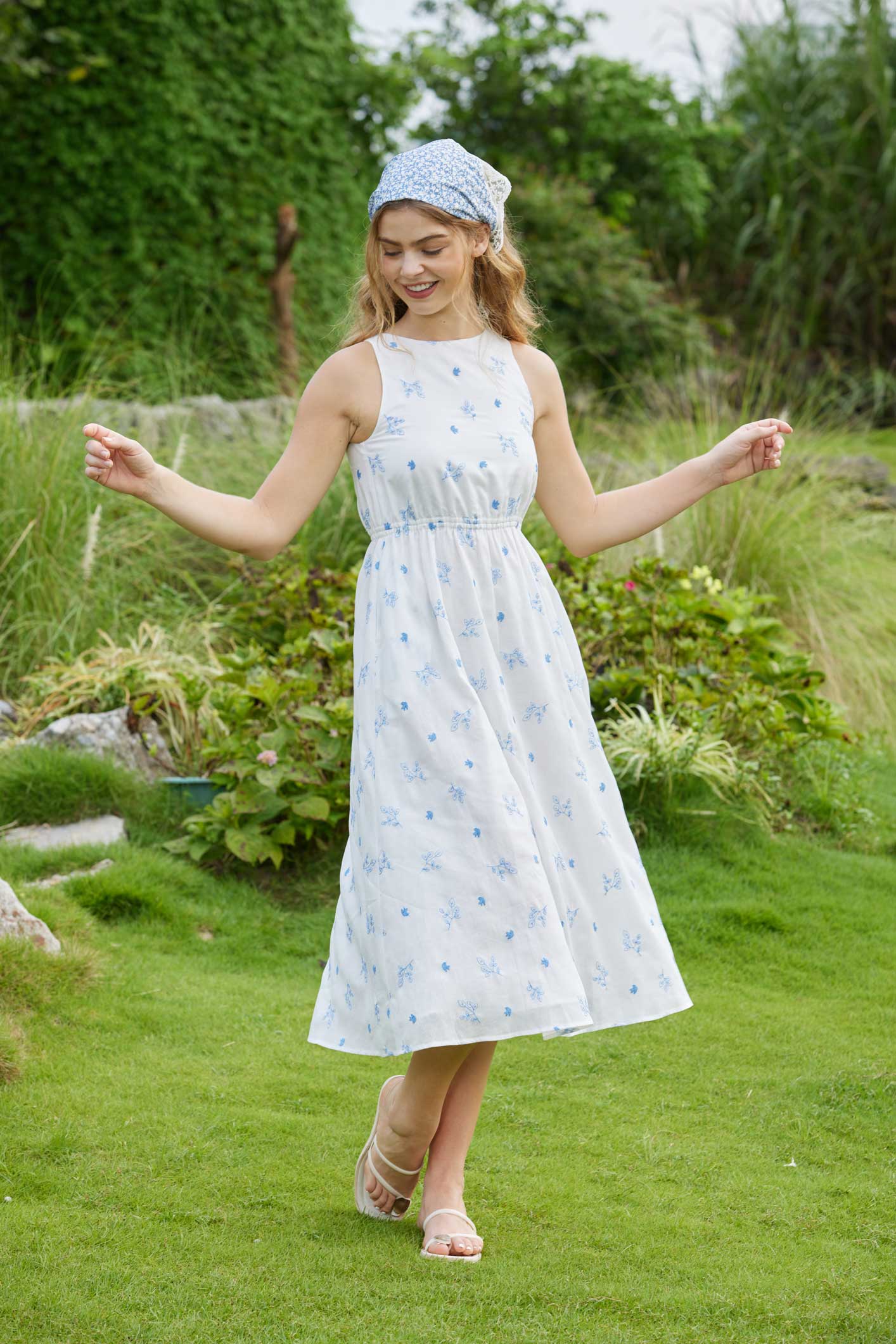
The fourth addition is optional but timely. Party season is the one period in the year when most wardrobes genuinely lack something, and linen can fill that gap better than its reputation suggests. A heavy linen dress in 200 to 240 gsm, in black, deep olive, chocolate or ink, reads formal enough for a dinner or a New Year's Eve gathering while remaining breathable in a crowded room. A linen set in the same weight does the same job with more flexibility, because the pieces separate afterwards.
The mistake is buying a summer-weight occasion piece in November. A 130 gsm linen dress is a beautiful object and a poor December purchase: it is cold outdoors, it creases the moment you sit at a table, and it looks like a holiday dress worn in the wrong month. Look for the weight stated on the page, and treat anything under 180 gsm as a summer piece regardless of how dark the colour is.
What makes an occasion piece work in linen comes down to cut rather than decoration. A defined waist, a hem that clears the ankle, and a sleeve that covers the upper arm do more for formality than any trim. Deep colours hide creases and read as evening wear; pale colours read as daytime even in the same cut. If you are choosing between two dresses at the same price, choose the heavier one with the simpler line, because it will be wearable in November, December and February, whereas the lighter one has a four-week window.
Fit checks are short but strict. The bust dart or princess seam should sit at your bust point, not above or below it, because linen does not forgive a misplaced dart. The armhole should allow a full range of movement without lifting the whole dress. And the hem should clear the widest part of your calf if you plan to wear flats; if you plan to wear heels, check the length in the shoes you actually own rather than in the ones you would like to own. The linen dresses collection lists fabric weight per style, which is the only reliable way to tell a winter dress from a summer one at a glance.
If you rarely attend formal events, skip this rank entirely and put the money into a second bottom or a better heavy layer. A wishlist that includes a piece you will wear twice is a wishlist that has stopped being a plan.
What to Leave Until Spring 2027
Knowing what to postpone is as important as knowing what to add. Four categories are almost always a mistake in a year-end order, not because they are bad garments but because the timing is wrong.
- Lightweight summer dresses. Anything under 160 gsm bought in November will sit unworn for five months and lose its newness before its first wear. Buy it in April, when you can wear it within a week.
- White and pale pieces. Winter is hard on pale linen: rain splashes, coat rub, and the darker drinks of the season. A white shirt bought in November spends more time in the wash than on your back.
- Second versions of what you already own. Three white linen shirts is not a wardrobe, it is one outfit repeated. If you already own the category, the next purchase should be a different weight or a different role, not another colourway.
- Matching sets in summer weights. A 140 gsm set is a holiday purchase. In December it is a promise about a future trip, and promises are what wishlists are made of when they fail.
There is a fifth category that depends on you rather than on the season: anything you would need to lose or gain weight to wear comfortably. Linen has almost no stretch, so a garment bought for a future body is a garment that stays in the wardrobe. Buy for the body you have in the month you will wear it, and let alterations handle the rest.
The Ordering Calendar: Late October to Mid-December
A wishlist without dates is a mood board. The calendar below is built around how linen stock actually behaves in the last quarter: mid-weight pieces and dark dyes move first, gift-sized accessories move last, and delivery queues lengthen through December. Dates are planning anchors, not guarantees, and they assume delivery within your own country rather than cross-border shipping.
| Window | Action | Why it matters |
|---|---|---|
| Late October | Audit what you wore this year; write the four-piece list and note weights | Decisions made before discounts are better than decisions made during them |
| Early November | Watch the pieces you ranked; note real prices rather than advertised percentages | Discount depth varies by weight and colour, not by brand-wide percentage |
| Mid-November | Buy the heavy layer and the long-sleeve shirt | These are the sizes and colours that sell out first |
| Late November | Buy the bottom and the occasion piece if still needed | Party-season demand peaks in the first week of December |
| Early December | Buy gifts and accessories; confirm delivery cut-offs | Accessories are the most forgiving late purchase |
| Mid-December | Stop buying for yourself; plan spring alterations and care instead | Late orders risk arriving after the events they were bought for |
The single most useful discipline in that calendar is the price note in early November. A 30 percent discount on a piece that was marked up in October is not a saving, and the way to know the difference is to write the price down before the sale starts. The same logic applies to stock: a heavy layer that disappears in mid-November was probably the right piece all along, and waiting for a deeper discount usually means buying a different colour you did not want. The guide to spotting real value on Black Friday covers the signals that separate a genuine markdown from a seasonal relaunch.
If any of these pieces are gifts rather than purchases for yourself, the calendar tightens by roughly two weeks. Sizing errors are the main reason a linen gift fails, and a size exchange in the last week of December is a slow, frustrating process. The guide to gifting linen sets out how to choose a size without asking, and what to include in the parcel so the recipient knows how to wash it.
Weight, Care and the Winter Reality Check
Every piece on this list has to survive a winter, and winter is where linen gets blamed for problems that are actually care problems. Three issues account for most complaints between November and March: stiffness after washing, static in dry air, and creasing that looks worse under artificial light than it does in daylight.
Stiffness comes from drying. Linen dried flat and slowly, away from direct heat, keeps more of its softness than linen tumble-dried on high. If a heavy piece comes out of the wash feeling like cardboard, a ten-minute tumble on low with a damp towel restores most of the drape. Garment-washed linen, which is how KOSSR pieces are finished, has already been through a softening cycle before it reaches you, so the first wash is not the shock it is with raw linen. The full routine, including humidity and storage, is in the guide to winter care for linen in cold, dry air.
Static is a climate problem rather than a fibre problem. Indoors at 20 to 22 degrees Celsius with heating running, relative humidity often drops below 35 percent, and at that level linen and wool rub together and crackle. A humidifier set to 40 to 50 percent solves it, and so does layering linen over cotton rather than directly over wool. Anti-static spray works for a day; humidity works for a season.
Creasing is the third complaint and the easiest to reframe. Linen creases because it has low elasticity, which is also why it breathes and why it lasts. A heavy linen piece creases in broad, soft folds rather than sharp lines, and those folds read as texture in daylight and as mess under a hard overhead light. If you need a piece to look pressed for an evening, steam it rather than iron it flat: steam relaxes the fibre without flattening it, and the result looks like linen rather than like a cotton shirt pretending to be linen.
One last check before you add anything: measure the pieces you already own against the new list. If two items overlap in weight, colour and role, you are not adding a piece, you are adding a duplicate. The winter linen care FAQ answers the specific questions that come up once a heavy piece is in rotation, from drying indoors to storing it between wears.
How the Wishlist Changes If Your Budget Is Fixed
Most year-end lists assume an open budget and then quietly shrink when reality arrives. A better approach is to decide the number first and let the number choose the pieces. The three tiers below assume a single purchase window and no gifts.
- One piece. Buy the heavy layer. It changes more outfits than any other single addition, and it is the piece most likely to be worn weekly from November to March.
- Two pieces. Add the long-sleeve shirt. A layer over a shirt is a system; a layer over a t-shirt is one outfit.
- Three pieces. Add the bottom. At that point you have a complete cold-weather linen rotation that does not depend on summer pieces.
- Four pieces. Add the occasion piece only if December holds an event you already know about. If not, stop at three and put the remainder toward alterations or care.
The tier logic matters because linen rewards repetition. A 220 gsm shirt-jacket worn three times a week for four months is a better purchase than four 150 gsm shirts worn once a fortnight, even though the four shirts look like more wardrobe. Cost per wear is the only number that improves with time; everything else is a snapshot.
There is also a maintenance budget to consider, and it is small. A soft brush, a spray bottle, a drying rack and a steamer cover almost everything a linen wardrobe needs, and they cost less than a single mid-weight shirt. What linen does not need is dry cleaning, high heat, or bleach, and those three are the most common ways a good piece is ruined in its first year.
Common Questions About a Year-End Linen Wishlist
Is it worth buying linen at the end of the year?
Yes, if you buy for the next twelve months rather than the next four weeks. Heavy layers, long-sleeve shirts and 200 gsm trousers are wearable from November through April in a temperate climate, and year-end discounts often apply to exactly those weights because they are not the pieces shoppers search for in summer. What is not worth buying at the end of the year is summer-weight linen, which will sit unworn for five months.
How many linen pieces should I add in one season?
Three or four at most. Beyond that, the new pieces compete with each other for the same wearing slots and the older pieces stop being worn. A workable rule is one addition per role: one layer, one top, one bottom, and at most one occasion piece. If two candidates fill the same role, choose the heavier weight for winter and postpone the other until spring.
What weight of linen is warm enough for winter?
As a outer layer, 200 to 240 gsm is the useful range; as a base layer under knitwear, 150 to 190 gsm works better because it adds less bulk. Linen is not a substitute for wool outdoors in freezing weather, but a 220 gsm shirt-jacket over a 170 gsm shirt is comfortable in a heated interior and in mild autumn temperatures down to roughly 12 degrees Celsius.
Should I buy the dress or the trousers first?
Buy the one you wore more often last year. If you wore trousers on most days, trousers will earn their cost faster; if you wore dresses four or more days a week, a dress will. The category you actually wear always beats the category you admire, and this is the single decision that most often goes wrong on a year-end list.
Build the List, Then Buy One Piece
A year-end wishlist works when it is short, weighted for the season, and dated. Write down four pieces, note the weight you need for each, and buy the first one in mid-November rather than during the first hour of a sale. Start with the linen outerwear collection if your wardrobe has no heavy layer, or with the linen tops collection if the gap is in the middle. Either way, buy one piece you will wear weekly, wear it hard for a month, and let that month tell you what the second piece should be.