Linen for Sensitive Skin: Why Natural Fibers Calm Irritation
Linen for Sensitive Skin: Why Natural Fibers Calm Irritation
Direct answer: Linen suits sensitive skin because of four measurable properties rather than a marketing claim. Flax fibre sheds almost no lint, so it creates less mechanical friction than cotton or polyester. It absorbs around 20% of its own weight in moisture before feeling damp, so sweat does not sit against the skin. It is a single natural fibre that needs no chemical softener finish once it has been garment-washed, and it releases heat faster than cotton. Linen is not a treatment for any skin condition, and a coarse, unwashed linen can feel rough on first wear, but a fine, garment-washed 100% linen worn over a gentle wash routine is one of the calmest fabrics available.
Written for adults whose skin reacts to friction, trapped heat, or laundry residue, and who want to know which linen to buy, what to check on the label, and how to wash it so it stays comfortable rather than becoming the problem.
What Sensitive Skin Is Actually Reacting To
Sensitive skin is not one condition. In practice, a reaction that people describe as sensitive skin usually comes from one of four mechanisms, and each one points at a different property of the fabric you are wearing. Separating them is the fastest way to work out whether linen is likely to help you.
The first mechanism is mechanical friction. Every fabric rubs against skin as you move. A coarse or lint-shedding fibre creates thousands of tiny abrasion events per hour, and on skin with a weakened barrier those events are experienced as stinging, itching, or redness along the seams and hems. Fabrics that shed lint and short fibres provoke this more than fabrics that do not.
The second mechanism is trapped heat and moisture. When a fabric does not carry vapour away, the microclimate between cloth and skin stays warm and wet. That is the environment where itching intensifies, where chafing appears, and where the skin's own surface flora shifts. Any fibre that keeps that layer drier reduces the trigger.
The third mechanism is chemical contact. Dyes, finishing agents, softeners, and detergent residue can all sit in a fabric after manufacture or after a wash. People with a reactive barrier often react to what is left in the cloth rather than to the fibre itself, which is why a shirt can feel fine in the shop and irritating after three wears.
The fourth mechanism is simple roughness of handle. Some people have no true dermatitis at all, but skin that is thin, dry, or recently exfoliated, and their threshold for a scratchy surface is much lower than average. For them, the answer is usually a softer grade of the same fibre rather than a different fibre.
A useful way to think about it is that linen is not a cure, but it is unusually good at removing three of those four triggers by construction. The fourth, roughness, is a question of grade and of whether the cloth was pre-washed. If you want a wider baseline, our explainer on whether linen clothing is comfortable covers the general hand-feel question, while this article stays on the skin-specific side.
Why Flax Fibre Behaves Differently Against Skin
Linen is the woven cloth made from the bast fibre of the flax plant. The fibre is long, and the plant is pulled rather than cut so the full staple length stays intact. That matters for skin because length is what keeps a fibre in place. Long fibres grip each other in the yarn and stay there. Short fibres work loose and end up on the skin surface, where they rub.
Flax fibre also has a naturally smooth outer surface relative to cotton, which is a seed fibre with a more irregular profile. Cotton's convoluted, ribbon-like structure is part of what makes it pleasant and absorbent, but it also gives the fibre more edges to catch on skin. Flax, by contrast, is a straight bast fibre with a waxy cuticle, so its contact with skin is more of a glide than a grab. More detail on the raw material itself is in our guide to what linen is made from.
There is a third property that is easy to miss: flax is a single fibre, not a blend. A great deal of clothing marketed for sensitive skin is cotton blended with elastane, viscose, or polyester to give it stretch and recovery. Those synthetic components are what trap heat, hold odour, and shed microfibres. A 100% linen shirt has none of them.
[IMAGE_PLACEHOLDER] img prompt: Macro photograph of the surface of a garment-washed natural linen weave in oatmeal colour, showing the open, slightly irregular weave structure and the soft fuzzy-free yarn, natural daylight, textile detail photography| Property of the cloth | How it behaves against skin | What to verify before buying |
|---|---|---|
| Fibre length | Long staple stays locked in the yarn and sheds very little lint | The label should state 100% linen or 100% flax, not linen blend |
| Fibre surface | Smooth bast fibre with a natural waxy cuticle, so it glides rather than grabs | A fine yarn count and a plain or twill weave rather than a heavy slub |
| Moisture handling | Takes up roughly 20% of its weight in moisture before feeling damp and then releases it quickly | Airtight packaging is a warning sign; linen should breathe even in the bag |
| Heat release | Conducts heat away from the body faster than cotton or wool | A mid-weight cloth (roughly 150 to 190 gsm) rather than a heavy 260 gsm canvas |
| Finishing | Garment-washing softens the cloth with water and movement rather than chemistry | The product page should say pre-washed or garment-washed and list the composition |
The Fibre Structure, in Plain Terms
A flax stem contains bundles of individual fibres held together by pectin, a natural glue. Retting, the controlled partial rotting of the stem in the field or in tanks, dissolves that pectin so the fibre bundles can be separated without cutting them. What remains after scutching and hackling is a fibre that is mostly cellulose with a small proportion of natural wax, pectin, and lignin still present on the surface.
That residual wax and pectin are not impurities to be stripped. They are what gives new linen its slight stiffness and, after washing, its characteristic cool hand. Because they are part of the fibre rather than a topical treatment, they do not wash away after five cycles the way a silicone softener does. The cloth starts slightly crisp, softens through the first handful of washes, and then stays in a stable, comfortable middle range for years.
For reactive skin, the practical consequence is predictability. A synthetic fabric with a surface finish can feel wonderful in week one and irritating in month three, once the finish has worn off and the underlying fibre is exposed. An unfinished natural fibre has nothing to wear off, so the hand you feel at the start is broadly the hand you will still feel in two years.
Cellulose itself is chemically unreactive against intact skin, and it does not support the growth of the bacteria that produce odour in the way that polyester does. That is why linen can be worn two or three times between washes in cool weather without developing a smell, which in turn means less detergent exposure for skin that reacts to detergent.
Low Lint, Low Friction: The Mechanical Side
Lint is the visible end of a mechanical problem. Every fibre that breaks free of a fabric becomes a small abrasive particle, and it either floats away or stays trapped between cloth and skin. Cotton produces noticeable lint, and so does any fabric made from short-staple fibres. Flax produces very little, because the fibres are long and are held by their own twist in the yarn.
There is a second friction factor that has nothing to do with lint: the surface area in contact with skin. A dense, tightly woven cloth touches skin almost continuously. A looser weave, which is what most linen is, touches in bands and leaves air channels between them. Less contact area means less total friction per movement, and more area for moisture to escape. This is one reason loosely woven linen feels cool even when it is not especially thin.
If friction is your main trigger, these choices matter more than the fibre itself:
- Choose a finer yarn over a coarser one. A smooth, closely spun yarn in a mid-weight weave produces far less abrasion than a thick slub yarn with visible irregular bumps.
- Avoid heavy canvas weights near skin. A 260 gsm canvas blazer is excellent outerwear and a poor next-to-skin layer. Keep next-to-skin pieces around 140 to 190 gsm.
- Prefer plain weave and twill over loose, textured weaves for anything that sits against the torso or inner arm, where movement is constant.
- Check the seams as carefully as the cloth. A flat fell or French seam removes the raw edge that causes most of the scratching under the arm and along the side seam.
- Wash before first wear. A single 30 °C wash removes the sizing applied to keep the cloth crisp in transit and softens the yarn ends.
One honest caveat: linen is not the smoothest natural fibre in absolute terms. Bamboo viscose and fine silk have a slicker hand. Linen's advantage is that it reaches a comfortable hand without a synthetic finish and stays there, which matters more for reactive skin than the first-touch number.
Breathability and Moisture Management
Linen's moisture behaviour is its strongest skin argument. The fibre can absorb a substantial share of its own weight in water vapour and liquid before the surface feels wet, a commonly cited figure is around 20%, and it then releases that moisture into drier air rather than holding it. Cotton absorbs less before feeling damp and dries more slowly. Polyester absorbs almost nothing, so sweat stays as a film on the skin until the fabric is removed.
Air permeability matters just as much as absorption. Because flax fibres are relatively stiff, linen fabrics sit away from the body in a way that softer fibres do not, and the open weave lets air move through the cloth. The combined effect is a dryer microclimate: less sweat, less warmth held at the skin, and a smaller chance that friction turns into chafing. Our explainer on why linen clothing is breathable goes into the airflow side in more detail.
[IMAGE_PLACEHOLDER] img prompt: Lifestyle photograph of a man and a woman walking outdoors in light garment-washed linen clothing on a warm bright day, natural relaxed movement, sunlight through fabric showing its porous weave, neutral earth tones, candid documentary style| Fabric | Moisture taken up before feeling damp | Dries in moving air | Effect on skin microclimate |
|---|---|---|---|
| Linen (flax) | High, around 20% of its weight | Fast | Driest of the natural options in heat |
| Cotton | Moderate, lower than linen | Moderate | Comfortable until saturated, then clings |
| Silk | High | Moderate | Smooth and dry against skin, warmer than linen |
| Bamboo viscose | High | Slow to moderate | Very soft, but wet cloth stays wet longer |
| Polyester | Very low | Fast as a surface, but not as a vapour path | Trap heat and odour against skin |
| Wool (fine merino) | High | Moderate | Excellent in cold, too warm for many reactive skins in heat |
The practical rule is that if your trigger is heat or sweat, you want the fabric that gets dry fastest and stays away from the skin. In warm weather that is linen. In cool weather, a mid-weight linen worn as a middle layer plays the same role, which is why the fabric does not need to be retired in September.
Chemical Residue: What Might Still Be in the Cloth
This is the part of the sensitive-skin conversation that gets the least attention and deserves the most. A finished garment can carry several categories of residue, and the fibre it is made from is only one variable.
Sizing and stiffeners are applied during weaving and finishing so the cloth behaves on industrial sewing machines and looks crisp on a hanger. They are water-soluble, which is why the first wash changes the hand of a new shirt so noticeably. Until that wash happens, sizing sits against the skin.
Softeners and easy-care finishes are applied to make a fabric feel smoother or to reduce creasing. Silicone softeners are common on synthetic and blended cloth. Resin-based easy-care finishes are used on some cotton shirts. These are topical layers rather than part of the fibre.
Dyes are a third category. Reactive dyes bond to cellulose and are used on most good-quality linen; pigment dyes sit more on the surface and are more likely to release with early washing. Neither is automatically a problem for every skin, but a dark, heavily dyed garment is a larger dye load than an undyed or pale one. If your skin is reactive, buying pale or natural-toned linen for the pieces that sit closest to the body is a reasonable precaution.
Detergent residue is the fourth and the most controllable. It is also the most common cause of what people describe as an allergic reaction to a fabric that has been worn comfortably for weeks. Here is what to check and control:
- Wash new linen before wearing it. One 30 °C cycle with a small dose of fragrance-free detergent removes most sizing.
- Use the extra rinse setting. A second rinse is the single most effective step against detergent residue.
- Skip fabric softener entirely. It coats the fibre, reduces absorbency, and adds a layer of chemistry exactly where you do not want it.
- Run a clean cycle on the machine. Residue in the drum and dispenser transfers to every load, including the one you think is clean.
- Prefer liquid over powder at low temperatures. Powder detergents dissolve less completely in cool water and are more likely to leave residue in the weave.
A good linen cloth is also a relatively small dye load per gram, because linen is usually dyed as yarn or as flat cloth rather than printed edge to edge. That is a smaller surface-to-chemical ratio than a printed synthetic.
Garment-Washing and the First-Wear Problem
Most complaints about linen against reactive skin come from the first three wears of an unwashed garment. The cloth is still carrying sizing, the yarn is still crisp, and the fibre ends are still standing slightly proud of the weave. People conclude that linen is scratchy when what they have actually experienced is unfinished linen.
Garment-washing solves this at the factory rather than in your laundry. The cut garment is washed in water, repeatedly and under controlled conditions, before it is pressed and packed. The sizing goes, the weave relaxes, the cloth shrinks to its final size, and the hand softens to close to what you will feel after a month of home washing. Because the shrinkage has already happened, a garment-washed piece does not tighten up after its first home wash either, which is one less variable on a reactive skin.
This is the difference between a generic linen shirt and one that is genuinely ready for a body that reacts. Our comparison of washed linen vs regular linen sets out the production differences, and the short version for sensitive skin is that garment-washed linen removes the two most irritating early-wear factors: residual sizing and shrinkage.
KOSSR uses 100% European Flax and a garment-washed process, so the pieces arrive pre-shrunk and pre-softened, and each product page states the composition and weight of the cloth. That is the information you need to make a skin decision before ordering rather than after.
Which Linen Grades Feel Calmest on Skin
Not all linen is the same. The variables that matter for comfort are yarn count, fabric weight, and weave density, and they are far more useful to compare than brand language.
| Weight band | Typical use | How it feels on reactive skin | Best for |
|---|---|---|---|
| Light, roughly 110 to 140 gsm | Shirts, camisoles, tank tops, sleepwear | Coolest and lightest, but thin cloth can crease sharply | Warm rooms, sleep, hot climates |
| Mid, roughly 150 to 190 gsm | Shirts, dresses, trousers, sets | The best balance of smoothness, breathability, and coverage | Every day, most wardrobes, most seasons |
| Heavier, roughly 200 to 240 gsm | Skirts, structured trousers, lightweight jackets | Substantial and smooth, warm enough for transitional weather | Cool evenings, autumn layering |
| Heavy, roughly 250 gsm and above | Canvas blazers, outerwear, bags | Structurally crisp, too abrasive as a base layer | Outer layers only, worn over a shirt |
Within a weight band, a finer yarn count gives a smoother surface and a slightly denser cloth, while a coarser count gives more texture and more visible slub. Neither is better in the abstract, but for skin that reacts to friction, the finer count in the mid weight band is the safest default.
Colour also plays a small role. Undyed and pale linen carries less dye than a deep saturated colour, and undyed natural linen has a visible fleck that some people find attractive precisely because it signals an unfinished cloth. If you are testing whether linen works for your skin, start with one pale, mid-weight, garment-washed piece and wear it twice before buying more.
What to Look For on a Label If Your Skin Reacts
A product page tells you more than a care label, but both are worth reading. Use this as a filter before you add anything to a basket.
- Composition first. 100% linen or 100% flax. "Linen blend" with no percentage breakdown is a signal that a synthetic share is hidden in the mix.
- A stated weight. Grams per square metre, or a clear descriptor such as light, mid, or heavy. A seller who cannot state the weight usually cannot state the yarn either.
- Pre-washed or garment-washed. This tells you the cloth has already been through the softening and shrinking stage.
- European Flax or equivalent origin disclosure. Fibre origin is not a skin guarantee, but it does indicate a supply chain that documents its raw material.
- No wrinkle-free or easy-care claim. Those finishes are the opposite of what reactive skin needs.
- Natural or pale tones for base layers. Fewer dye molecules in direct contact with skin.
- Seam and finish photography. If you can see flat seams and clean edges, you can predict the friction under the arm.
The same logic applies to how you read reviews. A review that says a shirt is soft after ten washes is describing a normal garment-washed linen. A review that says it felt like sandpaper on arrival is describing a cloth that was sized heavily and sold unwashed, and it tells you about the seller more than about linen.
How to Wash Linen for Sensitive Skin
The wash routine is where you control the chemical side of the equation. These steps assume a home machine and a garment-washed linen piece, and they are deliberately conservative.
- Read the care label and sort by colour. Keep pale linen with pale linen for the first few washes so fugitive dye from a darker piece cannot transfer onto the cloth that sits against your skin.
- Turn the garment inside out. This puts the seam allowances and any heavier stitching away from the drum and reduces surface pilling on the face of the cloth.
- Use a mesh bag for small or structured pieces. Camisoles, tank tops, and anything with a small button stand benefit most.
- Set a gentle or delicate cycle at 30 °C. For undyed or pale linen, 40 °C at most. Heat is what shrinks the fibres and sets creases, and it also drives residual dye into the cloth.
- Choose a fragrance-free, pH-neutral liquid detergent. Use roughly half of what the bottle advises if your water is soft. Enzyme-heavy or scented products are the usual culprits behind wash-day irritation.
- Turn on the extra rinse. This is the highest-value step in the whole routine for reactive skin.
- Skip fabric softener and dryer sheets. Both coat the fibre, block absorbency, and deposit a scented film on the cloth.
- Air dry, either flat or on a padded hanger. Tumble drying at high heat is not only hard on the fibre; it bakes in whatever residue is left.
- Press while slightly damp, on the reverse, at a moderate setting. If you dislike ironing, hanging the piece in a steamy bathroom removes most of the crease.
If you are unsure whether your machine can handle linen at all, our answer on whether linen can be machine washed covers the edge cases, including heavily structured pieces and older cloth.
| Do | Avoid | Why it matters for reactive skin |
|---|---|---|
| 30 °C gentle cycle, extra rinse | Hot wash, heavy cycle | Less shrinkage and far less detergent left in the weave |
| Fragrance-free pH-neutral liquid | Scented powder, booster beads | Removes the most common chemical trigger in laundry |
| Inside out, mesh bag | Washing with zips and hooks loose | Fewer broken fibres means less lint and less friction |
| Air dry flat or on a padded hanger | High-heat tumble dry | Prevents setting residue and stiffening the cloth |
| Wash every two to three wears | Washing after every single wear | Linen holds less odour, so fewer exposures to detergent |
Softening Linen Without Chemical Softeners
If a linen piece still feels firmer than you would like, the answer is movement and water, not chemistry. Softening happens when the fibre bundles are flexed repeatedly and the pectin between them relaxes slightly.
- Wash it more, but gently. Three or four gentle 30 °C cycles do more for the hand of the cloth than any additive.
- Wear it. Body heat and movement soften the areas that contact skin fastest, which is exactly where you want softness.
- Choose liquid over powder. Powder can leave mineral residue that makes cloth feel drier and rougher.
- Add a quarter cup of white vinegar to the rinse. It helps strip detergent residue and leaves no scent once dry. Do not use it on every wash if your water is already soft.
- Press on the reverse with steam. A light steam press flattens the weave slightly and improves the surface feel without adding anything to the cloth.
- Do not use a chemical softener as a shortcut. It improves the hand for two or three wears and then leaves the fibre coated and less absorbent.
Our dedicated guide to how to soften linen fabric covers the same methods in more depth, including what to do with a piece that has been stored stiff and creased.
Linen Compared with Other Gentle Fabrics
Linen is not the only fibre that works for reactive skin, and for some people it is not the best one. The honest comparison looks like this.
| Fabric | Strength for reactive skin | Weakness to weigh | Best used for |
|---|---|---|---|
| Fine linen | Low lint, high moisture uptake, no softener finish required, very breathable | Creases visibly and is not the smoothest fibre on first touch | Everyday layers in warm and transitional weather |
| Pima or long-staple cotton | Very smooth when fine, widely available | Sheds more lint and stays damp longer than linen | People who prefer a smoother, softer hand |
| Mulberry silk | Slick surface, minimal friction, temperature buffering | Costly, needs careful washing, warm for some skins | Sleepwear and base layers in cool weather |
| Tencel lyocell | Very smooth, good moisture management | Still a manufactured fibre and needs gentle handling wet | Anyone who wants a drapey, cool cloth |
| Fine merino wool | Excellent temperature and moisture regulation, no odour | Lanolin and fibre scale cause reactions for a minority | Cold weather, worn over a linen or cotton base |
| Polyester and nylon | Durable and quick to dry on the surface | Trap heat and odour, shed microfibres, often carry finishes | Outerwear and technical shells, not base layers |
For most reactive skin, a good rotation is linen for warm and transitional weather, fine merino for cold, and silk or lyocell for sleep. The point is not loyalty to a fibre; it is choosing the cloth that keeps the layer next to your skin dry, smooth, and free of added chemistry.
Sensitive Skin Through the Seasons
Linen is often filed away as a summer fabric, which is a mistake for reactive skin. From September onward, the useful behaviour changes rather than disappears. A mid-weight linen shirt worn as a middle layer keeps a warm room from turning into a humid one, and because linen releases heat quickly it does not overheat you the way a synthetic midlayer does when you move indoors.
The one adjustment for cooler weather is to stop treating linen as a base layer in the cold. Wear a smooth cotton or silk layer against the skin and put the linen over it. You keep the breathability and the low lint without relying on linen for warmth it was never designed to provide. Our summer-to-fall transition guide explains how to shift the same pieces into a cooler rotation.
Winter storage is worth a mention for reactive skin too, because storage is where cloth picks up dust, moth treatment, and mustiness. Store clean and fully dry, folded with a cotton sheet over the stack, and use cedar or lavender rather than a chemical moth treatment. Airing a piece for an hour before wearing it removes most of the dust that storage adds.
When Linen Is Not the Right Choice
An article that only lists benefits is not useful. There are three situations where linen is the wrong answer, and being clear about them saves you money.
First, if you are in an active flare of a diagnosed skin condition, the decision belongs to your clinician, not to a fabric. Linen can be a comfortable cloth during recovery, but it is not a treatment, it does not replace prescribed care, and no fibre choice should delay medical advice. This article is about comfort and reducing avoidable triggers, nothing more.
Second, if a coarse linen has already irritated you once, the issue may be grade rather than fibre. A heavy canvas with visible slub is genuinely abrasive, and no amount of washing will make it suitable as a base layer. Move down to a finer yarn in the mid weight band before concluding that linen does not work for you.
Limit of this guidance: everything here is general fabric information for adults choosing everyday clothing. It is not medical advice, it does not diagnose or treat any condition, and individual skin responds differently. If a garment causes a persistent rash, stop wearing it and speak to a healthcare professional.
Third, if you cannot tolerate creasing at all, linen will frustrate you. It creases as you sit and move, and the alternative is a wrinkle-resistant finish, which is exactly the chemistry a reactive skin usually wants to avoid. In that case a smooth fine cotton or lyocell is the more honest choice.
Building a Low-Irritation Linen Rotation
You do not need a whole wardrobe to test whether linen calms your skin. Five pieces cover most weeks, and each one is chosen so that it can be washed on the same gentle 30 °C cycle.
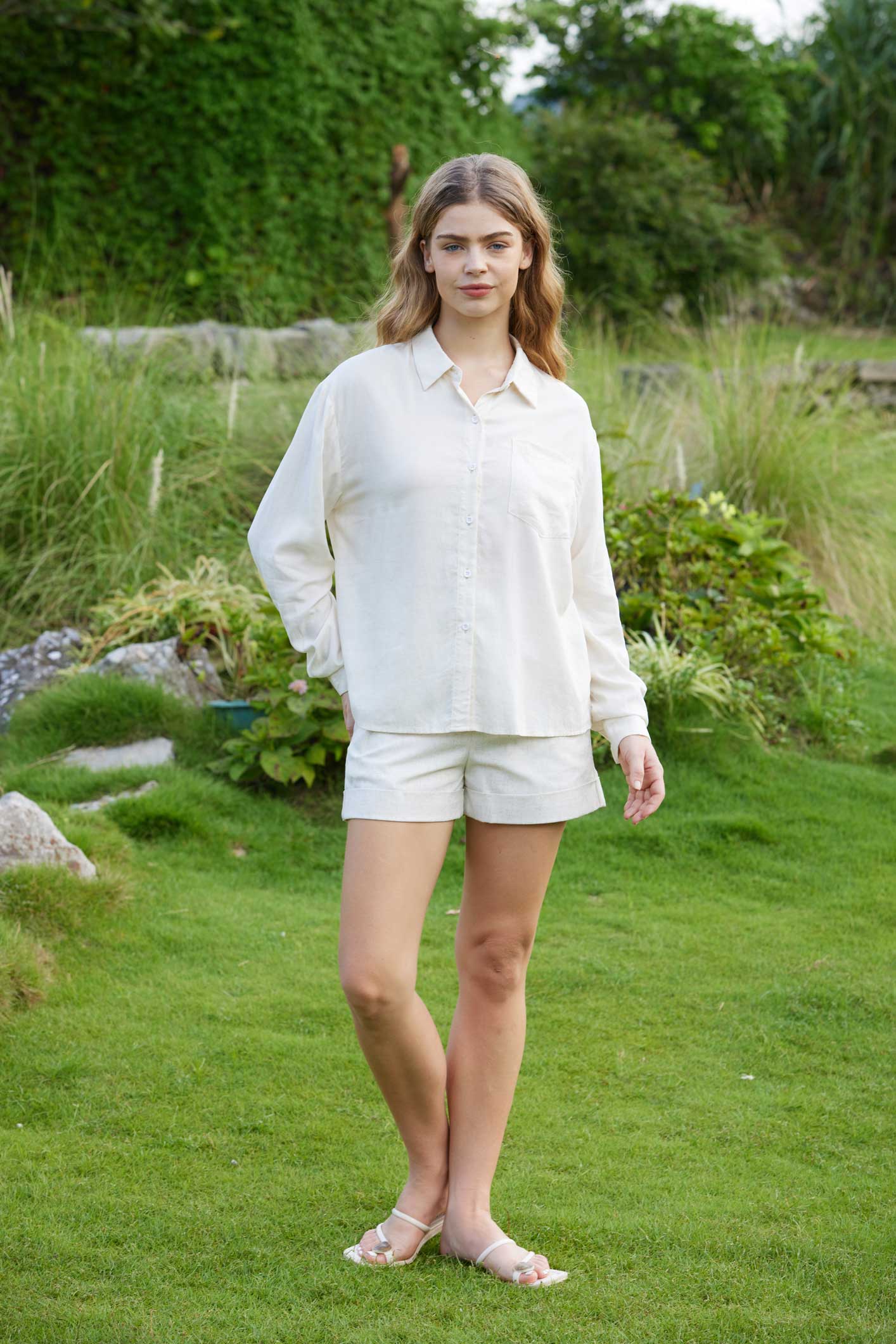
- One white or oatmeal linen shirt in a mid weight. The workhorse layer, worn alone in warm weather and open over a base layer as it cools.
- One loose linen top or camisole in a light weight. For the hottest days and for sleep, when friction matters most.
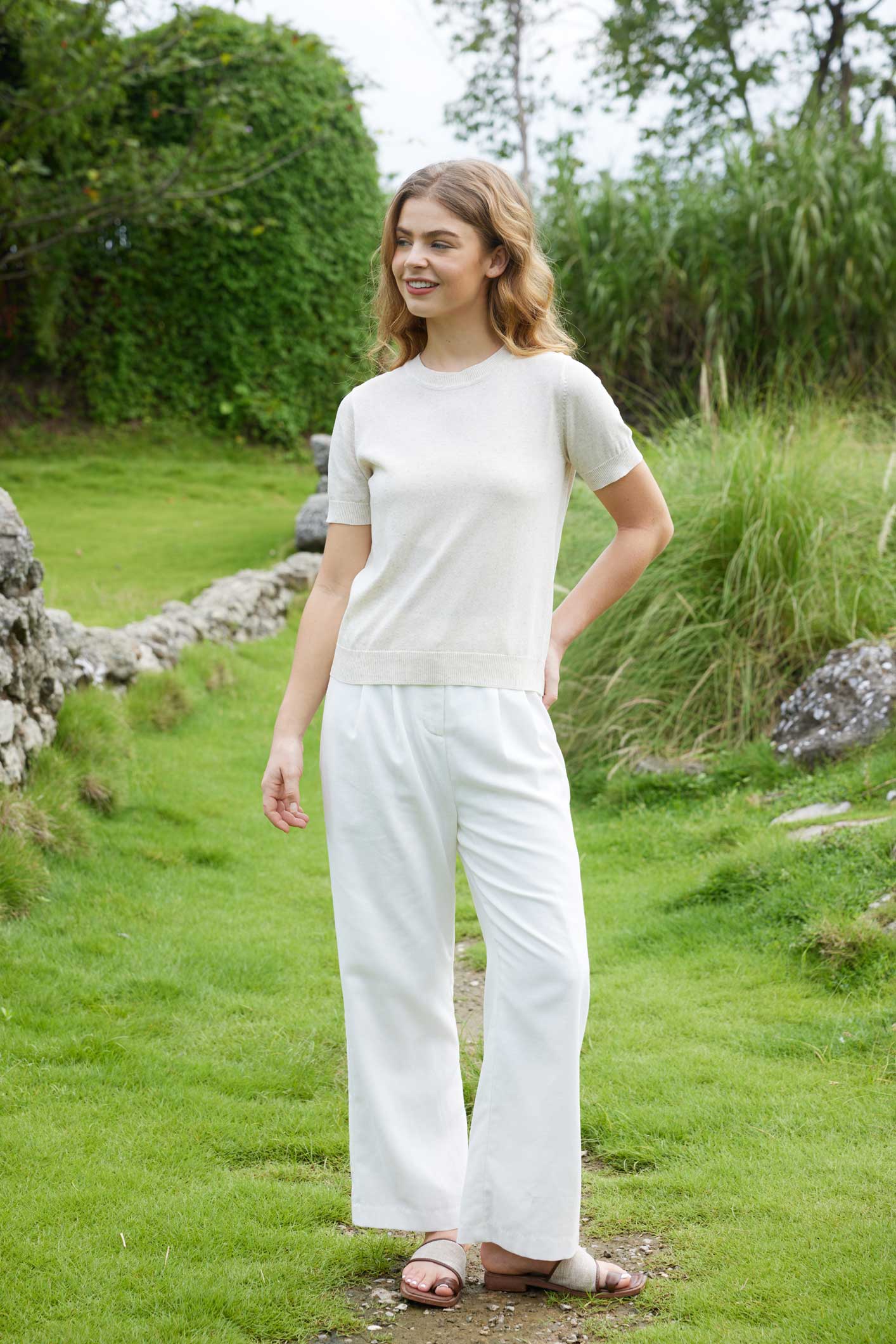
- One pair of relaxed linen trousers in a mid weight. Keeps the legs cool and dry without cling.
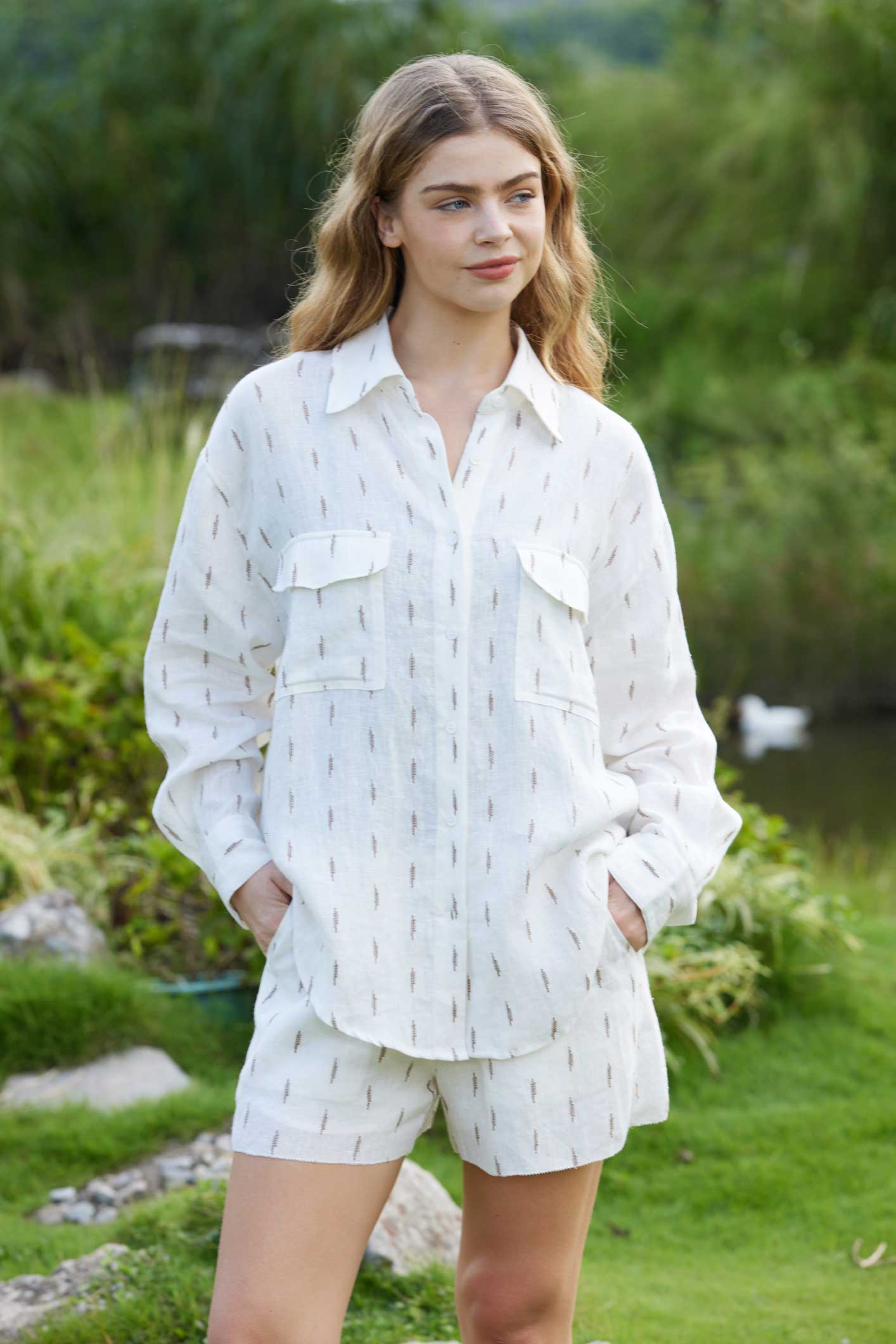
- One mid-weight linen dress or lounge set. A single garment reduces the number of seams and waistbands touching skin.
- One shirt in a pale tone specifically for travel. Linen travels well, and one piece that covers a plane seat and a warm evening keeps your exposure predictable.
Wash all five together on the same gentle cycle with the same fragrance-free detergent, and you have removed the guesswork that causes most reactive-skin trouble: an unknown cloth, an unknown finish, and an unknown detergent all at once.
Build the five around a simple rule: buy one piece at a time, wear it twice, and only then add the next. That pace is what keeps a small wardrobe in continuous use rather than repeatedly renewed.
Frequently Asked Questions
Is linen safe for eczema-prone skin?
Linen is often comfortable for people with eczema-prone skin because it sheds little lint, stays dry, and does not require a chemical softener finish. It is not a treatment and does not replace prescribed care. Choose a fine, garment-washed, pale mid-weight piece, wash it at 30 °C with fragrance-free detergent, and stop wearing it if your skin reacts.
Why does new linen feel scratchy at first?
New linen usually feels firm because the cloth still holds sizing from weaving and the weave has not yet been relaxed by washing. One 30 °C wash removes most of the sizing, and three or four gentle washes bring the hand to its long-term softness. Garment-washed linen arrives closer to that point already.
Does linen cause allergic reactions?
A true allergy to flax fibre itself is uncommon. Most reactions described as linen sensitivity come from what the cloth carries: sizing, dye, a softener finish, or detergent residue left in the weave. Changing to a garment-washed pale piece and a fragrance-free wash routine resolves the majority of cases.
Should sensitive skin wear linen directly against the body?
Yes if the piece is fine, mid-weight, and pre-washed, and if your skin tolerates it in a two-wear test. If you are in an active flare or the cloth is heavy canvas, use a smooth cotton or silk base layer underneath and keep the linen as the outer breathable layer.
Shop Linen That Arrives Soft, Not Scratchy
KOSSR pieces are cut from 100% European Flax and garment-washed before they are packed, so the sizing is gone and the shrinkage has already happened. Composition and weight are stated on every product page, which is the information you need before buying for reactive skin.