Hosting Thanksgiving in Linen: What to Wear and How to Protect It
Hosting Thanksgiving in Linen: What to Wear and How to Protect It
Wear a 150 to 190 gsm linen shirt or shirt dress with rollable sleeves, add a cotton apron for the time you spend at the stove, and treat every splash within sixty seconds. That keeps you cool through the oven heat, covered through the serving run, and out of the dry cleaner on Friday.
img prompt: A home cook in a stone-grey linen shirt dress with rolled sleeves standing at a kitchen island, tying a natural cotton apron over the dress, a roasting tray and linen napkins on the counter behind her, late afternoon window light, warm neutral palette, editorial lifestyle photography, 3:2 landscape
Why the Host's Linen Problem Is a Different Problem
There is already a good guide on this site for people who are attending Thanksgiving as a guest, and it solves the guest's problem: what to wear to somebody else's table, how dressy to go, how to layer for a cold house, how to look photographed without looking overdressed. If that is your situation, read Thanksgiving in linen outfit ideas for guests and stop there. This article is about the other job.
The host's problem is not a dress code. It is a sequence of physical environments that change every twenty minutes, and a set of contact points where food, heat and fabric meet. You open an oven at 180 C and stand in the blast. You lift a twenty-pound bird and carry it across a room. You lean over a table to pour gravy for an uncle who cannot reach. You wash four pans in water hot enough to fog your glasses, then walk into a dining room where somebody has opened a window because the radiator is winning. A guest sits for three hours. You are in motion for six.
That changes what you should wear in four specific ways. First, the garment has to survive a temperature range of roughly 15 degrees Celsius without becoming either a sweat patch or a shiver. Second, sleeves have to be genuinely rollable, not decoratively rollable, which means a cuff that stays where you put it. Third, the surface has to hide or release the kinds of marks that happen in a kitchen rather than at a table. Fourth, the whole outfit has to look intentional at the moment you sit down, because the only photograph that matters is the one taken after the food is on the table and before anyone starts eating.
Linen handles all four better than most fabrics, but only if you choose the right weight and cut, and only if you accept that protection is part of the outfit rather than an admission of failure. A host in a linen apron over a linen shirt dress is not less elegant than a guest in a silk blouse. She is the only person in the room who has thought about what the next four hours actually involve.
The rest of this guide works through the decisions in the order you will make them: weight, silhouette, apron, contact zones, spot response, heat and steam, movement, and the cleanup that happens after the last guest leaves. Each section is written to be usable on its own, because on the day itself you will not read the whole thing again.
The Kitchen Temperature Problem: 21 C to 32 C and Back
Most November hosting advice assumes a single indoor temperature. In practice a working kitchen with an oven, four burners, a dishwasher and six people in it will run between 26 C and 32 C, while the dining room next door sits at 20 C to 22 C with a window cracked for air. You cross that boundary every time you carry a dish through, which on a typical Thanksgiving is somewhere between fifteen and twenty-five times.
Cotton and linen both handle this better than polyester, but they handle it differently. Cotton absorbs moisture and holds it against the skin, which is comfortable in still air and clammy when you move fast. Linen absorbs faster and releases faster, because the flax fibre is hollow and the low-twist yarn wicks along the length of the fibre rather than across it. The practical result is that a linen shirt is dry again roughly twice as quickly as a comparable cotton shirt after a burst of activity. That is the reason linen has a reputation for being cool in summer and also for being wearable in a hot kitchen in November.
The weight you choose decides how much of that benefit you keep. A 110 to 130 gsm linen is what most people picture when they hear the word: light, airy, slightly translucent in pale colours. It is excellent in a 32 C kitchen and useless in a 21 C dining room, and it shows every drop of pan juice as a dark patch within seconds. A 160 to 190 gsm linen has enough body to hold a silhouette, enough opacity to hide a small mark until you can deal with it, and enough insulation to keep you comfortable when you step away from the stove. Above 200 gsm you are in trousers, overshirts and outerwear territory, which is the wrong direction for a room you are actively heating with your own cooking.
There is a second reason to go midweight: garment-washed linen at 150 to 190 gsm drapes rather than clings. Cling is the enemy in a hot kitchen. A light linen shirt that sticks to the small of your back after twenty minutes at the stove looks worse than a slightly heavier shirt that hangs clean. If you own only lightweight linen, wear it as a layer under a heavier overshirt and take the overshirt off when the oven goes on.
The 15-degree test
Before you commit to an outfit, walk from your kitchen to your dining room and back three times in it. If you feel the fabric sticking, flapping or clinging at any point in that loop, it will be worse on the day with six extra bodies in the room. Change the weight, not the style.
Choose the Weight Before You Choose the Style
Style decisions are easy once the weight is fixed. The table below maps the weights you are likely to find on this site to the jobs a host actually does, with the numbers that matter: opacity, drape, heat tolerance and how quickly a mark shows.
| Weight | Best host role | Opacity | Behaviour at 30 C | Mark visibility |
|---|---|---|---|---|
| 110 to 130 gsm | Layering piece under an apron or overshirt | Low in pale shades | Very cool, dries in about 20 minutes | High, especially oil and wine |
| 140 to 160 gsm | Shirt or blouse for a warm kitchen | Medium | Cool, dries in about 30 minutes | Medium |
| 165 to 190 gsm | Shirt dress, two-piece set, host uniform | High in all but white | Comfortable, holds shape | Low to medium |
| 200 to 240 gsm | Trousers, overshirt, apron-weight cloth | Very high | Warm unless worn open | Low |
Two rules follow from the table. The first is that the piece closest to the food should be the heaviest thing you wear. If you are carving, your torso and forearms take the splatter, so a 165 to 190 gsm shirt or dress is the right base. If you are only plating and carrying, a 140 to 160 gsm shirt is enough. The second rule is that white and cream are not forbidden, they are simply a commitment: at 110 gsm a single drop of gravy is visible from across the room, at 180 gsm the same drop stays inside the fabric long enough for you to blot it before it spreads.
Colour matters as much as weight for a different reason. Mid-tone naturals, stone, sage, clay and charcoal hide the two marks that are hardest to remove: oxidized oil, which turns yellow-brown over a wash, and red wine, which leaves a grey shadow even after a good treatment. Pale blue and pale pink are the least forgiving. If you want to wear white linen hosting, wear it at 180 gsm or above and accept the apron as part of the look rather than a cover-up.
img prompt: Flat lay of three folded linen garments in oatmeal, sage and charcoal on a pale oak table, with a small brass ruler and a fabric swatch card showing weave texture, soft daylight from the left, minimal styling, product editorial photography, 3:2 landscapeFour Host Outfits That Survive the Evening
These are not abstract outfit formulas. Each one is built around the contact zones described later in this guide, and each one assumes you will be standing, bending, carrying and reaching for several hours before you sit down.
1. The linen shirt dress with a rolled sleeve
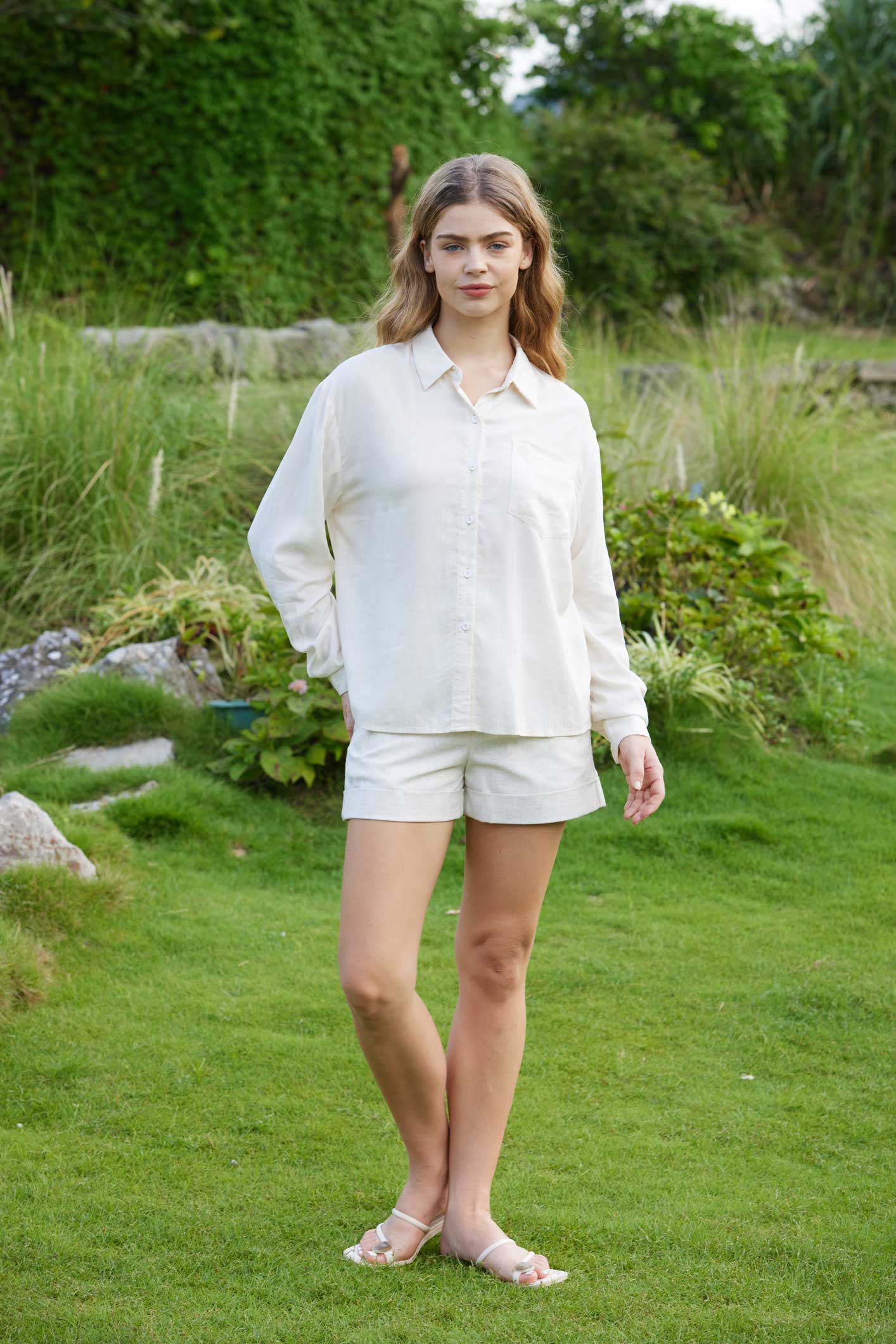
A 165 to 190 gsm shirt dress in stone, sage or charcoal is the single most practical host garment. The button front gives you ventilation control, the collar protects the neck from oven heat, and the sleeve rolls to just below the elbow, which is high enough to keep cuffs out of the washing-up water and low enough to look deliberate when you sit down. Choose one with a hem that clears the knee by 5 to 10 cm so you are not stepping on it while carrying a tray. A self-belt is useful: cinch it for the table, loosen it for the kitchen. If you want the silhouette without the dress, the same logic applies to a shirt dress in a heavier weave, which presses flat after a wash and needs almost no ironing.
2. The shirt and wide-leg trouser combination
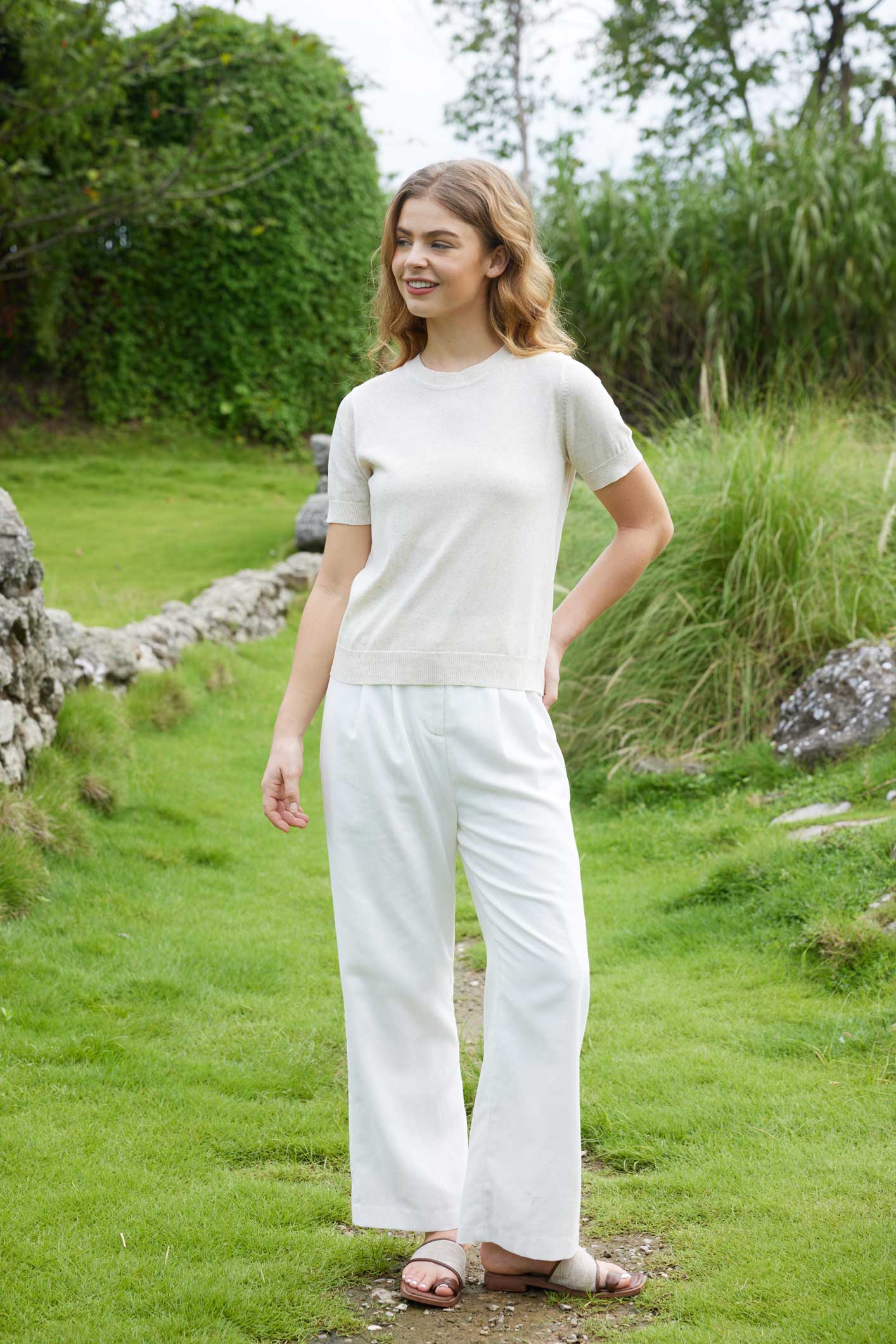
A 150 to 170 gsm shirt tucked into 200 to 240 gsm wide-leg trousers separates the two jobs: the top handles heat and splatter, the bottom handles posture and photographs. Roll the sleeve twice, leave the collar open one button, and choose a shirt with a straight hem so it looks intentional whether tucked or loose. Wide legs are better than slim for hosting because they do not show knee marks after an hour of standing, and because the airflow at ankle level is the difference between comfortable and overheated when the oven has been on since noon. A linen shirt in oatmeal or blue-grey is the most reusable version of this outfit.
3. The two-piece set, worn as a uniform
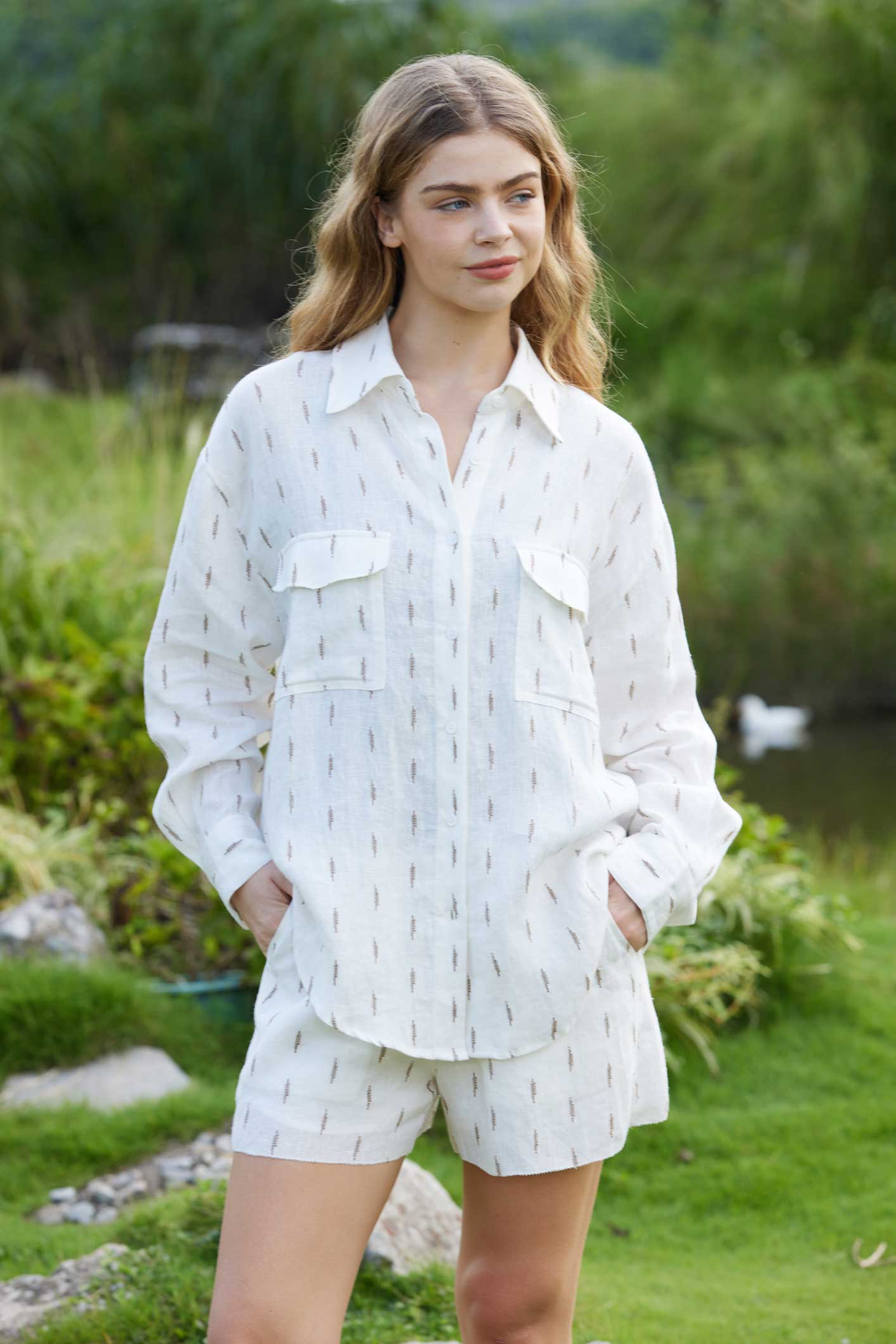
A matching top and trouser set in the same 170 to 190 gsm cloth reads as a decision rather than an accident, which is exactly what you want when you have no time to think about getting dressed. The advantage for a host is that the top can be swapped if it takes a serious hit, while the trousers carry the look. Keep the top loose through the waist and the trouser straight or wide. Avoid crop lengths: they expose the waistband exactly where you lean against a counter.
4. The tunic over slim trousers
A 140 to 160 gsm tunic top, hemmed at mid-thigh, over 200 gsm straight trousers, gives you a longer protective layer across the front panel without the heat of a dress. This is the best option if your kitchen is small and genuinely hot, because the tunic can be untucked and the trousers are light enough at the ankle. It is also the most forgiving shape after a large meal, which matters more than most style advice admits.
What all four have in common is a rollable sleeve, a front opening you can adjust, and a hem you will not trip over. Everything else is preference.
The Apron Question: What to Wear Over Linen
An apron is the single highest-return piece of host clothing, and it is also the piece most likely to be skipped because it feels like giving up. It is not. A cotton canvas or cotton-linen apron in a mid-tone covers the front panel from chest to mid-thigh, which is where roughly three-quarters of kitchen marks land, and it does so without adding heat if you choose a plain weave under 300 gsm.
Three rules make an apron work over linen rather than against it. First, choose a bib apron with a cross-back strap rather than a neck loop. A neck loop pulls the collar forward and creates a crease line across the chest that will still be there when you sit down. Second, the apron should be wider than the front panel of the garment by at least 5 cm on each side, otherwise oil finds the edge and wicks sideways into the linen. Third, tie it at the natural waist, not under the bust and not at the hip: a waist tie holds the apron flat when you bend and keeps the hem from swinging into the oven door.
For the table, take the apron off before you sit. Fold it once lengthwise and hang it on the back of your own chair or on a hook inside the kitchen door. Do not drape it over a guest's chair, and do not leave it on for the photograph unless the photograph is meant to be candid. The point of the apron is that the garment underneath is clean at the moment it matters.
If you dislike the look of a bib apron, a half apron at hip level plus a 165 gsm shirt with sleeves rolled covers most of the same risk, but it leaves the chest exposed to splatter from a hot pan. For a turkey, which releases a surprising amount of hot fat when it is moved, the bib is worth the compromise.
What the apron is actually for
It is not there to keep you clean. It is there to buy you time. A splash that lands on cotton canvas gives you thirty seconds to finish what you are doing and deal with the garment underneath. The same splash on linen is already wicking along the warp by the time you put the pan down.
Sleeves, Cuffs and the Front Panel: The Three Contact Zones
Almost every mark on a host's linen lands in one of three places. Understanding them changes how you move, not just what you wear.
The cuff and the lower sleeve
The cuff is the highest-risk zone because it is at the height of every pan, bowl and sink. A rolled sleeve that sits below the elbow will trail in washing-up water within the first hour, and water plus dish soap plus food residue is how a cuff turns grey at the edge. Roll to just above the elbow and check that the roll holds when you extend your arm. If the sleeve will not stay, a sleeve garter or a single fold pinned under the roll solves it without altering the garment.
The front panel from chest to waist
This is where oil, gravy and wine land when you lean over a counter or a table. The apron covers it. When you are not wearing the apron, the front panel is also where you will touch the fabric with wet or greasy hands without noticing, because that is where your hands rest when you lean. Keep a dry towel on the counter and use it, not your shirt, to wipe your hands.
The hem and the lower back
The hem picks up whatever is on the floor and whatever splashes off the bottom of a bucket or a dropped dish. The lower back takes the mark you cannot see: leaning against a counter edge that has a film of oil on it. A 180 gsm fabric resists penetration better here than a 120 gsm one, but the real fix is behavioural. Wipe counter edges before you lean, and keep a clean cloth at hip height rather than at the back of the counter where you will not reach for it.
There is a fourth zone that people forget: the shoulder and upper back, from carrying a hot tray close to the body. Carrying with the tray held away from the chest, at waist height, and turning with your feet rather than your waist reduces both the splash risk and the strain. It also keeps the front panel out of the steam plume that rises when you open the oven.
img prompt: Close-up of a person's forearms and rolled linen sleeve cuffs above a white ceramic sink, hands rinsing a roasting pan, water droplets on the stone counter, soft overcast window light, muted natural tones, documentary lifestyle photography, 3:2 landscapeThe First Sixty Seconds: Responding to a Splash
Speed beats product. In the first minute after a splash, the goal is to stop the liquid from travelling and to lift what can be lifted, not to clean the garment. The full substance-by-substance method lives in the holiday stain triage guide, and the general reference is the guide to removing wine, coffee and oil from linen. What follows is the host-specific order of operations, adapted for a kitchen where you have one hand free and ninety seconds.
- Blot, do not rub. Fold a dry cloth into a pad and press straight down for five seconds. Rubbing drives pigment between the fibres and abrades the yarn, which leaves a permanent fuzzy patch.
- Lift solids with the back of a knife. Gravy solids, cranberry and stuffing come off the surface before anything wet touches them. Work from the outside of the mark inward so the perimeter does not grow.
- Dust oil with cornstarch or baking soda. Ten to fifteen minutes, no pressing. The powder draws the oil up out of the fibre instead of pushing it deeper, which is the difference between a mark that washes out and one that oxidizes yellow in the dryer.
- Apply one drop of dish soap, not a puddle. Work it in with a fingertip for thirty seconds, then rinse from the back of the fabric with cool water. Rinsing from the back pushes the residue out the way it came in.
- Do not use hot water on protein or tannin. Above 40 C, gravy protein and red wine tannin set permanently. Cool water until the mark is visibly gone, then wash normally.
If the splash is on the apron, treat it the same way, but you have more time: cotton canvas releases oil more slowly and more completely than linen. If it is on the garment and you cannot stop cooking, blot it, dust it with starch, and leave the powder on until after dinner. A white patch on a stone-grey shirt is less noticeable than a spreading stain, and the powder is doing useful work while you carve.
One caution about club soda, white wine and salt, the three table remedies guests will offer. Club soda spreads pigment and dilutes the surfactant you need. White wine does the same with added acid. Salt on a wet stain draws liquid to the surface but also drives it sideways into dry fibre. None of them are better than a dry blot and a dusting of starch.
Heat, Steam and the Ironing Window
Linen and heat have a complicated relationship. The fibre tolerates a hot iron better than cotton, which is why linen can be pressed at 200 to 230 C with steam, but it also scorches visibly if the iron sits still, and it sets creases that were not there before if you press it damp in the wrong fold. For a host, the ironing question is really a timing question.
The best window is the night before, not the morning of. Wash the garment, shake it out, and hang it while it is still damp. Linen's own weight will pull most of the creases out as it dries, and the remaining ones press out in two minutes with a hot iron and a press cloth. If you iron on the morning of Thanksgiving, you will iron it again after the first hour in the kitchen, because body heat and steam from the stove relax the fibre and bring back every fold.
Two habits make the difference. First, iron the garment inside out, or through a thin cotton press cloth, so the iron never touches the face of the fabric directly. Direct contact on a hot setting gives linen a shine that cannot be washed out. Second, iron the front panel and the collar, then hang the garment immediately. Do not fold it over a chair, and do not leave it in the ironing board's steam for ten minutes while you answer the door.
During the evening, steam is your friend and pressure is not. If the shirt creases at the elbow after the first hour, hang it in the bathroom while you shower, or hold it near, not over, a boiling pan for thirty seconds and smooth it with your hand. Do not press it with a hot iron while you are wearing it, and do not use a hair dryer on a high setting: both drive moisture out unevenly and set the crease you were trying to remove.
For garments that have been garment-washed before they ship, the fibre has already been through its first shrink and its first softening cycle. That does not make it shrink-proof, but it does mean the first home wash will not change the fit. Wash at 30 to 40 C on a gentle cycle, skip the dryer or use low heat, and hang to finish. The linen washing guide has the full settings, and it also answers the common question of whether linen shrinks after washing with the numbers rather than a general reassurance.
Seating, Carrying and the Serving Run
Most hosting injuries to clothing happen in motion, not at the table. Three movements account for the majority: sitting down after standing for two hours, carrying a heavy dish across a room, and reaching across a table to serve.
When you sit, gather the garment at the hip and lower yourself, rather than dropping into the chair. Linen has low elasticity, so a hem caught under a thigh will pull at the seam rather than stretch. If you are wearing a shirt dress, unbutton the bottom button before you sit; it costs nothing and prevents the placket from straining. Sit back rather than perching on the edge, because the edge of a chair is where the fabric takes the most compression and where creases become permanent.
When you carry, hold the dish at waist height with both hands and turn with your feet. Carrying at chest height puts the dish in the steam plume and close to the front panel. Carrying with one hand tilts the dish and puts the liquid line at the rim, which is exactly where a wave will escape when you stop. If you must carry something heavy, like the bird, clear the path first and ask someone to open the door. The thirty seconds you spend clearing is the difference between a clean shirt and a lap full of pan juices.
When you serve, reach with the shoulder rather than the waist, and keep the sleeve clear of the plate. A rolled sleeve that has crept down is the most common cause of a cuff in the gravy boat. Before you lean across the table, glance at your cuff and push it up. It is a small habit that saves a garment.
One more movement deserves mention: the dishwasher. Loading and unloading puts your forearms at the height of every wet surface in the kitchen, and the bottom rack is where cuffs go to die. If you are wearing a garment you care about, let someone else do the bottom rack, or change into the apron and roll both sleeves above the elbow first.
After the Guests Leave: The Overnight Triage
What you do between eleven at night and eight the next morning decides whether the garment needs a professional or just a wash. The temptation is to leave everything until morning. The better move is a ten-minute triage before bed.
- Empty the pockets and turn the garment inside out. Crumbs and a forgotten napkin will stain in the wash.
- Check the three contact zones under a bright light. Cuffs, front panel, hem. Marks that are invisible in warm dining-room light show up under a cool kitchen light.
- Treat visible oil with starch and leave it overnight. Powder on a dry mark, no water. Water sets oil into a yellow shadow that survives washing.
- Hang, do not fold. A folded damp garment creases along the fold and the crease becomes permanent after drying.
- Do not wash at midnight. Fatigue plus hot water plus a heavy load is how a good garment gets a bad wash. Wait until morning, use 30 to 40 C, and wash the linen with other linen rather than with towels.
In the morning, treat any remaining marks with the sequence in the guide to keeping linen fresh between washes, then wash. If a mark has already been through a wash and a dry cycle, do not wash it again immediately. Dry heat is what fixes a stain permanently, and a second wash will not undo it. Treat it, air-dry it, and check in daylight before you decide whether it needs more.
Finally, inspect the wear points. A host's linen takes more abrasion at the cuff edge, the elbow and the seat than a guest's does in a season. The guide to linen wear spots explains where they start and how to reinforce them before they become holes. Ten minutes with a needle in November is worth more than a replacement in January.
img prompt: A linen shirt dress hanging on a wooden hanger beside a window at night, a small bowl of white powder and a folded cloth on the sill, warm lamp light against dark blue evening light outside, quiet domestic still life, editorial photography, 3:2 landscapeWhat Not to Wear Hosting Thanksgiving
Some choices fail reliably, and it is worth naming them so you do not rediscover them at 4 p.m. on the day.
- Freshly pressed white linen at 110 gsm. It will show the first splash and every subsequent one, and it will be translucent under kitchen lighting.
- Long unrolled sleeves. A cuff in the sink or the gravy boat is not a question of if but when.
- Anything that needs a belt to stay closed. You will be bending, lifting and reaching; a garment that depends on a belt is a garment that will gap.
- New shoes. You will be on your feet for six hours on a hard floor. This is not a fabric issue but it ruins more hosting days than any stain.
- Delicate jewellery at the wrist and hand. Rings catch on oven racks and bracelets trail in food. Take them off before you cook and put them back on before you sit.
- A garment you have never washed. Dyes that have not been through a wash can bleed onto a hot, damp surface, and sizing can make linen feel stiff and look shiny under lights.
The positive version of this list is simple: midweight linen, rollable sleeves, a bib apron, mid-tone colour, and shoes you have already worn for a full day.
Frequently Asked Questions
Is linen a good choice for hosting Thanksgiving?
Yes, if it is midweight. A 150 to 190 gsm linen shirt or shirt dress handles the 26 to 32 C kitchen and the 21 C dining room without clinging, and it releases moisture faster than cotton. Lightweight linen below 130 gsm is the wrong choice for a host because it shows every mark and clings after twenty minutes at the stove.
Should I wear an apron over linen?
Yes. A cotton canvas bib apron with cross-back straps covers the front panel, which is where most kitchen marks land, and it adds very little heat if the cloth is under 300 gsm. Choose one at least 5 cm wider than the garment on each side and tie it at the natural waist so it stays flat when you bend.
How do I stop my sleeves from getting into the food?
Roll to just above the elbow and check that the roll holds when you extend your arm. If it slips, fold once more and pin under the roll, or use a sleeve garter. Before you reach across a table to serve, glance at the cuff and push it up. This one habit prevents most cuff stains.
What should I do if gravy gets on my linen during dinner?
Blot with a dry cloth for five seconds, lift any solids with the back of a knife, then dust with cornstarch and leave it for ten to fifteen minutes. Apply one drop of dish soap, work it in for thirty seconds, and rinse from the back with cool water. Do not use hot water, salt or club soda, all of which set or spread the mark.
Can I wash host linen the same night?
Better to wait until morning. Treat visible oil with starch overnight, hang the garment rather than folding it, and wash at 30 to 40 C on a gentle cycle the next day. Washing while tired, in hot water, with a mixed load is the most common way a treatable mark becomes permanent.
The Short Version
Host Thanksgiving in midweight linen: 150 to 190 gsm for the piece closest to the food, sleeves rolled above the elbow, a cotton bib apron for the stove, and mid-tone colour that hides the marks you cannot treat immediately. Protect the cuff, the front panel and the hem, and treat every splash within sixty seconds: blot, lift, dust with starch, one drop of soap, cool water. Iron the night before, sit back rather than perching, carry at waist height, and leave the wash until morning. Do that, and the only thing anyone remembers about your outfit is that you looked calm.
Linen Built for a Working Kitchen
Our shirts and shirt dresses are woven from 100 percent European Flax at 110 to 240 gsm and garment-washed before they ship, so the cloth has already been through the wet process that shrinks and softens lesser linen. The European Flax standard traces the fibre back to Western European fields, and our dyehouse works to OEKO-TEX limits on harmful substances rather than guessing at them. Start with a linen shirt you can roll at the sleeve, or a linen midi dress that clears the knee, and let the apron take the damage.