First Day of Fall: A Transitional Linen Capsule for Unpredictable Weather
First Day of Fall: A Transitional Linen Capsule for Unpredictable Weather
Direct answer: A fall linen capsule needs seven pieces, not a new wardrobe: one mid-weight linen shirt, one wide-leg or straight linen trouser, one linen overshirt or blazer-style layer, one long-sleeve linen top, one linen dress or midi skirt, one heavier linen outer layer around 200 to 240 gsm, and one relaxed linen set for warm afternoons. The trick is weight and layering rather than fabric type. Linen stays comfortable from roughly 24 °C (75 °F) down to about 12 °C (54 °F) when it is worn in three thin layers instead of one thick one. This guide builds that capsule piece by piece and then shows what to wear at 20 °C, 15 °C and 10 °C on the same autumn day using the same seven garments.
1. Why the First Day of Fall Is the Hardest Day of the Year to Dress For
The first day of fall looks like a date on a calendar, but it behaves like two seasons in one day. The September equinox, which most calendars mark on 22 or 23 September depending on the time zone, arrives just as daytime highs are still summer-soft while the mornings have already turned sharp. A common pattern in temperate cities in late September is a low of about 9 to 12 °C (48 to 54 °F) before eight in the morning, a high of 20 to 24 °C (68 to 75 °F) in the middle of the afternoon, and a drop back to 13 °C (55 °F) by the evening. That is a swing of more than ten degrees inside a single waking day.
This is why so many people feel that autumn catches them out. A summer outfit is right at noon and wrong at breakfast. A heavy autumn outfit is right at breakfast and unbearable by three o'clock. Buying a new wardrobe for a seven-degree average change is an expensive answer to what is really a layering problem. The better answer is a small group of pieces that can be added and removed during the day, and linen is unusually well suited to that job because it is breathable enough for the warm half of the day and, when cut at the right weight, structured enough for the cold half.
There is also a practical calendar argument for building this capsule now. The pieces you add to your wardrobe in the first week of fall are the pieces you will reach for through October and again in spring, whereas pieces bought for a single cold snap tend to sit unused. A capsule built around weights rather than around seasons carries further, and the method is the same one used to plan any wardrobe that has to work across a wide temperature range.
If you have already read about building a longer-term linen capsule wardrobe, this article is the seasonal version of the same idea: fewer pieces, a narrower temperature window, and a stronger emphasis on what goes over what.
2. What "Unpredictable Weather" Actually Means for Fabric Choice
Unpredictable weather is not the same as cold weather, and the distinction matters when you choose cloth. It means rapid change: a warm afternoon that turns damp and windy, a dry morning that becomes humid by midday, a light shower in the middle of a walk. The fabric has to cope with all three states without being changed, which is why loosely woven natural fibres handle transition seasons better than tightly woven synthetic ones.
Linen is a hollow-core natural fibre. Air moves through the inside of the fibre and through the gaps in the weave, so the cloth transports moisture away from the skin and lets it evaporate at the surface. The practical effect in a transition season is twofold. In the warm part of the day, the fabric does not trap heat against the body, so you can keep the layer on instead of stripping down. In the cool part of the day, the same fabric keeps a layer of still air close to the body when it is worn under something else, which is why two thin linen layers often feel warmer and less bulky than one heavy cotton sweater.
The second property is that linen does not hold moisture the way dense fabrics do. It dries quickly, so a light drizzle or an hour of humid air does not leave the garment heavy and cold against your skin. This is the reason the fibre appears so often in travel wardrobes and in clothing built for changeable climates, and it is also the reason a linen layer is a more useful autumn purchase than a heavier fabric of the same warmth.
What fabric choice cannot fix is a genuine fall in temperature after dark. Linen is not a substitute for a winter coat, and it is not designed to be one. It is designed to work in the band between mild and cool, which is precisely the band that the first weeks of fall occupy. If you are still working out where linen ends and colder-weather fibres begin, the short summary in whether you can wear linen in the fall sets out the limits honestly.
3. The Seven-Piece Transitional Linen Capsule
Seven pieces is enough to cover the transition season without turning your closet into a warehouse. Each piece below performs a different job and earns its place by working with at least three of the others. The weights are given in grams per square metre (gsm) because that number is a far better predictor of how a garment will behave in changing weather than the name on the label.
| Piece | Suggested weight | Its job in the capsule | Works with |
|---|---|---|---|
| Mid-weight linen shirt | 150 to 180 gsm | Base layer on cool mornings, outer layer on warm afternoons | Trousers, dress, skirt, set |
| Long-sleeve linen top | 140 to 170 gsm | Light warmth under an outer layer without bulk | Trousers, skirt, overshirt |
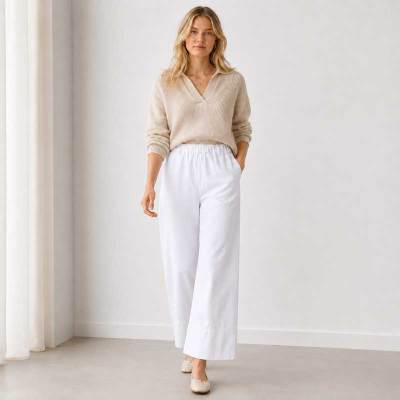
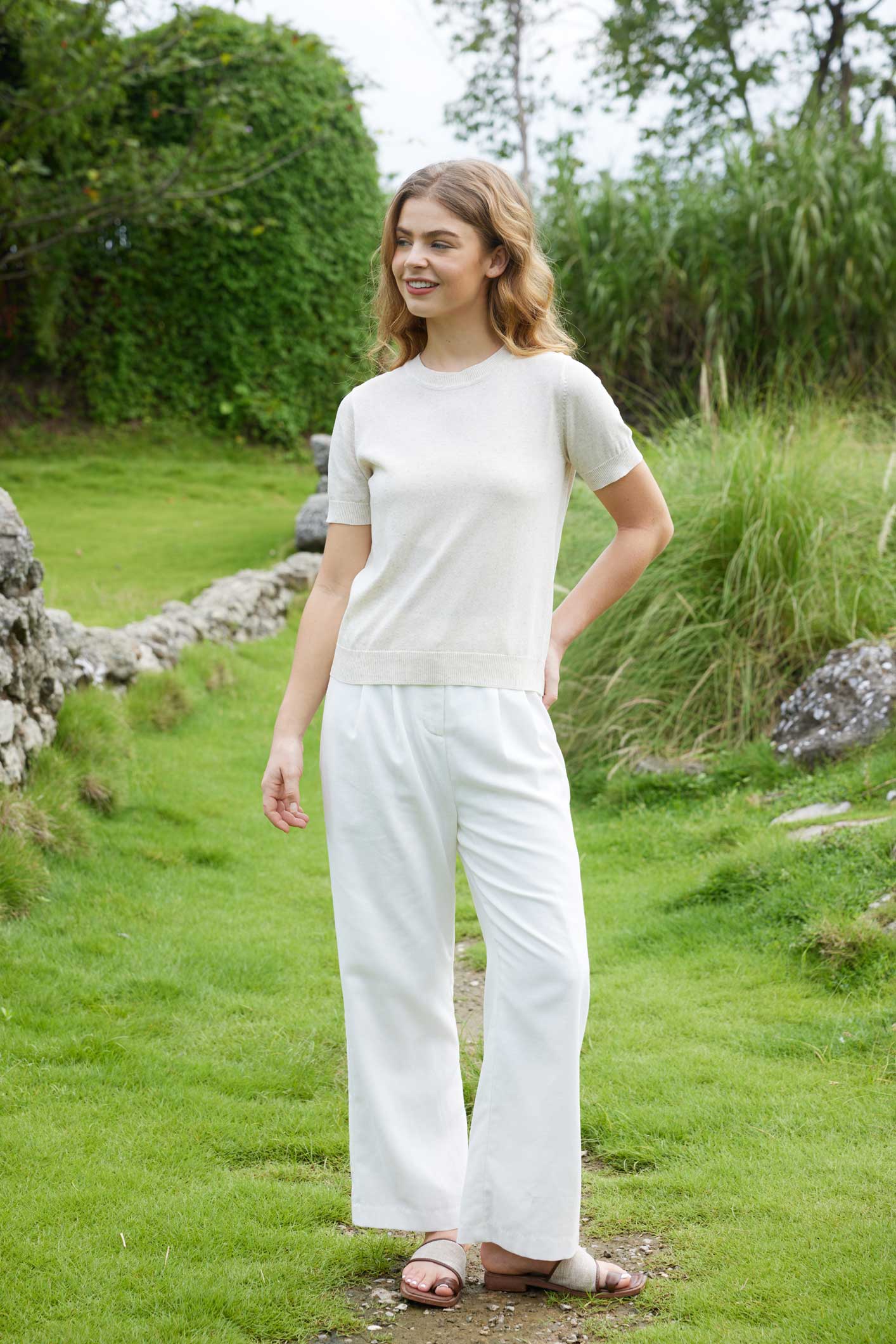
| Wide-leg or straight linen trouser | 180 to 220 gsm | Anchors the lower half and holds a clean line | Every top and every layer |
| Linen overshirt or blazer-style layer | 190 to 230 gsm | The mid layer that manages the 15 to 20 °C range | Shirt, top, dress |
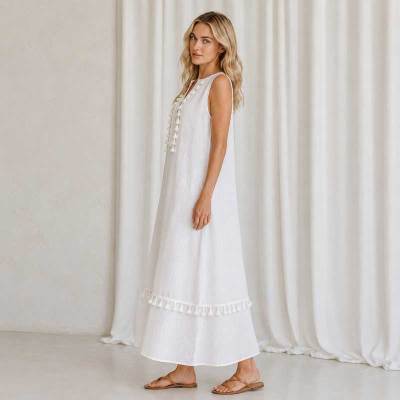
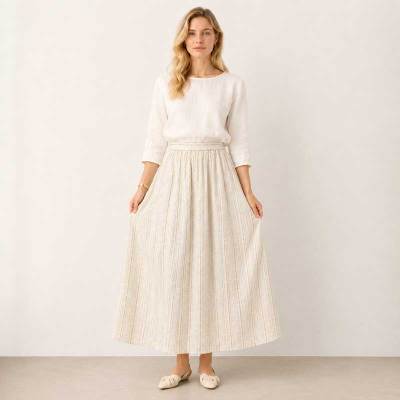
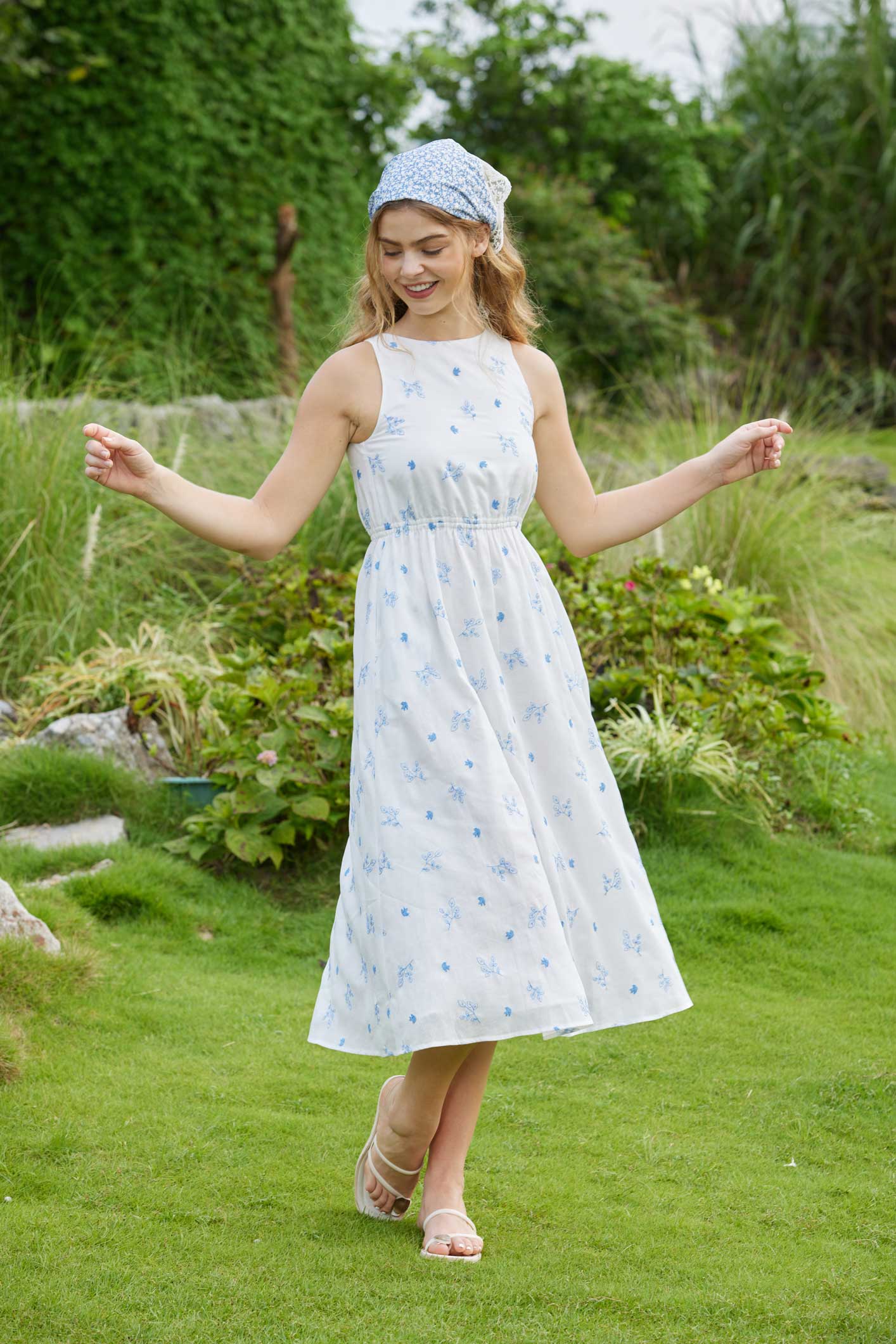
| Linen dress or midi skirt | 160 to 200 gsm | Gives the capsule a dressed-up option for work and evenings | Overshirt, top, outer layer |
| Heavier linen outer layer | 200 to 240 gsm | Handles mornings and evenings below about 14 °C | Everything except the heaviest trouser |
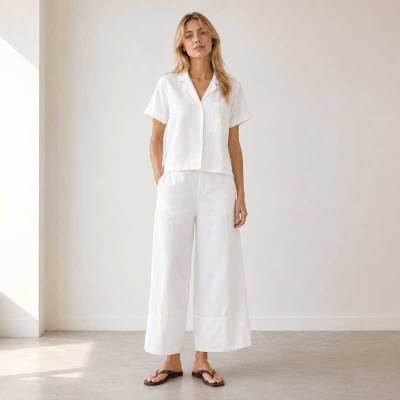
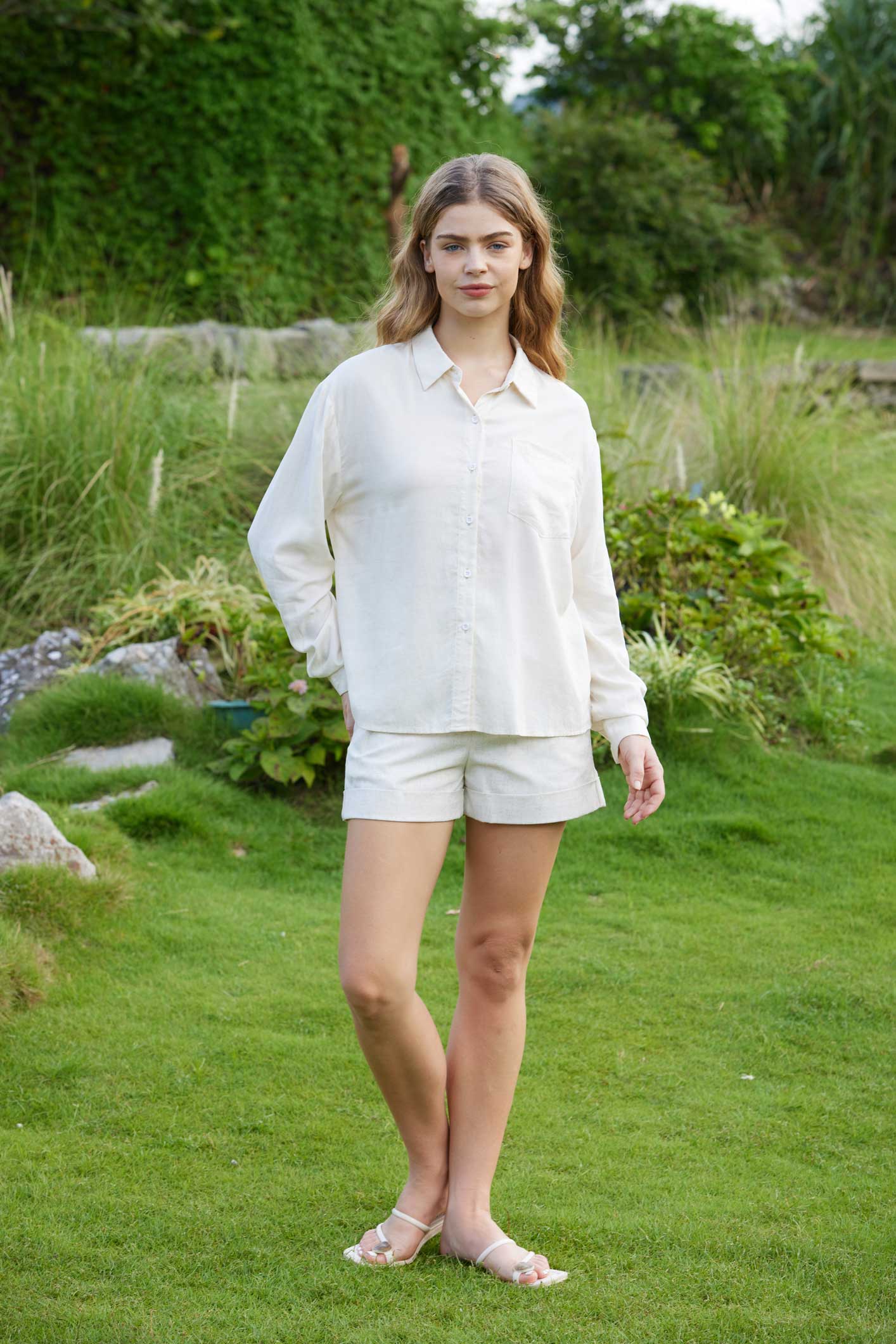
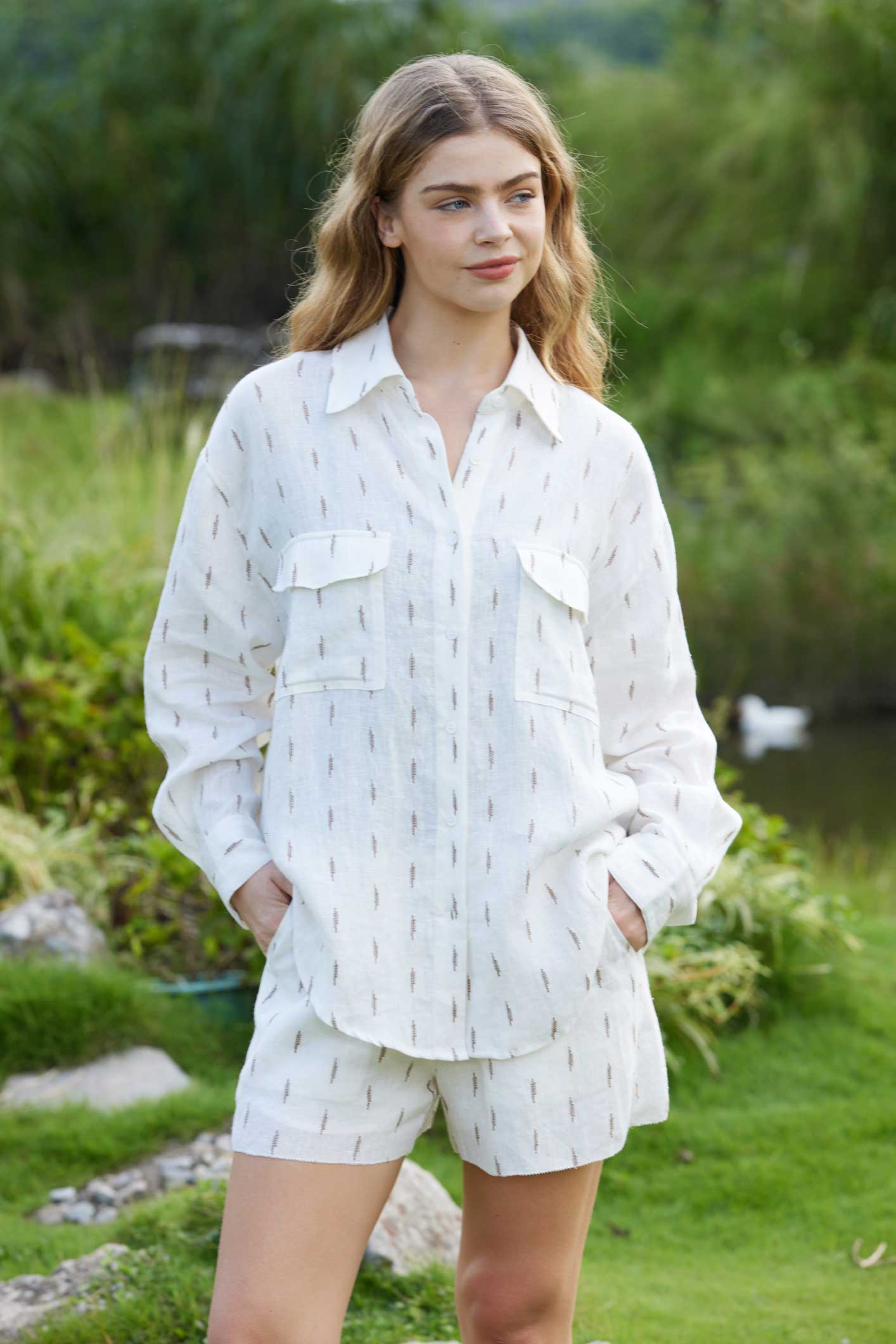
| Relaxed linen set | 140 to 180 gsm | Warm afternoons, travel days and loungewear duty | Worn alone or under the overshirt |
Two of those categories deserve a note before you shop. The mid layer is the piece most people are missing, and it is the piece that makes the whole capsule work; a linen overshirt or a light, unlined blazer-style jacket is what allows the same shirt to be a summer garment at noon and an autumn garment at six. If you want the fuller comparison of cuts and shapes in that category, the guide to linen blazers and jackets for fall layering goes through the options in detail.
The second note is about weight discipline. A capsule fails when it contains four pieces of the same weight. Four pieces at 170 gsm give you one temperature band and no flexibility. One piece at 150 gsm, one at 190 gsm and one at 230 gsm give you three bands and a much wider useful range from the same number of hangers.
4. Layer One: What Sits Against Your Skin
The base layer decides whether you feel dry. In a transition season, the most common mistake is choosing a base layer for warmth instead of for moisture management, which is why people end up overheated at midday and clammy by evening. A linen shirt or long-sleeve top at 140 to 180 gsm handles both jobs: it moves moisture away from the skin, dries quickly, and because it is woven rather than knitted, it does not cling when you begin to warm up.
Fit matters more here than anywhere else in the capsule. A base layer should sit close but not tight, with roughly 2 to 5 cm (about one to two inches) of ease across the bust or chest so that air can circulate between the skin and the cloth. Linen has very little stretch, so a base layer that is too small will feel restrictive in exactly the moments you want to move freely, and it will crease hard at the stress points. If you are between sizes in a woven shirt, the practical rule is to take the larger size when the cut is fitted or button-fronted, and your measurement-matched size when the cut is already described as relaxed.
Colour choice at this layer is not cosmetic. A light base layer such as white, oatmeal or pale sand is the most flexible, because it works under every outer layer in the capsule and it does not show through a light overshirt. A darker base layer is more forgiving in a humid climate and photographs better indoors, but it is also more visible if you remove the mid layer, which is worth considering on days when the temperature is likely to swing.
One further advantage of linen as a base layer is that it does not build up static or cling after repeated wear, which is why the same garment can go from a morning commute to a long afternoon outdoors without needing to be changed. Building this layer around two shirts rather than one is enough for a week: one in a light neutral and one in a mid tone gives you visual variety without adding weight to the capsule. Both belong in the linen tops range, where composition and fabric weight are listed on each product page.
5. Layer Two: The Mid Layer That Does the Work
If you buy one thing for this transition season, buy the mid layer. It is the piece that turns a warm-weather wardrobe into a cool-weather one without replacing anything, and it is the reason a linen capsule can cover a ten-degree daily swing. The mid layer sits over the base layer and under the outer layer, and its job is to trap a thin band of still air while remaining breathable enough to be worn indoors.
A linen overshirt, a light blazer-style jacket or a relaxed longline shirt all do this job. The best version is unlined or lightly lined, cut with enough room in the shoulders that it can be worn over a shirt without pulling, and finished with a hem long enough to cover the waistband. A mid layer that is too thick loses the flexibility you are paying for: it becomes a coat you cannot take off indoors. A mid layer that is too thin adds no warmth at all.
The measurable target is 190 to 230 gsm. At that weight, the cloth has enough body to hold a clean line and enough stiffness to stay off the body, so there is a genuine insulating air gap between the two layers. Below about 170 gsm you are adding a third thin layer rather than a mid layer, and above about 240 gsm you have crossed into outerwear that is difficult to wear indoors.
Layering works because the boundaries between layers matter as much as the layers themselves. Two thin linen layers at 170 gsm and 210 gsm create more trapped air, and more flexibility, than a single 380 gsm garment. That principle, and the temperature ranges in which it holds, is explained from the fabric side in whether linen is suitable for autumn layering.
Wearing the mid layer open is the fastest way to cool down without removing anything. Left open, it forms two vertical lines down the body, which is also one of the simplest ways to look taller and more deliberate in a transition-season outfit. Close one button in the morning and open it again at two o'clock, and you have adjusted your outfit to a five-degree change without carrying anything extra.
6. Layer Three: The Outer Layer for Cold Mornings and Evenings
The outer layer is not a winter coat, and treating it as one is the most common way to spoil a fall linen capsule. Its job is to cover the two cold edges of the day, roughly before nine in the morning and after six in the evening, and to be light enough to carry or fold into a bag once the temperature climbs. At 200 to 240 gsm, a linen outer layer does exactly that: it blocks wind, holds its shape, and weighs a fraction of a wool coat.
Three details decide whether an outer layer is actually useful in changeable weather. The first is length. A hip-length or mid-thigh layer covers the waistband and the top of the leg, which is where a morning chill is felt most. The second is closure. A single-breasted front with real buttons can be closed in the cold and worn open in the warm, giving you two garments in one. The third is the sleeve. A sleeve that ends at the wrist rather than mid-forearm keeps the wind off your hands without the bulk of a cuff.
What linen will not do is shrug off sustained rain or a hard frost. Below about 10 °C (50 °F) a lightly woven natural layer is no longer sufficient on its own, and the honest recommendation is to move to a heavier fibre for the coldest part of the day rather than to add a fourth linen layer. The transition season has firm edges, and knowing where they are is more useful than pretending they do not exist.
Structure is the visual payoff of this layer. Because linen holds the shape it was cut into, a defined shoulder and a clean, slightly boxy line read as intentional rather than bulky, which is exactly what you want in the weeks when everyone else is wearing shapeless knitwear. The linen outerwear range lists the weights and compositions needed to check that a piece really sits in the 200 to 240 gsm band before you commit.
7. Temperature Bands: What to Wear at 20 °C, 15 °C and 10 °C
The clearest way to use a capsule is to attach each combination to a temperature rather than to a date. The table below describes three bands that a typical late-September day will pass through, and the same seven pieces cover all three. Read the band, choose the combination, and adjust the closures as the day moves.
| Band | What goes on | Why it works | Adjustment during the day |
|---|---|---|---|
| 20 to 24 °C (68 to 75 °F) | Long-sleeve linen top or shirt, trouser, overshirt carried open or in a bag | A single woven layer is cool enough to stay on in the sun and still blocks a light breeze | Remove the overshirt; roll the sleeve once |
| 15 to 19 °C (59 to 66 °F) | Shirt plus mid layer at 190 to 230 gsm, trouser or dress | Two thin layers trap a useful band of air without bulk, and the mid layer can be opened indoors | Open the mid layer at midday, close it after four o'clock |
| 10 to 14 °C (50 to 57 °F) | Long-sleeve top, mid layer, outer layer at 200 to 240 gsm, heavier trouser | Three layers of 150 to 230 gsm outperform one heavy garment and can be shed one at a time | Remove the outer layer indoors, keep the mid layer closed |
Two details make the table work in practice. The first is that the bands overlap by about two degrees, which is deliberate: you should be comfortable on both sides of a boundary, not only at the midpoint. The second is that each band has an adjustment that takes less than five seconds. A capsule is not useful if changing your mind costs ten minutes in a fitting room; it is useful when the difference between comfortable and uncomfortable is one button.
For anyone who has already spent the summer in lighter linen, the main change is weight rather than quantity. The lighter pieces stay in rotation for the warm band, and the heavier pieces take over for the cool one. The full logic of that handover, including which summer pieces survive into autumn and which should be stored, is set out in the summer-to-fall linen wardrobe transition guide.
8. Colour and Weight: Two Variables That Change Everything
Temperature is only half of the equation. The other half is how a garment reads in low autumn light and how heavy it feels against the skin. Colour and weight are the two variables that decide whether the same seven pieces feel like a summer wardrobe carried into October or a genuine autumn one.
Start with weight, because it is measurable. Very light linen, around 110 to 140 gsm, reads as summer: it moves constantly, it is translucent in pale shades, and it creases in sharp lines. Mid-weight linen, around 150 to 190 gsm, is the true transition material because it holds a soft fold, offers coverage without bulk and stays cool enough for an unheated afternoon. Heavier linen, around 200 to 240 gsm, reads as autumn: it falls in broad folds, holds a defined silhouette and recovers more slowly, which makes a crease look deliberate rather than crushed.
Colour follows a similar logic. In a transition season, a palette built from oatmeal, sand, stone, olive and deep charcoal is more flexible than a summer palette of white and bright print, because mid-tone neutrals absorb low light instead of reflecting it and they layer against each other without contrast problems. The practical rule is to keep two pieces in a light neutral, three in mid tones and two in a dark tone. That distribution gives you variety in the mirror while guaranteeing that any two pieces in the capsule can be worn together.
Texture is the third, quieter variable. Because linen is woven rather than printed, the weave itself provides visual interest, so a capsule can stay almost plain and still look considered. If you want one piece with pattern, keep it to a single garment and let the remaining six stay solid. This is also what allows the same capsule to work for a dressed-up evening and a Saturday market without any piece looking out of place.
9. A Week of Outfits From a Seven-Piece Capsule
Seven pieces combine into twenty-one pairs and a much larger number of complete outfits, which is more than enough for a working week with two weekend days. The list below shows one way to distribute them so that no piece is worn on consecutive days and every garment is used at least twice. It is deliberately plain: the point is that the combinations are obvious, not clever.
- Monday, 14 °C, meetings: long-sleeve top, mid layer, heavier trouser, outer layer carried for the morning.
- Tuesday, 18 °C, office to dinner: linen dress, mid layer worn open, overshirt tied at the waist for the walk.
- Wednesday, 22 °C, warm afternoon: shirt worn alone with the wide-leg trouser, overshirt in the bag.
- Thursday, 12 °C, early start: top, mid layer, outer layer closed, heavier trouser and a scarf if the wind is up.
- Friday, 19 °C, casual: relaxed linen set worn together, mid layer over the top if the evening cools.
- Saturday, 16 °C, errands: midi skirt or dress with the shirt knotted, outer layer for the walk home.
- Sunday, 20 °C, at home: set worn alone, everything else airing on a hanger for the week ahead.
Notice that the trouser and the mid layer appear four times each and the set appears twice. Use frequency is the real test of a capsule. If a piece is not used at least twice in a week, it is either the wrong weight for the season or it duplicates something you already own, and it should be replaced rather than kept in reserve.
A second test is the swap test. Any two pieces in the list above should be interchangeable without a change of shoes. When every item shares the same weight band and the same neutral palette, that is automatically true, and it is the reason a small capsule outperforms a large one during a month when the forecast is unreliable.
10. Packing the Capsule for a Trip With an Uncertain Forecast
An autumn trip is the place where a capsule proves itself, because a forecast that is wrong by four degrees costs far more when you are away from home. The packing version of the seven-piece wardrobe fits into a carry-on: three tops, two pairs of trousers, one mid layer, one outer layer, one dress or skirt, and one set if space allows. Rolled rather than folded, that is roughly the volume of a single jumper and a pair of jeans.
Three rules make it work in practice. First, pack by weight, not by outfit: two tops at 150 gsm and one at 190 gsm give you three different temperature outcomes from three garments. Second, keep the heaviest single piece on the plane or in the car rather than in the bag, since outerwear is bulky and rarely needed in transit. Third, choose one accent piece in a mid tone rather than a second dark layer, because two dark layers limit the combinations more than they add options.
Linen has an additional advantage on the road: it does not hold odour the way dense fabrics do, and it dries overnight after a cool hand wash. That means a five-day trip genuinely needs three tops rather than five, which is what makes a carry-on possible in the first place. Hang each piece in the bathroom while you shower, and the light creases that follow a flight will relax on their own.
Packing shortlist for a changeable forecast: one shirt at 150 to 180 gsm, one long-sleeve top at 140 to 170 gsm, one mid layer at 190 to 230 gsm, one outer layer at 200 to 240 gsm, two trousers at 180 to 220 gsm, and one dress or set for the evenings.
11. Care Rules That Keep the Capsule Ready
A capsule only works if all seven pieces are clean at the same time, so care habits matter more in a transition season than in a summer one. The good news is that linen is one of the easiest natural fibres to look after, provided heat is kept out of the process. Hot water and tumble drying are what move a garment's measurements, and a capsule that has been shrunk out of its fit is a capsule that has been lost.
- Wash at 30 °C on a gentle cycle with a mild detergent and similar colours.
- Do not bleach, which weakens the fibre and dulls mid-tone colours first.
- Line dry in shade. Direct sun fades colour and dries the fibre harshly, which makes creases set harder.
- Iron while slightly damp on a warm setting for a crisp finish, or leave the creases if you prefer the relaxed look that linen is known for.
- Store folded rather than hung, especially for the heavier outer layer, to protect the shoulder line.
Because KOSSR linen is garment-washed before it ships, most of the first-wash shrinkage has already happened, so the size you receive is close to the size it keeps. That is a meaningful advantage in a capsule, where one garment shrinking by a couple of centimetres can break a layering combination. It also means the heavier pieces stay true to their cut, which is what allows them to be worn over a shirt for a full season.
The end of the transition season is also the moment to plan storage, and the same rules apply to autumn pieces as to summer ones: clean, fully dry, folded, and away from damp and direct light. The complete method is in the guide to storing linen clothing for winter.
12. Common Questions About a Fall Linen Capsule
How many pieces do I actually need for fall?
Seven is enough for most people in a temperate climate: three tops of different weights, two trousers, one mid layer and one outer layer, plus a dress or set if you need a dressed-up option. The number matters less than the weight spread. A seven-piece capsule that spans 140 to 240 gsm covers far more weather than a ten-piece capsule in which everything sits at the same weight.
Can I wear linen in the fall without being cold?
Yes, within a defined band. Linen performs well from roughly 24 °C down to about 12 °C when it is worn in three thin layers, and it does so without the bulk of knitwear. Below about 10 °C it is no longer sufficient on its own, and the honest answer is to add a genuinely warmer outer layer rather than a fourth linen one.
Is linen too wrinkly for autumn layering?
Creasing is a property of the fibre, not a defect, and it is much less visible on mid and heavy weights. Above about 170 gsm linen falls in soft folds rather than sharp lines, and a garment-washed finish softens it further. If you dislike visible creases, iron the base layer while damp and let the outer layers wear their texture.
What weight of linen should I buy first?
Buy the mid layer first, at 190 to 230 gsm. It is the piece that unlocks the whole capsule, because it is what turns a summer shirt into an autumn outfit. Trousers at 180 to 220 gsm come second, and the lighter tops last, since most people already own something that can act as a base layer.
Does linen work for both women and men in fall?
Yes. The principles are identical for both: base layer close but not tight, mid layer loose enough to go over a shirt, outer layer long enough to cover the waistband. Only the cuts change. Weight, ease and layering order are the same for a men's linen overshirt and a women's linen blazer-style layer.
13. The Short Version
The first day of fall is not a signal to replace your wardrobe; it is a signal to change your layers. Build seven pieces across three weight bands, from about 140 gsm to about 240 gsm, keep the palette to two light neutrals, three mid tones and two dark tones, and use the mid layer as the piece you open and close as the day moves. That system covers a ten-degree daily swing from the same hangers you already own, and it carries into October without a second shopping trip.
Linen is a good fit for this job because it is breathable in the warm half of the day, structured in the cool half, and quick to dry when the weather turns damp. KOSSR states composition and fabric weight on every product page and garment-washes each piece before it ships, which is exactly the information you need to check that a garment sits in the weight band a capsule is missing.
Bottom line: buy for the weight band, not for the season. Three layers of 150 to 230 gsm will keep you comfortable across more of an unpredictable autumn than one heavy garment, and the same seven pieces will work again in spring.
Ready to build the capsule? Browse the linen dresses collection and the linen outerwear and trouser ranges, then check the fabric weight on each product page against the bands in this guide before you decide.