Cost Per Wear: The Real Math Behind a Linen Purchase
Cost Per Wear: The Real Math Behind a Linen Purchase
Cost per wear is price plus care cost minus resale value, divided by the number of times you actually wear the garment. A 128 dollar linen shirt worn 60 times a year for six years lands near 36 cents per wear. A 68 dollar blend worn 30 times a year for three years lands near 76 cents.
Cost Per Wear Is a Decision Rule, Not a Spreadsheet
Most shoppers meet cost per wear as a slogan: divide the price by the wears, and the expensive thing turns out cheap. That version is not wrong, but it is incomplete enough to be misleading, because it treats two estimates as if they were facts. The number of wears is a forecast with real uncertainty attached, and the purchase price is not the only money leaving your account over the life of the garment.
The version worth using has four inputs and one division. Add the purchase price to the care cost across the garment's life, subtract whatever residual value remains at the end, then divide by the total number of wears. Written as a line: cost per wear equals price plus care minus resale, divided by wears. Every input except price is an estimate, which is exactly why the answer should be read as a range rather than a verdict.
That distinction matters more for linen than for most categories, because linen's case rests almost entirely on the denominator. A linen shirt costs more at the register and repays that premium through frequency and lifespan. If either of those two numbers disappoints, the arithmetic reverses. The point of working the numbers is not to prove linen is cheap. It is to find out whether this particular piece, at this particular weight and fit, will be worn often enough to justify itself. Our earlier honest cost per wear analysis answered the yes-or-no question. This one takes the arithmetic apart.
Why the order of the calculation matters
Work the division before you look at the discount, and the discount stops being the headline. A 30 percent saving on a garment you wear four times a year is a smaller saving than a zero percent discount on one you wear twice a week. The same logic applies to sale seasons, when the reference price is chosen by the retailer and the wear forecast is chosen by nobody at all. If you fill in the denominator first, the offer has to compete on the only terms that survive past the delivery date.
Three Price Tiers, One Formula
The cleanest way to see how the arithmetic behaves is to hold the wear assumptions constant and move only the price. The three examples below are illustrative figures built on stated assumptions, not current store prices. Each describes a long-sleeve linen shirt in a comparable cut: one entry-level blend, one garment-washed 100 percent linen piece at a mid weight, and one heavy premium piece.
| Tier | Construction | Price | Wears per year | Years | Total wears | Cost per wear |
|---|---|---|---|---|---|---|
| A | 55 percent linen, 45 percent viscose, 150 gsm | 68 dollars | 30 | 3 | 90 | 0.76 dollars |
| B | 100 percent European Flax, garment-washed, 165 gsm | 128 dollars | 60 | 6 | 360 | 0.36 dollars |
| C | 100 percent European Flax, 210 gsm, reinforced seams | 215 dollars | 70 | 7 | 490 | 0.44 dollars |
The first thing to notice is that the cheapest shirt is not the cheapest shirt. Tier A wins on the sticker and loses on the division, because both the frequency and the lifespan are lower. The blend pills and loses shape earlier, the lighter weight limits it to warm rooms, and 30 wears a year reflects a garment that sits in the drawer for half the calendar.
The second thing to notice is that the most expensive shirt does not win either. Tier C carries better construction and a heavier hand, but 215 dollars against 490 wears still lands at 44 cents, above Tier B. Premium construction buys durability only up to the point where your wardrobe can absorb the extra weight. If you live somewhere with four warm months and no cool evenings, the 210 gsm piece gets worn less often than its build quality deserves, and the extra 87 dollars never earns back.
Tier B wins because it is the only one of the three where price, weight and frequency line up. That is the real conclusion of cost per wear analysis, and it is less exciting than either extreme. The formula does not reward spending more. It rewards matching the garment to the number of times you will actually reach for it, then paying enough to make that number realistic. Our guide to the linen pieces worth buying first applies the same logic at the level of a whole starter order.
[IMAGE_PLACEHOLDER] img prompt: Three long-sleeve linen shirts in natural, olive and charcoal hanging on a wooden rail against a plaster wall, with a small paper tag showing a hand-written figure beside each, soft window light, editorial slow-fashion photographyReading the tiers correctly
A common misreading is to treat the winning tier as a recommendation to buy the middle option in every category. That is not what the numbers say. The tiers were built with fixed wear assumptions, and the assumptions did most of the work. Change the climate, the dress code, or the size certainty and the ranking moves. The method is portable; the ranking is not.
[IMAGE_PLACEHOLDER] img prompt: A laundry basket of folded neutral linen shirts on a pale wooden floor beside a compact washing machine with a 30 degree dial visible, morning light, domestic editorial photographyEstimating the Denominator From Your Laundry
Almost every cost per wear argument fails here. People estimate wears by imagining an idealized week in which they wear the garment constantly, then divide by that fantasy. The result is a number that flatters the purchase and never survives the first season. A better estimate comes from evidence you already have: how often you do laundry, and how many garments go into each load.
Count the last four weeks. For each week, note how many days you wore a garment of that type, then divide by the number of such garments currently in rotation. If you wore a shirt on five days a week and own eight shirts, each shirt saw roughly 2.2 wears per week, which is about 115 wears a year, before seasons reduce it. If you own fourteen shirts, the same five days a week spreads to 1.4 wears per shirt per week, or about 73 a year. The pool of wearing days is fixed. The closet is the variable.
- Count days, not outfits. A shirt worn to work and then to dinner is one wear. Counting it twice inflates the denominator and flatters the purchase.
- Use a real four-week window. Pick a month you remember, not a month you aspire to. Holiday weeks and travel weeks distort the count in both directions.
- Separate seasons. A 110 to 145 gsm shirt may be wearable ten months a year in a warm climate and four months in a cold one. Divide the annual figure by the seasons the weight actually covers.
- Discount for size uncertainty. A piece bought in a size you have not worn from that maker should be counted at 70 percent until it survives the first wash and the first full day. Our guide to what to do when you are between sizes explains why the exchange usually resolves it, but the uncertainty still belongs in the forecast.
- Cap the lifespan at the fabric, not the optimism. A 150 gsm blend rarely holds shape past three years of regular washing. A 165 to 190 gsm garment-washed linen commonly runs six. A 210 gsm piece can run longer, but only if the seams and buttonholes are built to match.
The weight question is worth a separate read if you are buying outside summer, because the gsm figure changes both the season count and the lifespan. Our breakdown of how 190 to 240 gsm linen changes everything covers the thresholds in detail. For the forecast, the practical rule is that every step up in weight adds wearing days in cool weather and subtracts them in hot weather, and the net effect depends on where you live rather than on which fabric sounds more premium.
The Care Line Adds Less Than You Think
Care cost is the input most often exaggerated in both directions. Some analyses treat it as negligible, which is not true. Others load the garment with the full cost of running a washing machine, which overstates it by a wide margin. The honest figure sits in between and, for linen, is small enough to change the answer by a few percent rather than by a factor.
Take a cold wash at 30 degrees Celsius, line dried. A domestic load uses roughly half a kilowatt hour, a measured dose of detergent and a few litres of water. In most European and North American markets that lands between 20 and 30 cents per load, all in. If six garments share the load, the per-garment cost is about four cents per wash. A shirt worn twice between washes therefore carries roughly two cents per wear. Over 360 wears that is about seven dollars, which moves a 36 cent cost per wear to 38 cents.
| Routine | Load cost | Garments per load | Cost per garment wash | Wears between washes | Cost per wear |
|---|---|---|---|---|---|
| Cold 30 C wash, line dry | 0.24 dollars | 6 | 0.04 dollars | 2 | 0.02 dollars |
| Warm 40 C wash, line dry | 0.34 dollars | 6 | 0.06 dollars | 2 | 0.03 dollars |
| Warm wash, tumble dry | 0.62 dollars | 6 | 0.10 dollars | 1 | 0.10 dollars |
The third row is where cheap garments lose quietly. A blend that needs a warm cycle and a tumble dry costs five times more per wear to maintain, and the heat accelerates the pilling that shortens the lifespan in the first place. The saving at the register is partly repaid in electricity and partly repaid in replacement. Linen's advantage here is not that it is precious. It is that the fibre tolerates a cool wash and dries flat in a few hours, so the cheapest maintenance routine is also the correct one. The full method is in our answer on how to wash linen clothing.
Chemical safety belongs in the same line, because a garment that irritates skin gets worn less. OEKO-TEX Standard 100 certification is the reference most buyers use to confirm that a finished textile has been tested for harmful substances at the level intended for direct skin contact. The standard, explained at oeko-tex.com, is a testing framework rather than a fabric claim, and it applies to finishes and dyes as much as to fibre. For a garment worn against the skin in summer, that is a relevant input to frequency, not just to comfort.
Years to Parity: When the Expensive Piece Overtakes the Cheap One
Cost per wear is an average, and averages hide timing. A shopper comparing two shirts wants to know not only which one ends cheaper, but when. The crossover point is easy to calculate and useful to see, because it converts an abstract ratio into a date on the calendar.
Take Tier A at 68 dollars with 30 wears a year and Tier B at 128 dollars with 60 wears a year. After one year, Tier A has cost 2.27 dollars per wear and Tier B has cost 2.13 dollars per wear. The crossover happens inside the first twelve months, which is earlier than most shoppers expect. By year three, the gap has widened to 0.76 against 0.36.
The same comparison against a genuinely cheap alternative behaves differently. A 25 dollar fast-fashion shirt worn 20 times a year will reach 1.25 dollars per wear in year one and will not improve much, because the garment rarely survives past year two. Against that baseline, the 128 dollar shirt crosses over at around 26 wears, or roughly five months of regular use.
| Price paid | To reach 1.00 per wear | To reach 0.50 per wear | To reach 0.30 per wear |
|---|---|---|---|
| 68 dollars | 68 wears | 136 wears | 227 wears |
| 128 dollars | 128 wears | 256 wears | 427 wears |
| 215 dollars | 215 wears | 430 wears | 717 wears |
Reading the table backwards is the more useful exercise. If you expect to wear a garment 200 times, the most you can pay and still stay under one dollar per wear is 200 dollars. That is a ceiling, not a target, and it is a far better guardrail than a percentage discount. Sale-season comparisons work the same way, which is why our note on how to spot real value during Black Friday starts with wear forecasts rather than with markdown percentages.
Sensitivity: Which Input Moves the Number Most
Every input in the formula is an estimate, so the honest question is not what the answer is but how much the answer moves when an estimate is wrong. Running a one-at-a-time sensitivity test on Tier B shows which assumption deserves the most care.
| Change to one input | New cost per wear | Movement |
|---|---|---|
| Base case: 360 wears, no care, no resale | 0.36 dollars | none |
| Wears fall 20 percent to 288 | 0.44 dollars | plus 25 percent |
| Wears rise 20 percent to 432 | 0.30 dollars | minus 17 percent |
| Price rises 20 percent to 154 dollars | 0.43 dollars | plus 19 percent |
| Care cost added in full | 0.38 dollars | plus 6 percent |
| Resale recovers 30 dollars | 0.27 dollars | minus 25 percent |
The asymmetry is the lesson. A 20 percent error in the wear estimate moves the answer by 25 percent downward and 17 percent upward, because the division compresses large denominators. A 20 percent error in price moves it by 19 percent in one direction only. Care cost, the input people argue about most, moves it by 6 percent. The wear forecast is where the uncertainty lives, so that is where the effort belongs.
This also explains why two shoppers can run the same formula on the same shirt and reach opposite conclusions without either being wrong. They are not disagreeing about arithmetic. They are disagreeing about whether the shirt will be worn on 60 days a year or 30, and that disagreement is settled by looking at the last four weeks rather than by reading more reviews.
What Resale Does to the Last Line
Residual value is the input most often left out, and for linen it is not trivial. A 215 dollar linen shirt that sells second-hand for 60 dollars after five years has an effective cost of 155 dollars spread across its wears. At 490 wears, that is 32 cents rather than 44, and the premium tier moves from third place into first.
Two caveats keep this honest. First, resale depends on condition, and condition depends on care, so the resale assumption is not independent of the routine you choose. Second, resale value is realised only if you actually sell, which takes time and involves platform fees that typically take 10 to 20 percent of the sale price. Netting those out, a 60 dollar sale becomes roughly 50 dollars in hand.
For most shoppers the more realistic version of residual value is not resale but replacement avoidance. A garment that stays in rotation for seven years instead of three postpones a purchase, and the postponed purchase is the saving. That framing keeps the arithmetic conservative and removes the need to forecast a second-hand market that may not exist for a given colour or size.
[IMAGE_PLACEHOLDER] img prompt: A linen shirt folded on a pale wooden shelf beside a notebook with hand-written columns of numbers, a soft measuring tape and a sprig of dried flax, natural daylight, calm editorial still lifeFive Situations Where Cost Per Wear Misleads
The formula is a good servant and a poor master. There are specific situations where it produces a confident number that points the wrong way, and knowing them in advance is what separates using the method from being used by it.
- Occasion pieces. A garment worn three times a year will always have a high cost per wear, and that number is irrelevant if the alternative is owning nothing suitable. The formula compares garments; it cannot compare a garment against an unmet need. Judge occasional pieces on fit and versatility instead.
- Wardrobe saturation. Wears are not created by buying. They are redistributed. If your closet already covers every shirt occasion in your week, a new shirt takes wears from an existing one, and the true marginal cost per wear of the new piece is calculated on the wears it takes, not the wears it shares. At 210 shirt-days a year and ten shirts, each garment averages 21 wears. At that rate a 128 dollar shirt needs six years just to reach one dollar per wear.
- Sunk-cost rationalization. The most common misuse is running the formula after the decision, to justify a purchase that already felt wrong. If the fit is off, the colour does not combine, or the weight suits a season you do not have, the correct denominator is not 60 wears. It is 8, and the arithmetic says return it.
- Blends that fail early. A linen blend below 140 gsm with a high synthetic share can pill within 20 washes, which caps the denominator before the forecast has a chance to be right. The label matters here: 100 percent European Flax at a stated weight is a different proposition from a linen-look blend, and the fibre's origin and processing are documented by the European Flax organisation rather than asserted on a hangtag.
- Comparison against zero. Buying nothing has a cost per wear of zero and is frequently the correct answer. The formula is for choosing between garments you have already decided to buy, not for proving that buying is rational.
The fourth point deserves a practical test. Turn the garment inside out and look at the side seam and the underarm. A well-built linen shirt has a seam allowance wide enough to survive a repair and a flat-felled or bound finish that will not fray through twenty washes. If the seam is a narrow overlock on a lightweight fabric, the lifespan estimate should come down regardless of the price.
The Six-Line Cart Audit
The whole method reduces to six lines that can be filled in before checkout, using numbers already in your head. It takes about four minutes and it replaces the discount percentage as the deciding figure.
- Price paid, delivered. Item price plus shipping, minus any discount actually applied. Not the reference price.
- Wears per year. Laundry-derived, as described above. Write the range, not the best case.
- Years. Capped by weight and seam construction, not by hope. Three years for a light blend, six for a mid-weight garment-washed linen, longer only with evidence.
- Care cost. Two to ten cents per wear depending on routine. Add it, do not agonise over it.
- Residual value. Zero by default. Add it only if you genuinely resell.
- The comparison garment. The piece you would wear instead. If there is no such piece, you are filling a gap and the formula is the wrong tool.
Line six is the one that changes decisions. Cost per wear compares two garments; a cart contains one. Naming the alternative forces the comparison the formula assumes, and it frequently reveals that the alternative is already hanging in the wardrobe. When it is not, the audit produces a defensible number rather than a feeling, which is the entire point.
If the purchase is happening inside a holiday promotion, run the audit before the timer does its work. Our Black Friday weight checklist covers the fabric side of the same decision, and the two lists together cover most of what goes wrong in a seasonal cart.
The one-sentence version
Divide the delivered price plus care cost by the wears you can evidence from the last four weeks, then ask whether the resulting figure is lower than the garment you would otherwise wear. If it is, buy it. If you cannot name the comparison garment, the number is not the problem.
Answering the Objection: This Is Just Rationalization
The fair criticism of cost per wear is that it can be used to justify any purchase, because the denominator is chosen by the buyer. That criticism is correct, and the defence is procedural rather than rhetorical. A forecast built on the last four weeks of laundry is falsifiable. A forecast built on how often you imagine wearing something is not. The difference between the two is the difference between an estimate and a wish.
There is also a version of the objection that misreads the purpose. Cost per wear is not a claim that expensive clothing is better. The tier comparison above shows the opposite: the middle option won, and the most expensive lost. What the formula does is make the trade-off explicit, so that paying more is a decision about expected frequency rather than about taste dressed up as durability.
For linen specifically, the trade-off is unusually legible. The fibre is strong when wet, tolerates cool washing, dries quickly and softens with use rather than degrading at the surface. Those properties are what make a high denominator plausible in the first place, and they are documented at the fibre level rather than promised by marketing. The garment still has to be cut and sewn well. The arithmetic only rewards the ones that are.
Common Questions About Cost Per Wear
Is cost per wear the same as price per wear?
In everyday use the terms are interchangeable, but the fuller version includes care cost and subtracts residual value. For linen the difference is small, typically under ten percent of the final figure, because the care routine is cheap and resale is modest. The distinction matters more for garments that need dry cleaning, where care can exceed the purchase price over a long life.
How many wears should a linen shirt last?
A 165 to 190 gsm garment-washed linen shirt, washed cool and line dried, commonly reaches 300 to 400 wears before the fabric thins at the collar and cuffs. A 150 gsm blend often reaches 80 to 120. The gap is not marketing: it comes from fibre length, weight and the finish applied before the first wash.
Does a higher price always lower cost per wear?
No. Price only lowers cost per wear when it buys additional wears. Above the weight and construction your climate can use, extra spend adds to the numerator without adding to the denominator, and the figure rises. The tier table in this article shows a 215 dollar shirt losing to a 128 dollar one for exactly that reason.
What if I am not sure about the size?
Count the piece at 70 percent of your forecast until it has been worn and washed once. Sizing uncertainty is a real cost, and the returns process is the way to remove it rather than absorb it. The return policy and the exchange route for another size are both straightforward, which is why the uncertainty should be resolved rather than priced in permanently.
Run the Numbers on the Pieces You Will Actually Wear
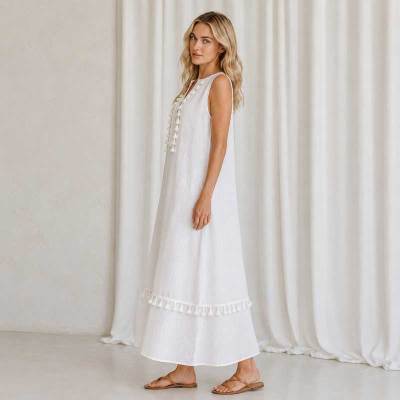
The formula rewards frequency, so the honest place to start is the category you already wear most. Linen dresses carry some of the highest wear counts in a warm-climate wardrobe, because one piece covers a full outfit on the days that matter.
Browse the linen dress collection and check the weight on each listing before you run the audit. The gsm figure tells you which seasons the piece covers, and the seasons tell you the denominator.