Buying Guide
Corporate and Team Gifting with Linen: Ordering, Lead Times, Sizing
Short answer: run a team linen gift as a small production order, not a shopping trip. Fix three dates first, collect sizes with a spreadsheet that has a hard deadline, choose garment shapes with built-in fit tolerance, and decide logo or no logo before you request a quote. That sequence removes most of the risk.
The Short Answer: Three Dates Decide Everything
A team linen order is a scheduling problem wearing a shopping costume. When it goes wrong, it is almost never because someone picked the wrong shirt. It goes wrong because the order was placed after the decoration window closed, because four people never sent a size, or because the box arrived at a warehouse instead of a desk.
So start with dates rather than styles. You need the date the gifts must be in people's hands, the date by which the order must be confirmed and paid, and the date by which every size must be locked. Work backwards from the first date and the other two appear on their own. Once those three dates are on a calendar, the rest of this guide is simply the detail that fills the gap between them.
Linen is a good fabric for this kind of order, and also an unforgiving one. It is a woven cloth with very little stretch, so a garment either has enough ease drafted into it or it does not. That makes the shape decision more important than in a jersey order, where a knit quietly absorbs a size of error. Choose shapes that carry tolerance and the size sheet can be approximate. Choose a fitted silhouette and the size sheet has to be perfect, which in a team of thirty people it will not be.
Why Team Orders Fail, and Why Linen Is Different
Four failure points account for most of the friction in corporate gifting. The first is late size collection: one reminder email is sent, half the team replies, and the order is placed with estimated sizes that later need exchanging. The second is decoration timing: embroidery or a woven label is added to the plan after the quote, which pushes the whole schedule back a week. The third is a distribution mismatch, where sixty pieces arrive at one office and have to be re-packed and re-shipped to five locations at the company's cost. The fourth is a stock surprise, where the piece chosen in the meeting is short in two sizes by the time the order is confirmed.
Linen adds two wrinkles of its own. Because the cloth does not stretch, fit tolerance has to come from the cut, not from the fabric. And because linen is usually garment-washed, the piece people receive is already at its final size: it will not shrink much further, but it also will not relax into a forgiving shape the way an unwashed cotton might after a few wears. What you approve in the sample is what the team gets.
Those wrinkles are manageable, and they are worth managing. Linen reads as considered rather than promotional. A garment-washed linen shirt in the 140 to 180 gsm range feels like something a person would buy for themselves, which is the actual bar for corporate gifting. The pieces that clear that bar get worn, and worn pieces are the only ones that keep working after the event.
The one-line version
Pick shapes that tolerate a size of error, collect sizes against a hard deadline, and decide decoration before you ask for a price.
Step 1: Fix the Three Dates Before Anything Else
Put the three dates in a shared calendar and invite the people who can actually approve spend. The table below is the back-plan most team orders settle into once decoration is involved. Treat it as a planning frame, then confirm the exact working days with the team handling your order, because production calendars move around holidays.
Back-plan for a decorated team order
| Milestone | When it happens | What is fixed at this point |
|---|
| Budget approved | 8 to 10 weeks before the event | Per-person ceiling, total headcount, currency |
| Piece shortlist agreed | 7 to 8 weeks before | Two or three styles, colours, size range |
| Quote requested | 7 weeks before | Quantities, decoration method, delivery address |
| Size sheet opens | 6 weeks before | Link sent, deadline published, owner named |
| Size sheet closes | 4 to 5 weeks before | Final size counts, no more changes |
| Order confirmed and paid | 4 weeks before | Stock reserved, decoration slot booked |
| Production and decoration | 2 to 4 weeks before | Nothing, unless a fault is found |
| Quality check and packing | 1 to 2 weeks before | Kits assembled, labels checked |
| Delivery | 7 to 10 days before | Buffer for the one box that goes astray |
The buffer at the end is not padding for comfort. It is the only thing standing between a shipping delay and an apology. If the event date is fixed and immovable, an order that lands ten days early costs nothing, while one that lands two days late has no recovery path. Where the calendar is tight, shorten the shortlist stage rather than the delivery buffer, because choosing between three shirts takes an afternoon and re-shipping sixty parcels takes a week.
If your event is the winter holiday season, the cut-off logic is stricter than for the rest of the year, because decoration queues and carrier volume both peak at the same time. There is a separate walkthrough of that timing in when to order linen so it arrives on time, and it is worth reading before you commit to a date in November or December.
Step 2: Build a Size Collection Sheet People Actually Fill In
The size sheet is where team orders are won. A good one takes ninety seconds to complete and asks for nothing a person would need to measure themselves for. A bad one asks for eleven fields, requires a tape measure, and gets a forty percent response rate.
Ask for five things and no more:
- Preferred size in the piece you are ordering, chosen from a short list rather than typed as free text.
- The size they normally wear in one named brand, so you can translate when their answer looks unusual.
- Height band, in four ranges, which is enough to flag who will need a longer or shorter length.
- Fit preference: close, regular, or relaxed. This decides whether you size up for them.
- Delivery location, if the team is split across offices.
Everything else is noise. Chest, waist and hip measurements sound rigorous, but asking a colleague to measure themselves introduces errors and delays that a brand-reference answer avoids. If you must have a real measurement, ask for waist in centimetres only, and only for trousers.
Size sheet columns and how to keep them clean
| Column | Format | Why it earns its place |
|---|
| Name | Text, required | Matches the packing label and the delivery list |
| Requested size | Dropdown: XS to 3XL | Prevents "medium-ish" from entering the order |
| Brand reference | Text, optional | Lets you correct a mismatch before it ships |
| Height band | Dropdown: under 160, 160 to 170, 170 to 180, over 180 cm | Flags length adjustments on trousers and dresses |
| Fit preference | Dropdown: close, regular, relaxed | Tells you whether to size up on a relaxed cut |
| Location | Dropdown of offices | Drives the packing and shipping split |
Set a hard deadline and put it in the calendar as an event people can see, not just a line in an email. Then publish the default rule: anyone who has not answered by the deadline receives the size they wear in the company polo, or a mid-range size in that person's height band. Publishing the fallback in advance converts a chase into an administrative step, and it removes the awkward conversation later.
Two practical refinements. First, allow one correction window of forty-eight hours after the sheet closes, then lock it and stop accepting changes; late edits are how a clean count turns into a re-order. Second, keep a single owner for the sheet. Shared ownership of a spreadsheet produces two versions, and two versions produce a packing error.
Step 3: Pick Garments With Built-In Tolerance
The fastest way to make a team order safe is to choose pieces whose fit tolerates being slightly wrong. In a woven fabric, that means ease: the difference between the garment measurement and the body it goes on. The table below shows the working windows, expressed as the range of body variation a piece can absorb and still look intentional.
Fit tolerance by piece, for team gifting
| Piece | Key measurement | Ease built in | Risk in a group order |
|---|
| Relaxed linen shirt | Chest | 10 to 14 cm | Low. The most forgiving clothing gift for mixed builds |
| Oversized linen shirt | Chest | 16 to 22 cm | Low, but the size range narrows at the small end |
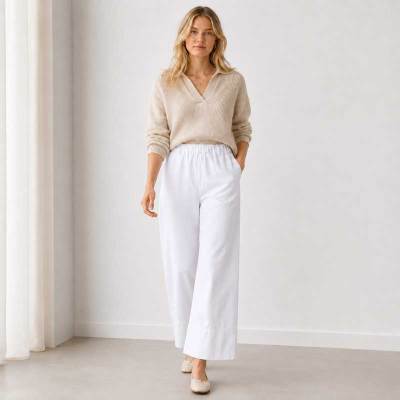
| Wide-leg trousers, elastic back | Waist and inseam | 6 to 8 cm of waist adjustment | Low to medium. Inseam needs a height band |
| Straight-leg trousers, fixed waist | Waist | 2 to 3 cm | High. Requires an accurate waist number |
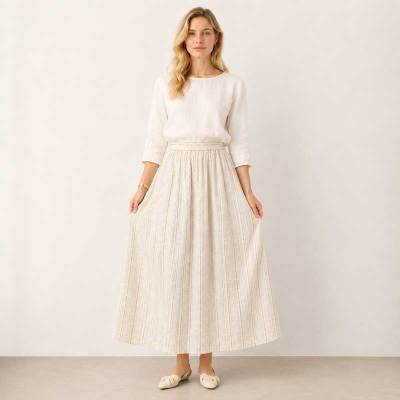
| A-line or tiered skirt | Waist | 3 to 5 cm | Low. Hip variation is absorbed by the flare |
| Fitted linen dress | Bust, waist, hip | 2 to 3 cm | High. Avoid for a group unless every size is measured |
| Scarf, apron, tote, napkin set | None | Not applicable | None. The safest option in the catalogue |
For a mixed team, the strongest combination is one tolerant garment plus one size-free accessory. A relaxed shirt in 140 to 180 gsm garment-washed linen covers nearly everyone, and a linen scarf, apron or tote covers the people whose size you never receive. That pairing also solves the headcount problem: if you order accessories for the full team and shirts for ninety percent of it, the two or three missing sizes stop being an emergency.
Fabric weight matters more than people expect. A 110 to 130 gsm linen is light and breezy, which suits warm climates and summer events but reads as thin in a corporate context. A 160 to 200 gsm linen has enough body to hold a collar and to feel substantial in the hand, and 200 to 240 gsm is a cool-weather weight that works for overshirts and trousers. For gifting, the middle band is the safest: heavy enough to feel like a gift, light enough to be worn most of the year. The fibre itself is traced to European Flax, which is the standard most buyers now ask about before they approve a purchase.
Step 4: Logo or No Logo, Decided Before the Quote
Decoration is the single decision most often made too late. It changes the cost, the lead time and the reversibility of any mistake, so it belongs in the first meeting rather than the last. There are four realistic options for a linen team gift, and each has a different failure mode.
Decoration options for linen team gifts
| Option | How it looks | Adds to lead time | Watch out for |
|---|
| No logo, branded packaging | A garment the person would wear anywhere | Nothing | Brand recall lives only on the box and card |
| Woven label at the inner neck | Discreet, premium, invisible when worn | Several working days | Needs a clean vector file and a label size decision early |
| Tonal embroidery, small chest placement | Subtle, reads as uniform rather than merchandise | Several working days plus a sample approval | Dense logos stiffen lightweight linen; keep stitch count low |
| Printed patch or hang tag | Removable, keeps the garment unbranded | Shortest of the decorated options | Attachment method must not mark the cloth |
Three questions decide which one fits. Is the gift meant to be worn outside work? If yes, tonal embroidery or no logo beats a large chest print, because a loud logo turns a good shirt into a uniform. Is the budget per person under roughly the price of the garment itself? If yes, packaging and a card carry the branding more cheaply than decoration. And is the design final? If the artwork is still moving between marketing and leadership, choose a removable patch so a late change costs a tag rather than a re-run.
One technical note specific to linen. The cloth has a visible, slightly irregular weave, and fine detail disappears into it. A logo with thin strokes, small text, or gradients will not read on linen the way it reads on a screen. Simplify to a solid mark, keep the smallest text at a size that survives the weave, and approve a physical sample on the actual fabric before the full run. That sample is the cheapest insurance in the whole project.
Skin-contact check
If the gift is a shirt worn against the skin for a full day, ask whether the dyeing and finishing are certified to a recognised standard such as OEKO-TEX. It is a reasonable question for a corporate purchase and a good line in the accompanying card.
Step 5: Back-Plan the Lead Time Week by Week
Lead time in a decorated order is not one number. It is a stack of stages, and the stack behaves differently depending on stock, decoration and destination. The useful way to plan is to know which stages run in parallel and which cannot start until the previous one finishes.
- Quote and stock check, two to four working days. Runs in parallel with nothing; it gates everything else.
- Sample or swatch approval, three to seven days. Can overlap with size collection, which is why the size sheet opens at the same time.
- Order confirmation and payment, one to two days. Starts the clock on stock reservation.
- Decoration, five to ten working days after stock is confirmed. Cannot start before the pieces exist in one place.
- Quality check and packing, two to four days. Where a wrong size is caught, if anyone is checking.
- Shipping, three to ten days depending on destination and service level, longer for split deliveries.
Add those stages and a comfortable decorated order sits at four to six weeks from confirmation, with a further week of buffer before the event. An undecorated order compresses to two to three weeks. A split delivery to five offices adds packing time and usually a day or two of transit, and it is the stage people forget when they count backwards from the event.
The compressible stages are sampling and packing. The incompressible ones are decoration and transit, because both depend on queues you do not control. When the calendar is tight, cut the shortlist to one piece and one colour, approve artwork from a digital mock plus a stock-fabric swatch, and accept a single delivery address with internal distribution. That trade is almost always better than paying for expedited freight on a order that has not yet been decorated.
For a single gift rather than a team order, the same logic applies at smaller scale; there is a separate guide on gifting linen without knowing the size that covers the one-person case.
Step 6: Quantities, Budget Bands and the Cost of Small Runs
Corporate budgets are usually expressed per head, and the per-head figure hides the real structure of the cost. Three components move independently: the garment, the decoration, and the logistics. Decoration has a fixed setup element, so its per-unit cost falls sharply as quantity rises. Logistics has a fixed shipping element per destination, so its per-unit cost falls with consolidation. The garment itself scales almost linearly, with modest breaks at volume.
That structure produces a useful rule. If the per-head budget is tight, spend it on one good garment rather than two cheaper ones, and put the branding on the packaging. Two thin pieces read as a promotional giveaway; one substantial shirt reads as a gift. A 160 to 180 gsm garment-washed shirt, folded into a printed box with a card, costs less per head than a shirt plus a tote plus a notebook, and it lands better.
- Under a modest per-head ceiling: one size-free accessory per person, branded packaging, no decoration on the cloth.
- Mid ceiling: one relaxed shirt or wide-leg trouser per person, woven neck label, unbranded exterior.
- Higher ceiling: a two-piece set, tonal embroidery, individual names on the packing card rather than the garment.
Watch the small-run penalty. Below a few dozen units, setup costs dominate and the per-unit price can look unreasonable next to retail. That is not a markup on the garment; it is the fixed cost of setting up a decoration run for a small batch. If the headcount is genuinely small, the better answer is often an undecorated order plus custom packaging, which avoids the setup entirely. If the budget conversation is happening around a gift price point rather than a corporate one, the logic in where the value actually is under a hundred maps onto team orders as well.
Ask for the quote broken into those three lines rather than one total. A single number cannot be optimised and cannot be defended to finance. A three-line quote lets you move budget between garment and packaging without renegotiating the whole order, and it makes a later quantity change a simple arithmetic exercise instead of a new negotiation.
Step 7: Packaging, Kitting and Getting Boxes to the Right Desk
The last mile of a team gift is logistics, and it is where a well-run order still manages to disappoint. Sixty identical parcels arriving at a reception desk with no names on them creates an hour of work for someone and a week of "did you get yours?" messages. Fix it with labelling, not with more spending.
Three packaging patterns work, in ascending order of effort:
- Bulk to one address, individually labelled. Each piece is folded with a named card and a size sticker on the outside of its inner bag. Cheapest per unit, needs one person to hand out boxes.
- Kits per person, shipped in batches by office. Each kit contains the garment, a care card and a note. Costs a little more in packing time, removes all on-site sorting.
- Direct-to-home. The most personal and the most expensive, and it requires a clean address list with correct postal codes before the order closes.
Whatever the pattern, put the name and size on the packing slip, not just on the outside of the box. If a parcel is opened by the wrong person, the slip is what gets it back to the right one. And include a care card: linen is easy to look after, but people who are used to cotton will wash it too hot and dry it too hard. A short card that says cool wash, line dry, and steam rather than press prevents the garment from becoming a slightly smaller garment by February.
For kit composition, the pieces that work together without looking like a hamper are a garment plus one small accessory, or a set of two accessories for the size-free option. There is a fuller treatment of what belongs in a considered set in building a linen gift set that looks considered, including how many items before a set starts to feel like clutter.
Sizing Edge Cases: Petite, Tall, Between Sizes and Pregnancy
Every team has four or five people the standard size grid does not serve well, and those are the people whose gift quietly goes unworn. Handle them deliberately rather than hoping the sheet captures them.
Petite. A relaxed shirt at 70 cm centre-back length will hang past the hip on someone 155 cm tall, which changes the proportion but not the fit. That is usually fine for a shirt and usually not fine for a trouser, where a 78 cm inseam needs taking up by 8 to 10 cm. Ask for height and plan a hem, or choose a cropped or shorter cut for the petite group.
Tall. The reverse problem. A standard trouser will sit above the ankle, which reads as deliberate in summer and as a mistake in winter. If several people are over 185 cm, choose a longer inseam option or a wide-leg cut that is meant to break at the shoe.
Between sizes. In a woven linen shirt, size up. The ease is drafted for a relaxed look, so one size up reads as intentional and one size down reads as strained across the chest. In an elastic-back trouser, stay with the smaller size if the waist is the deciding measurement, because the elastic accommodates the difference.
Pregnancy and post-partum. Do not guess. Offer the size-free option, or ask privately whether the person would prefer an accessory or a gift card. A relaxed shirt in a larger size is a reasonable second choice; a fitted dress is not.
For the broader question of how a linen garment is supposed to sit, the site's size and fit guide sets out the exact measurement points and the ease each cut is drafted with. Read it before you promise the team that anything can be swapped after delivery.
Cross-Border Teams: Duties, Windows and Split Addresses
A team spread across three countries turns one order into three. Each destination has its own transit time, its own import threshold and its own chance of a customs delay, and those risks multiply rather than average out.
Three habits keep a multi-country order predictable. First, consolidate to one address per country rather than shipping to individuals, then distribute internally. That single change usually removes most of the per-parcel cost and nearly all of the address errors. Second, confirm who is the importer of record before the goods ship, because a gift shipment still has a customs entry and the receiving company may need to provide a tax number. Third, keep the declared description accurate and boring: "linen shirt, woven, women's" clears faster than a creative description, and an under-declared value creates a problem that costs more than the duty saved.
Timing deserves its own buffer. Domestic transit is measured in days; international transit is measured in weeks when something goes wrong, and the thing that goes wrong is usually paperwork rather than distance. If the event is fixed, ship international destinations two weeks earlier than domestic ones and treat that gap as non-negotiable. If a destination is genuinely unreachable in time, send a card and a gift card rather than a parcel that arrives after the event; a late gift is worse than a promised one.
Finally, check the invoice details before payment clears. Company name, VAT or tax identifier, and a contact who will answer a customs query are the three fields most often missing, and each one can hold a shipment for days. Send them with the order confirmation rather than after the first delay notice.
A Worked Example: Forty People, Four Weeks, One Budget
Here is how the decisions fit together when the calendar is short. Forty people, one budget per head, four weeks to the event, two offices, and a leadership team that wants the company mark on the gift.
Week minus four. The shortlist collapses to one relaxed shirt and one wide-leg trouser, both in a mid-weight garment-washed linen, in two colours. Decoration is settled as a tonal woven neck label rather than embroidery, because embroidery needs a sample approval the calendar cannot absorb. The quote is requested with three lines: garment, label, logistics.
Week minus three. The size sheet opens with five columns and a deadline nine days out. The default rule is published in the same message: no reply by the deadline means the size the person wears in the company polo. Accessories are added for anyone who asks to opt out of sizing, which handles the two edge cases without a separate conversation.
Week minus two. The sheet closes at thirty-eight responses. Two people are defaulted, one of whom replies within the correction window. The order is confirmed and paid, stock is reserved, and the label run is booked. Packing is planned as two office batches with named cards, not individual shipping.
Week minus one. Quality check catches one trouser with a mismatched leg length and one shirt with a skipped stitch at the placket; both are replaced from stock before packing. Forty named kits are assembled, each with a care card. Parcels ship to the two offices with five working days of buffer.
The order lands four days early. Nobody exchanges anything, because the tolerant shapes absorbed the two defaulted sizes, and the two edge cases received accessories rather than a guessed size. The lesson is not that the plan was clever; it is that every risky decision was made early enough to be reversible.
What to Confirm in Writing Before You Pay
A purchase order protects the buyer only if it names the things that can go wrong. Put these eight points in the confirmation email and ask for them to be acknowledged in the reply. It takes ten minutes and prevents most disputes.
- Exact piece, colour and fabric weight in gsm, with the approved swatch reference.
- Size breakdown by size, not just the total quantity.
- Decoration method, placement, and the approved artwork version.
- Confirmed delivery date, and whether it is a ship date or an arrival date.
- Delivery addresses with contact names and phone numbers.
- What happens if a size is out of stock: substitute, refund, or wait.
- The exchange window and who pays return freight for a sizing swap.
- Payment terms, currency, and what the invoice will say.
Point six is the one people skip, and it is the one that decides whether a short stock situation becomes a calm substitution or a crisis in the last week. Point seven matters because a team gift produces exchanges even when the sizing is good, and the difference between a prepaid return label and a customer-paid one is the difference between a good experience and a complaint.
Ask for the arrival date, not the ship date
Suppliers quote what they control. If the confirmation says "ships by the 12th", ask what that means for arrival at your address, and add the transit days yourself.
Pre-Order Checklist
Run this list the day before you approve the order. Each line has caught a real problem in a real order at some point, and none of them takes more than a minute to check.
- Event date confirmed with the person who owns the event, in writing.
- Order-by date is at least four weeks before the event for a decorated order.
- Size sheet closed, defaulted responses recorded, corrections applied.
- Total quantity matches the headcount plus a small buffer for damage.
- Fabric weight and colour approved on a physical swatch, not a screen.
- Decoration artwork approved at final size on the actual cloth.
- Delivery addresses confirmed, including floor and receiving hours.
- Named cards printed and matched to the packing list.
- Care cards included in every kit.
- Exchange path and return freight terms confirmed in writing.
If any line is blank, the order is not ready. The two that most often get waved through are the physical swatch and the artwork at final size, and those are precisely the two that cannot be fixed after production starts. A colour that looked right on a monitor and a logo that looked crisp at 300 pixels both behave differently on a woven cloth.
Quick Answers
How far in advance should a team linen order be placed?
Plan on four to six weeks from confirmation for a decorated order and two to three weeks for an undecorated one, then add a week of buffer before the event. The decoration stage and international transit are the two parts that cannot be compressed, so protect them first and shorten the shortlist stage instead.
What is the safest linen gift for a team whose sizes are unknown?
A size-free accessory such as a scarf, apron or tote, paired with a relaxed shirt for everyone who did send a size. The accessory covers the missing responses and the edge cases, and the shirt covers the majority, so no one receives something that does not fit.
Does embroidery work on lightweight linen?
It works, but dense stitching stiffens a 110 to 130 gsm cloth and can pucker around the edges of the design. Keep the stitch count low, simplify the mark to a solid shape, and approve a sample on the actual fabric. A woven neck label is the lower-risk option when the cloth is light or the deadline is short.
What happens if one size runs out mid-order?
Agree the substitution rule before you pay. The three workable options are a different colour in the same size, a comparable piece in the same size, or a refund for that unit. Whichever you choose, get it acknowledged in the confirmation so the decision is not being made in the last week under time pressure.