Circular Fashion: How to Give Old Linen a Second Life
Circular Fashion: How to Give Old Linen a Second Life
The short answer: old linen has five real second lives, and they run in a fixed order of value. Repair it first, because a darned seam or patched elbow costs almost nothing and adds two to five years of wear. Restyle or remake it second, since a tailor can turn a wide-leg pair of linen wide-leg pants into shorts for a fraction of the price of new ones. Resell it third while it still holds shape, donate or swap it fourth when it is wearable but no longer yours, and recycle or compost it last, when the cloth is genuinely finished. Linen is unusually good at this loop because it is a long-staple cellulose fibre that gets stronger when wet, tolerates heat, and is very often a single-material garment, which makes both repair and fibre recycling simpler than they are for a polyester blend. This guide walks through each stage with the numbers that matter: what repairs cost, what resale actually returns, how to read a care label before you decide, and how to compost or recycle the pieces that nothing else can save.
What Circular Fashion Means for a Linen Wardrobe
Circular fashion is not a synonym for recycling. It is a design and ownership logic in which a garment is treated as a material resource that keeps moving through use, rather than as a product that ends at the bin. In a circular wardrobe, the question after "do I still want this?" is not "where do I throw it?" but "what is the highest-value next use?"
For linen specifically, that logic fits the fibre. Flax is grown as a bast fibre, which means the usable fibre runs the length of the stem rather than forming short cotton-like staples. Long fibres can be spun into fine yarn, then plied and woven into cloth that holds together through repeated washing, pressing and abrasion. A 100% European Flax linen shirt at 160 to 190 gsm is not a fragile object. It is a piece of cloth that has already survived harvest, retting, breaking, scutching, spinning, weaving and a garment wash before it ever reaches a hanger.
That durability changes the arithmetic of ownership. Fast-fashion economics assume a garment is worn a limited number of times and then discarded. Circular economics assume the opposite: that the cloth will outlive the trend that prompted the purchase, and that the owner's job is to route it onward intelligently. The practical version of that idea needs no certification, no app and no collection scheme. It needs an order of operations.
The order matters because the options are not equal. Repair preserves the embedded energy, water and labour already in the garment. Resale transfers it to a new owner intact. Recycling breaks the cloth back into fibre, which is valuable but always a step down in quality unless the fibre is long enough to re-spin into a comparable yarn. Composting returns the carbon and nutrients but ends the garment's life as clothing. Do the high-value steps first, and the low-value steps only when the higher ones are genuinely impossible.
Why Linen Takes a Second Life Better Than Most Fabrics
Four properties make linen unusually cooperative at the end of a first ownership.
It gains strength when wet. Flax fibre is roughly 20 percent stronger damp than dry, which is why linen can be washed hot, scrubbed, boiled and pressed without the fibre fatigue that damages weaker cellulosics. A stained or stretched linen garment is often recoverable by methods that would ruin a viscose blouse.
It tolerates heat. Linen can be ironed at high temperature and tumble dried on low to medium heat, which makes it one of the few fabrics where a home wash-and-press routine can restore a garment to near-original appearance rather than merely cleaning it.
It is often mono-material. A pure linen shirt is linen cloth, cotton thread and usually shell buttons. That simplicity is what makes both home repair and industrial recycling feasible. A polyester-cotton-linen blend, by contrast, has to be sorted, separated or downcycled into lower-grade products. When you are choosing new linen, the fibre content line on the label is effectively a recyclability score.
It shows its history gracefully. Linen softens with every wash, and the softening is cumulative rather than cosmetic. A five-year-old garment-washed linen shirt at 180 gsm does not look "worn out" the way a pilled synthetic knit does; it looks relaxed, with a slight surface bloom at the weave. That visual ageing is why secondhand linen photographs well and resells better than most secondhand basics.
There is a limit, and it is honest to name it. Linen abrades at high-friction points: collar fold, cuffs, underarm seam, seat, knee. It also creases sharply along fold lines if stored compressed for months. Those are the two failure modes worth inspecting for, and both are repairable far more often than owners assume. The durability profile of linen is high, but it is not uniform across the garment.
The Linen Second-Life Hierarchy
Use this as the decision table. Read down from the top and stop at the first row that genuinely applies to the garment in front of you.
| Priority | Route | Best for | Typical cost or return | Effort | What it preserves |
|---|---|---|---|---|---|
| 1 | Repair | Snags, split seams, small holes, worn cuffs, loose buttons | 0 to 25 USD, or free if you sew | 20 to 90 minutes | Whole garment, full material value |
| 2 | Restyle or remake | Good cloth, wrong fit, dated cut, damaged hem | 20 to 60 USD at a tailor | 3 to 10 days | Cloth and most of the construction |
| 3 | Resell | Clean, intact, in-demand size and colour | 25 to 40 percent of retail | 30 to 60 minutes of listing work | Garment as a wearable item |
| 4 | Donate or swap | Wearable but low resale value | 0 USD, possible tax receipt | 15 minutes | Wearability for someone else |
| 5 | Recycle, downcycle or compost | Torn, stained beyond recovery, worn through | 0 USD, occasionally a small payout | 15 to 45 minutes | Fibre or nutrients, not the garment |
Two rules keep the table honest. First, never skip a row because it feels like effort. A ten-minute seam repair on a 180 gsm linen shirt is worth more, in material terms, than any recycling scheme will ever recover from the same garment. Second, do not force a garment up the hierarchy. A shirt with a torn out underarm and three bleach spots is not a repair candidate; pretending otherwise just postpones the decision.
- If it fits and the damage is smaller than a coin: repair it.
- If the cloth is sound but the shape is wrong: restyle it.
- If it is intact and in a common size: resell it.
- If it is intact but low value or an unusual size: donate or swap it.
- If it is structurally finished: recycle, downcycle or compost it.
Step 1: Audit Your Linen Before You Let It Go
Most linen is discarded for reasons that have nothing to do with the cloth: a button, a hem, a stain that was never treated correctly, a fit change of a few centimetres. A twenty-minute audit once a season prevents that.
Lay every questionable piece flat in good light and run five checks in order.
- Structure. Hold the garment up and look through it toward a lamp. Pinpoint holes are repairable. A tear longer than 5 cm across a high-stress seam, or cloth that pulls apart under light finger tension, is not.
- Stains. Distinguish a stain from dye loss. A stain sits on the surface and can usually be lifted with an oxygen-based bleach soak in 40 degrees C water for 30 to 60 minutes. A bleached patch is missing colour and cannot be restored by cleaning. Check the stain removal routine for linen before writing a piece off.
- Fit. Note specifically what changed: shoulder, waist, length, sleeve. A waist or length change is a tailor job under 40 USD. A shoulder change on a lined garment usually is not worth it.
- Fabric condition. Feel the collar fold, cuffs, underarm and seat. Thinning that you can see through when held to light means the cloth is near the end of its wearable life, even if the garment still looks fine hanging.
- Sentiment and frequency. Count the wears in the last twelve months. Zero wears plus intact cloth is a resale or swap decision, not a repair decision.
Sort the results into three piles: repair, release, and finish. Keep the piles physical and separate, because a "maybe" pile is where garments go to sit for another three years. If you want the audit to take ten minutes instead of twenty, do it at the seasonal wardrobe change, when everything is already out of storage.
Step 2: Repair Is the Highest-Value Move You Can Make
Repair wins on economics and on material accounting. A 10 USD seam repair on a garment that originally cost 90 USD preserves 90 USD of value and every stage of processing already invested in the cloth. Recycling the same garment recovers a fraction of the fibre and none of the construction.
The four repairs that cover most linen damage:
- Snags and pulled threads. Never cut a pulled thread. Work it back to the wrong side with a blunt needle, then press. Cutting it creates a hole within a few washes.
- Split seams. Turn the garment inside out, match the original stitch line, and sew with a short straight stitch 2 to 3 mm from the fold. Linen frays easily, so overcast or zigzag the raw edge afterwards.
- Small holes. Darn with matching-weight thread in rows 2 mm apart, then turn 90 degrees and weave across. On a visible area, a deliberate contrast darn in a similar-weight linen patch reads as a design choice rather than a repair.
- Worn cuffs and collars. Bind the edge with a 2 cm strip of matching linen, or take the sleeve up 1 to 2 cm to move the wear line. Both are under an hour of work.
For anything beyond a straight seam, follow a proper method rather than improvising. The guide to repairing and mending linen covers darning patterns, patch placement and how to stabilise a frayed edge before it spreads. The short version of the decision rule: if the damaged area is smaller than a coin and not on a seam under tension, repair it yourself. If it is larger, or sits where the fabric moves constantly, pay a tailor.
Two habits extend the interval between repairs. Wash linen less often than you think necessary, because most odour leaves with airing overnight; and dry flat or line dry rather than tumble drying on high heat, which abrades the weave at fold points. Both are covered in the general linen care and maintenance guide.
Step 3: Restyle and Remake What No Longer Fits
Restyling is the overlooked middle ground between repair and resale. It is also where the biggest recoverable value sits for garments whose cloth is fine but whose cut has dated or whose fit has drifted.
Five remakes that work reliably with linen, and what they cost at an average alterations shop:
- Wide-leg pants to shorts. Hem to just above the knee, keep the original hem allowance, re-stitch. Expect 15 to 30 USD. Wide-leg linen shorts are a genuinely current silhouette, so the result does not read as a compromise.
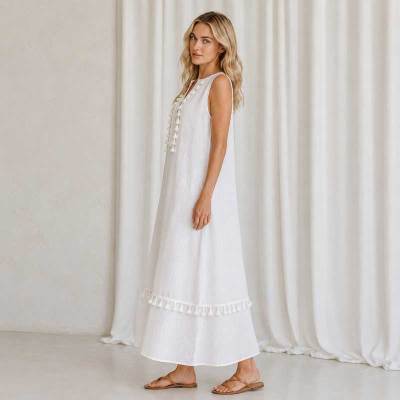
- Maxi dress to midi or knee length. 20 to 35 USD. Keep the cut-off fabric: it becomes a matching scarf, a pocket bag or patch material.
- Oversized shirt to fitted shirt. Take in the side seams and shorten the sleeve. 25 to 45 USD. Only worth it if the shoulders already fit, since shoulder adjustment is the expensive operation.
- Shirt to apron, tote or cushion covers. A single large shirt yields enough cloth for two 45 cm cushion covers if you exclude the collar and cuffs. Home sewing only, effectively free.
- Two damaged garments into one. A torn shirt body plus intact sleeves from another can become a single patched shirt. This is the highest-skill option and the one that most often produces something you will actually wear.
Restyling has one hard constraint: respect the grainline. Linen drape depends on the warp and weft running straight, and a piece cut on the bias from an old garment will hang differently from the original. If you are cutting down a garment, cut parallel to an existing seam rather than to the print or the hem.
The pieces you remove are not waste. Offcuts from a 20 to 40 cm hem make drawstring bags, hair ties, quilt patches, glasses cases and garden ties. Keep a single box for linen scrap and it will absorb most of the small textile waste a household generates.
Step 4: Resell Linen Without Underselling It
Secondhand linen sells because the fibre has a reputation that polyester does not: buyers search for it by name. The mistake sellers make is pricing it like generic used clothing instead of pricing it like a fibre-led purchase.
A working pricing formula: start at 35 to 40 percent of original retail for excellent condition, 25 to 30 percent for good condition with visible softening, and 15 to 20 percent for well-worn but intact pieces. Then adjust for size and colour. Neutral colours (natural, oatmeal, black, white, olive) and the middle sizes move fastest; very small and very large sizes sit longer and should be priced at the lower end of the band.
| Garment | Excellent | Good | Well worn | What buyers check first |
|---|---|---|---|---|
| Linen dress | 35 to 40% | 25 to 30% | 15 to 20% | Underarm discolouration, hem length |
| Linen shirt | 35 to 40% | 25 to 30% | 12 to 18% | Collar and cuff wear, missing buttons |
| Linen pants | 30 to 35% | 22 to 28% | 12 to 18% | Seat thinning, crotch seam, hem drag |
| Linen set | 40 to 45% | 28 to 35% | 18 to 22% | That both pieces are included and match |
| Linen jacket or blazer | 30 to 40% | 22 to 30% | 10 to 15% | Shoulder shape, lining condition, buttons |
The listing itself does most of the selling. Photograph on a hanger against a plain wall in daylight, then photograph the label showing fibre content, the care label, and any flaw in close-up. State the measurements flat: chest, waist, length, inseam. Write the words buyers actually search: 100% linen, European Flax, garment washed, the weight if you know it, and the fit. A shirt described as "linen shirt, size M" competes with thousands of listings. A shirt described as "100% European Flax linen shirt, 180 gsm, garment washed, relaxed fit, chest 58 cm, length 76 cm" competes with almost none.
Disclose flaws explicitly and price them in. A visible darn or a faint mark is not a deal-breaker for a buyer searching specifically for linen; an undisclosed one is a return and a bad rating. Bundling helps too: two shirts and a pair of shorts sold as a single lot usually nets more than three separate listings with three sets of shipping and three sets of fees.
Step 5: Donate, Swap and Pass It On Properly
Donation is not a bin with better branding. What happens to a donated linen garment depends entirely on whether it is wearable, and the difference is decided before it leaves your house.
Three conditions make a donation genuinely useful: the garment is clean, it is intact, and it is in season. Charities routinely discard items that arrive dirty, wet or structurally damaged, and those items then enter a waste stream at the charity's cost. Wash and dry everything first. Repair loose buttons and open seams first. Bag by category and label the bag if the organisation asks for it.
- Best fit for charity shops: clean, intact, current-season garments in standard sizes.
- Best fit for clothing swaps: good-condition pieces in unusual sizes or strong personal style, which move poorly in shops but well between individuals.
- Best fit for textile banks: worn but clean items, which are sorted for fibre recovery rather than resale.
- Not a donation: stained, torn, mildewed or wet garments. Those belong in textile recycling, not in a charity bag.
Swaps deserve more credit than they get. A local swap, a workplace clothing exchange or a friend with a similar build can move a garment to a second owner in an afternoon with no shipping, no fees and no sorting. For linen specifically, swaps work well because the fibre is neutral in style: a plain linen shirt reads the same in most wardrobes.
If you are donating linen that still has years left, attach a small care note. A line explaining that the garment is 100% linen, has been garment washed, and should be washed cool and line dried makes it more likely the next owner keeps it long enough to matter. Education is part of circularity, not a marketing extra.
Step 6: Recycle and Downcycle the Unwearable
When a linen garment is genuinely finished as clothing, the fibre still has value. Pure linen is one of the easier textiles to recycle mechanically because it does not need to be separated from a synthetic partner.
Prepare it properly before it goes anywhere:
- Wash and dry it. Contaminated textiles are rejected or downgraded.
- Remove hardware. Buttons, zips, snaps, hooks, elastic and interfacing all come off. Metal and plastic contaminate a fibre batch.
- Cut out worn panels. A collar that has thinned to transparency will shorten the recycled fibre; removing it improves the yield quality.
- Bag by fibre. Pure linen in one bag, linen-cotton in another, blends in a third. Mixed bags get downcycled by default.
- Deliver to a textile recycler or in-store collection point that explicitly accepts worn textiles, not a charity shop.
Mechanical recycling shreds the cloth back to fibre, and the fibre length shortens in the process. Recycled linen is therefore usually spun into coarser yarns for insulation, wiping cloths, packaging, upholstery interlining or non-woven products rather than a new 180 gsm shirt. That is not a failure of the system; it is the reason repair ranks above recycling.
Home downcycling often beats the industrial route for a single garment. A worn linen shirt becomes four or five cleaning cloths, a set of kitchen towels, garden ties, a bread bag, or quilt batting. A worn linen sheet is one of the best dust cloths available: lint-free, absorbent, and soft enough for glass. Cut with pinking shears to limit fraying, or overcast the edges if the piece will be washed repeatedly.
Composting Linen: The End-of-Life Route Most Clothes Never Get
Pure linen is plant fibre and it composts. That single fact gives a linen wardrobe an end-of-life option that almost no synthetic garment has, and it is worth using deliberately rather than accidentally.
Compost only 100% linen, or linen with cotton thread. Remove everything else first: polyester thread, elastic, fusible interfacing, buttons, zips, printed transfers and any finish you cannot identify. Cut the garment into strips 5 to 10 cm wide, because whole garments mat down and compost slowly. Mix the strips into the active centre of a heap with roughly the same volume of green material, and keep the pile as moist as a wrung-out sponge.
Expect shredded linen to break down over one to two seasons in a well-managed heap, faster in summer and slower in a cold winter pile. Dyed linen composts, but heavily dyed dark cloth can leave visible colour in the finished compost for the first few months; it is harmless, and it disappears with turning. If you only have a small worm bin, limit linen to thin strips and small quantities, since the worms need time to work through dense weave.
Check the full picture on whether linen is biodegradable before you compost anything with a lining or a blended label. The fibre is biodegradable; the garment is only biodegradable if everything in it is.
For anyone who wants the whole loop, this is the cleanest end: a linen shirt that was grown, woven, worn for a decade, repaired twice, then returned to soil. Nothing in that sequence requires a collection scheme.
Buying New Linen So It Can Circle Back
Circularity is decided at purchase more than at disposal. Five choices make the second life possible years later.
- Choose mono-material. 100% linen with a cotton thread. A linen-viscose or linen-polyester blend is comfortable and cheaper, but it removes repair ease, resale clarity and fibre recycling in one move.
- Choose a weight that can take repair. 110 to 150 gsm is light and lovely but less forgiving of patching. 160 to 240 gsm holds a darn, keeps its shape and survives more wash cycles. A 180 to 200 gsm shirt is the sweet spot for a long-life garment.
- Choose construction you can open. Generous seam allowances and flat-felled seams can be let out and remade. Narrow overlocked seams cannot. Turn a garment inside out before buying and look at the seam finish.
- Choose colour that survives repair. Natural, oatmeal, black, navy and olive are easy to match with repair thread and patch cloth. A complex print is not.
- Choose one garment instead of three. The most circular purchase is the one you do not make. If you are rebuilding a wardrobe, the case for linen as a slow fashion essential is less about virtue and more about cost per wear.
KOSSR linen is 100% European Flax, garment washed before it ships, and specified at 110 to 240 gsm depending on the style, with fibre content and weight stated on the product page. Garment washing matters for circularity in a practical way: the fabric has already been through its first shrinkage and softening cycle, so the garment you resell or hand on is close to its final dimensions rather than a size that will shift after two washes. That makes sizing honest for the second owner, which is exactly what a resale listing needs.
Cost per wear is the number that settles the argument. A 120 USD linen dress worn 60 times a year for five years costs 0.40 USD per wear. A 40 USD dress worn eight times costs 5 USD per wear. The circular wardrobe is usually the cheaper one, and it is cheaper because the garments stay in use.
A Twelve-Month Circular Linen Calendar
Circularity fails from neglect rather than from principle. Spread the work across the year in small blocks and it never becomes a purge.
| When | Task | Time | Why this season |
|---|---|---|---|
| Early spring | Audit the warm-weather pieces; repair seams and buttons before first wear | 60 minutes | Damage is still small and the garment has months of use ahead |
| Late spring | Wash and store the heavy winter linen with cedar or lavender | 45 minutes | Prevents fold-line creasing and damp storage marks |
| Midsummer | Treat stains the week they happen; do not let them set | 15 minutes per item | Fresh protein and tannin stains lift; aged ones often do not |
| Early autumn | List two or three unworn pieces for resale | 60 minutes | Autumn buyers search for layering pieces and sets |
| Late autumn | Review the winter linen; check cuffs, collars and elbows | 30 minutes | Repairs done now last the whole cold season |
| Year end | Donate or swap the release pile; bag textile waste for recycling | 45 minutes | Clears space before gifting season adds new items |
Two maintenance habits belong on the calendar permanently. Store linen folded rather than on a thin wire hanger, which distorts the shoulder over months. And keep a small repair kit with the laundry: matching thread in natural, black and white, a blunt needle, small scissors, a 15 cm square of spare linen and a thimble. Repair happens when the kit is within reach; it does not happen when the needle is in a drawer upstairs.
Five Myths About Old Linen
"Once linen is worn, it is finished." Linen fails at friction points, not everywhere at once. Cuffs, collars, elbows, knees and seats wear first while the body cloth is intact, which is precisely the pattern that makes patching and binding effective.
"Secondhand linen is second-rate." Garment-washed linen improves with washing. A five-year-old 180 gsm shirt is usually softer and drapes better than the same shirt when new, and buyers who know linen search for exactly that.
"Recycling is the responsible default." Recycling is the lowest-value recovery route. It consumes energy, shortens fibre and produces a coarser yarn. Repair and resale preserve far more of the original material and labour.
"Linen blends are just as recyclable." They are not. A linen-polyester blend has to be separated or downcycled, and most mechanical recyclers will not take it at all. Fibre purity is the single biggest determinant of recyclability.
"Donating is always better than throwing away." Only if the item is wearable. Soiled or torn donations cost charities money to dispose of, and they often end up in the same waste stream with an extra journey attached.
Frequently Asked Questions
How many times can linen be recycled?
Mechanically, linen fibre can be re-shredded and re-spun several times, but each cycle shortens the fibre and lowers the yarn quality. In practice, recycled linen usually becomes a coarser product such as insulation, wiping cloth or packaging rather than a new fine shirt. That is why repair and resale come first: they keep the long fibre intact.
Can I put old linen in a clothing donation bin if it has a small hole?
Yes, if the hole is small and the garment is clean. A repair someone else can do in ten minutes is not a reason to discard. If the cloth is thin enough to see light through, put it in a textile recycling stream instead, because it will not survive another owner's wear.
What is the most valuable second life for a linen dress?
Resale, if it is intact and in a common size, because a dress carries the highest resale percentage of any linen category at roughly 35 to 40 percent of retail in excellent condition. If the fit has changed, restyling to midi length or taking in the side seams recovers more value than donating it.
Does garment-washed linen last as long as loom-state linen?
It lasts as long in wear, and it starts softer. Garment washing does remove some surface fibre, but it also pre-shrinks the cloth and settles the weave, so the garment does not distort after the first home wash. For resale and hand-me-down purposes, that predictability is an advantage.
Start the Loop With One Piece
You do not need a collection scheme to run a circular linen wardrobe. Pick the garment you wear least, run the five checks, and put it in one of three piles today. If the cloth is still good, the next owner is already out there: browse the linen dresses that were built to be repaired, resold and worn for a decade rather than a season, and check the care notes before you buy so the first life lasts as long as possible.