How Linen Should Fit: A Guide to the Right Silhouette
How Linen Should Fit: A Guide to the Right Silhouette
Direct answer: Linen should fit with visible ease rather than tightness. Because linen is a woven fabric with no stretch, comfort comes from room to move, not from give in the cloth, so a linen shirt or blouse needs roughly 4–8 cm (1.5–3 in) of extra circumference across the chest compared with your body, a linen dress about 5–10 cm across the bust and hip, and linen pants about 4–7 cm at the waist and hip. The shoulder seam should sit on the shoulder bone, the fabric should not pull into creases when you close it or raise your arms, and the hem should cover the areas you want covered without floating far away from the body. A well-fitting linen garment looks relaxed but deliberate: it follows your silhouette with a little air around it, and it never fights you when you sit, reach, or breathe. When you are unsure between two sizes, size up for tops and dresses where drape matters, and choose the smaller size only for woven bottoms whose waistband already sits cleanly. This guide explains the ease each garment needs, how to read the five key measurements, how to tell a relaxed cut from an oversized one, and how garment-washed linen relaxes after the first wash. Start with the linen shirts to see how the allowances look in practice.
img prompt: A woman standing side-on in a softly lit studio wearing a relaxed stone linen shirt and wide-leg linen trousers, showing the drape and the gap between fabric and body at the waist, neutral beige backdrop, natural daylight, calm minimal fashion photography, warm earthy tones
Why Linen Is Judged Differently to Stretch Fabrics
Most people learn what “fits” means from jersey, denim and knitwear, and all three of those fabrics stretch. A cotton T-shirt can be pulled on without a fastening, a pair of jeans eases a centimetre after a day of wear, and a jumper simply follows whatever shape is underneath it. Linen does none of those things. It is a woven cloth made from a stiff, low-elasticity fibre, and once it is cut and sewn, its measurements are essentially fixed. That single fact is the reason a pair of linen trousers that felt right in the changing room can become uncomfortable after a long lunch, and the reason a linen shirt that looks crisp on a hanger can pull across the chest when you sit down.
The practical consequence is that linen has to be bought with the movement of the body already built in. In tailoring this allowance is called ease: the difference between the garment measurement and the body measurement it is designed to cover. A garment with no ease can only stand or lie still. A garment with the right ease lets you sit, reach, breathe and cross your legs while the fabric stays smooth. Because linen has almost no natural give, the ease has to be slightly more generous than it would be in a stretch fabric of the same supposed size. Two garments can both carry a size label “M” and fit differently, because the allowance is a design decision, not a size decision.
That is why buying linen by size label alone is unreliable and buying it by measured ease is reliable. The size label tells you very little about how the garment will feel; the numbers on the size chart tell you almost everything, provided you know your own body measurements and what a comfortable allowance looks like for each garment type. Learning three or four of those allowances is the fastest way to stop returning linen and start wearing it. It also explains why two people of identical height and weight can need different sizes in the same shirt: one prefers a close, tucked look, the other wants an untucked, airy one, and each look is produced by a different amount of ease rather than a different body.
There is also a texture dimension that stretch fabrics do not have. Linen is at its best when it hangs with a slight, deliberate looseness, because the fibre is meant to look airy and a little unstructured. A skin-tight linen shirt looks strained rather than sleek, and it creases in awkward places because the fabric has nowhere to go. A linen shirt with proper ease creases in long, soft folds that read as intentional. The fit and the aesthetic therefore point in the same direction: give linen enough room, and it both feels better and looks better.
The Five Numbers That Decide Any Linen Fit
Almost every fit question resolves into five measurements, taken in this order. If you learn to check them, you can judge a garment from its size chart without trying it on, which is exactly what you need when you buy linen online.
- Shoulder. The seam where the sleeve meets the body should sit on the point of your shoulder bone. If it hangs past the bone, the garment is too wide or is cut as a drop-shoulder style; if it ends before the bone, it will pull the neckline and restrict raising your arms.
- Chest or bust. This is the fullest circumference around your upper body. The garment should sit about 4–8 cm larger here for shirts and blouses and about 5–10 cm larger for dresses. Compare the size chart figure with your own, never with a size label.
- Waist. For trousers, the waistband should sit flat against you when standing without digging in. A linen waistband does not stretch, so a waistband that is tight when new will only become less comfortable, never more.
- Hip. Measure the fullest part of the hip or seat and allow about 4–7 cm for trousers and 5–10 cm for dresses and skirts, so the fabric can hang straight instead of gripping.
- Length. Sleeve length should end at the wrist bone; dress and trouser length depends on your intended styling, but a linen hem should always clear the floor and stay clear when you sit.
Shoulder and length are the two measurements that cannot be altered easily at home, so they should drive your size choice. Chest, waist and hip can all be taken in by a tailor for a modest cost, which means a garment that is slightly too generous in the body is a far better purchase than one that is slightly too tight in the shoulder or too short in the sleeve. If you are deciding between sizes, this is the single most useful rule: buy the size that gets the shoulder and length right, then have the body adjusted if you want a closer line. The full method for choosing between two sizes is set out in the guide to how to choose the right size.
Measuring yourself takes about two minutes and removes almost all of the guesswork. Use a soft tape measure, keep it level and snug but not tight, wear the undergarments you intend to wear with the garment, and write the numbers down so you can compare them with the size chart every time. Men should measure the chest at the widest point, women should measure the bust at the fullest point and the underbust separately, and both should measure the natural waist at the narrowest point of the torso rather than at the hipbone where low-rise trousers sit.
How Much Ease Each Linen Garment Should Have
The table below gives the range of ease that suits each type of linen garment, expressed as extra circumference beyond your body measurement. Treat the lower end as a close, tailored look and the upper end as a relaxed, untucked look. Both ends are correct; they simply produce different outfits, and neither should ever reach the point where the fabric pulls.
| Garment | Body measurement to compare | Comfortable ease | What it looks like |
|---|---|---|---|
| Linen shirt or blouse | Chest or bust | 4–8 cm (1.5–3 in) | Clean over the torso, room to close without pulling |
| Linen tunic or long top | Bust and hip | 6–12 cm (2.5–5 in) | Flows past the hip, reads as a relaxed layer |
| Linen dress (sheath or shift) | Bust and hip | 5–10 cm (2–4 in) | Follows the body with an air gap, no horizontal pull lines |
| Linen dress (A-line or maxi) | Bust only, then flares | 5–8 cm at bust | Structured shoulders, free below the waist |
| Linen pants or shorts | Waist and hip | 4–7 cm (1.5–2.75 in) | Straight fall from the hip, no strain across the seat |
| Linen wide-leg pants | Waist and hip | 6–10 cm (2.5–4 in) | Fluid drape, the leg does not cling or twist |
| Linen skirt | Waist and hip | 4–8 cm (1.5–3 in) | Sits flat at the waist, hangs without gripping |
| Linen set (two-piece) | Bust and hip, waist and hip | 5–10 cm each | Coordinated ease, pieces read as one silhouette |
Read the numbers as a starting point for a woven, non-stretch cloth. If you run warm, prefer airflow, or live in a humid climate, take the upper end of each range. If you want a sharp, tucked silhouette for an occasion, take the lower end and accept that sitting down will crease the fabric at the waist and hip, which is normal for linen and part of its character. What you should never do is buy a size that produces less ease than the lower figure, because there is no stretch to compensate and the garment will only get less comfortable over a long day.
One more consideration shapes the table. Garment-washed linen, which is pre-washed to soften it before it reaches you, typically relaxes a little further with the first few home washes, gaining perhaps a small amount of give as the fibre settles. So a garment at the lower end of the ease range can feel slightly closer after a month of wear, while one at the upper end stays loose. If you are between sizes and want the fit to stay as it is on delivery, the middle to upper range is the safer choice.
Should Linen Be Loose or Fitted?
The honest answer is that linen should be neither tight nor shapeless, and the difference between the two is the whole art of wearing it. A fitted linen shirt that hugs the torso shows every crease and defeats the purpose of the fabric; an oversized one that drops off the shoulders looks like a borrowed garment. The sweet spot is a relaxed fit that follows the outline of the body at a small distance, so the linen moves with you rather than on you.
A useful way to picture this is the one-finger rule, borrowed from tailoring. When you lift the fabric away from your torso at the side seam, you should be able to pinch roughly a finger to a finger-and-a-half of air, more at the back and less at the front. In a skirt or pair of trousers, the fabric should hang away from the leg by about a finger when standing, and the waistband should allow a finger to slide in comfortably. That small amount of clearance is what lets the cloth drape instead of strain, and draping is what makes linen look expensive rather than tight.
There is also a cultural expectation worth naming. Linen was historically a leisure fibre, and the relaxed, slightly rumpled look is part of its identity. Trying to force linen into a body-hugging silhouette works against that identity and produces an outfit that looks fussy rather than elegant. When you see linen styled well, whether in editorials or on the street, the common thread is space: a little room at the waist, a loose sleeve, a hem that swings. That is not a trend, it is the fabric behaving as it should, and it is also the most comfortable way to wear it in warm weather.
Where the “loose” instinct goes wrong is when it turns into oversizing. A garment is oversized when the shoulder seam drops well past the shoulder and the chest measurement is more than about 15 cm above your body. At that point the linen stops following any shape and begins to hang in vertical folds from the shoulder, which flattens the body rather than flattering it. A relaxed fit follows the frame with air around it; an oversized fit ignores the frame completely. Choose the first, and size down if you find yourself in the second.
How Linen Shirts, Blouses and Tops Should Fit
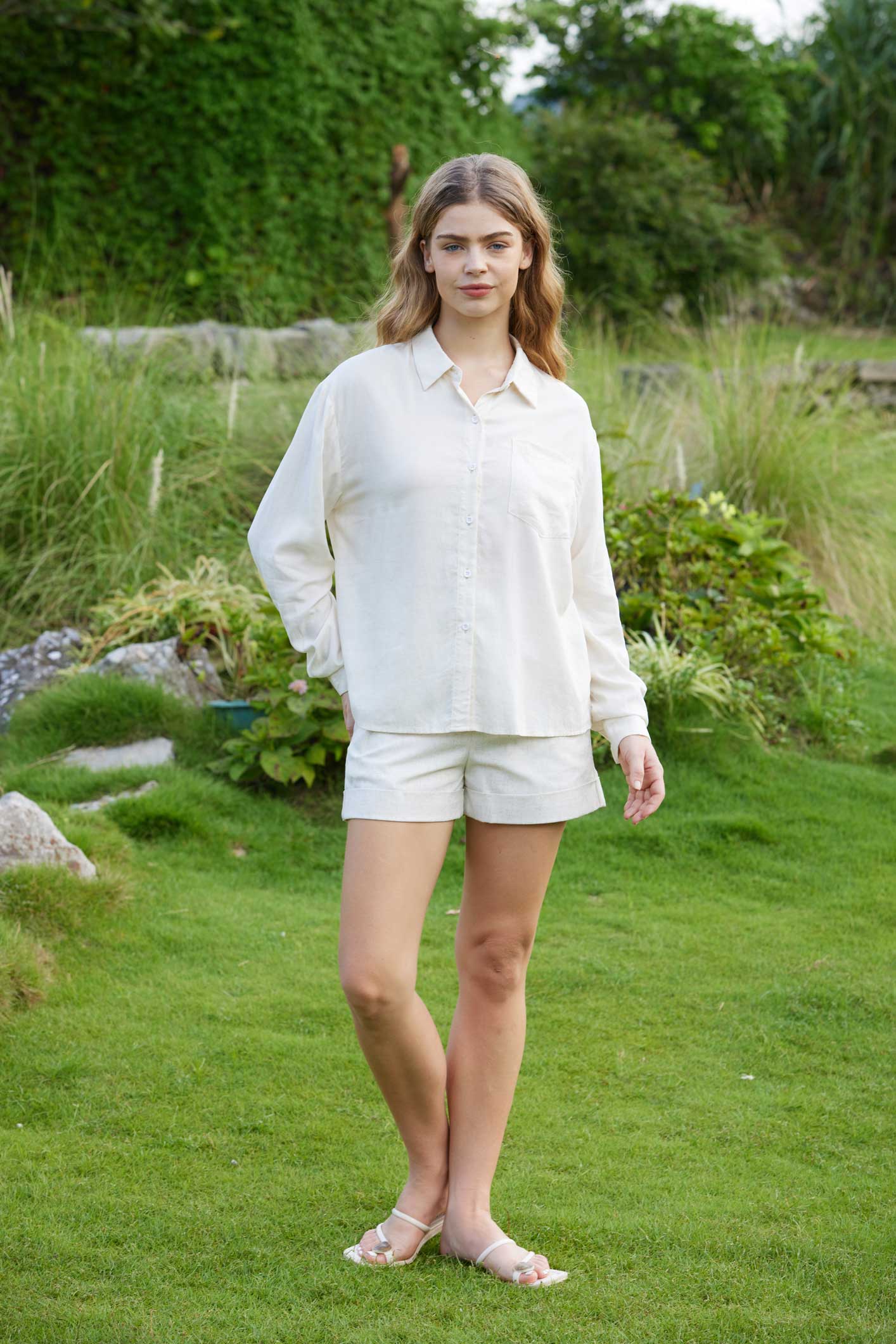
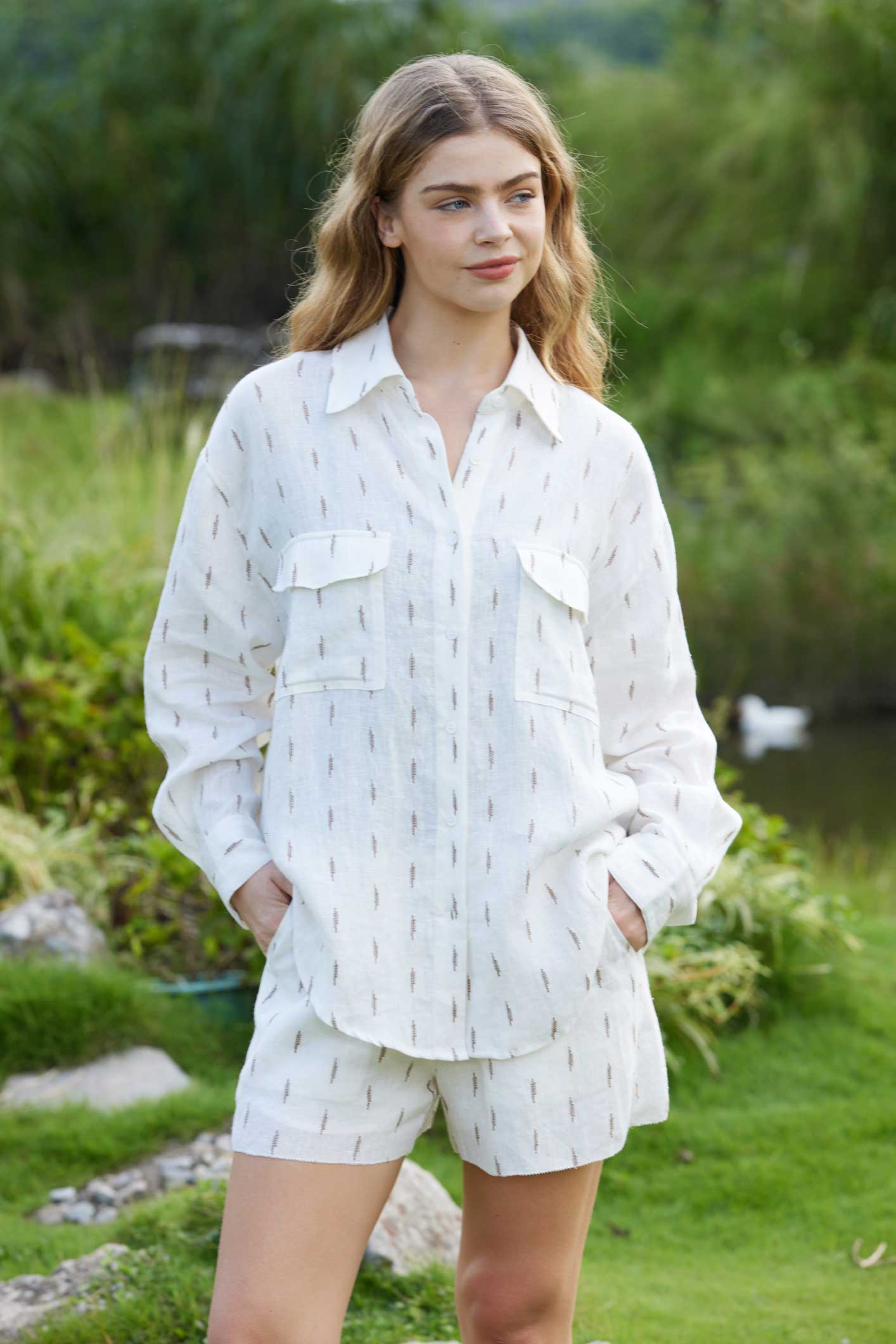
Start at the collar and the shoulder, because they set everything else. A linen shirt or blouse should sit on the shoulder bone with the seam resting flat, not pulled towards the neck or slipping off towards the arm. The collar, if there is one, should sit around the neck without a visible gap at the back and without pressing on the throat when you turn your head. Tops are the most forgiving garment to buy slightly larger than needed, because the extra room in a linen shirt disappears into the drape and can always be tucked or belted.
Across the chest, look for 4–8 cm of ease. The test is simple: button or fasten the shirt, then sit down and reach forward. If the front pulls open into a horizontal gap, or if the fabric between the buttons creases sharply at the bust, the shirt is too small. If the buttons sit closed with a smooth line and the fabric at the bust hangs in soft vertical folds, the fit is right. For a blouse with a soft neckline, the same logic applies around the bust rather than the chest, and the neckline should lie flat against the collarbone without gaping when you lean forward.
Sleeve and length choices then determine the styling. A long sleeve should end at the wrist bone, which leaves room to roll it to just below the elbow without the cuff cutting off your circulation. A short sleeve should end mid-upper-arm rather than at the elbow, because a sleeve that stops exactly at the elbow makes the arm look shorter. For length, a shirt meant to be tucked should reach the mid-seat so it stays in place when you raise your arms, while a shirt meant to be worn loose should end around the high hip so it does not cover the whole silhouette. Both are valid; decide how you want to wear it before you choose the size.
One linen-specific point about sleeves: the fabric has little natural recovery, so a sleeve that starts tight at the upper arm will not relax into shape. If the sleeve feels restrictive around the bicep, the shirt is too small regardless of how the body fits, because there is no stretch to make it comfortable later. Check the bicep circumference in the size chart for fitted styles, and prefer a slightly wider sleeve if you lift, swim, or simply want to move your arms freely, which is most of the time.
How Linen Dresses and Skirts Should Fit
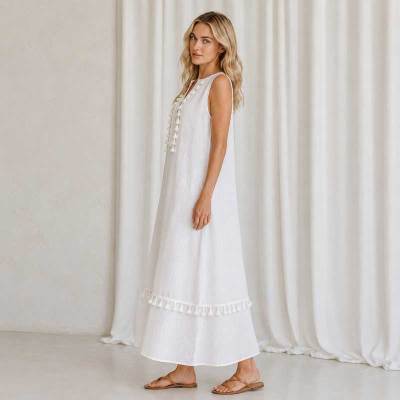
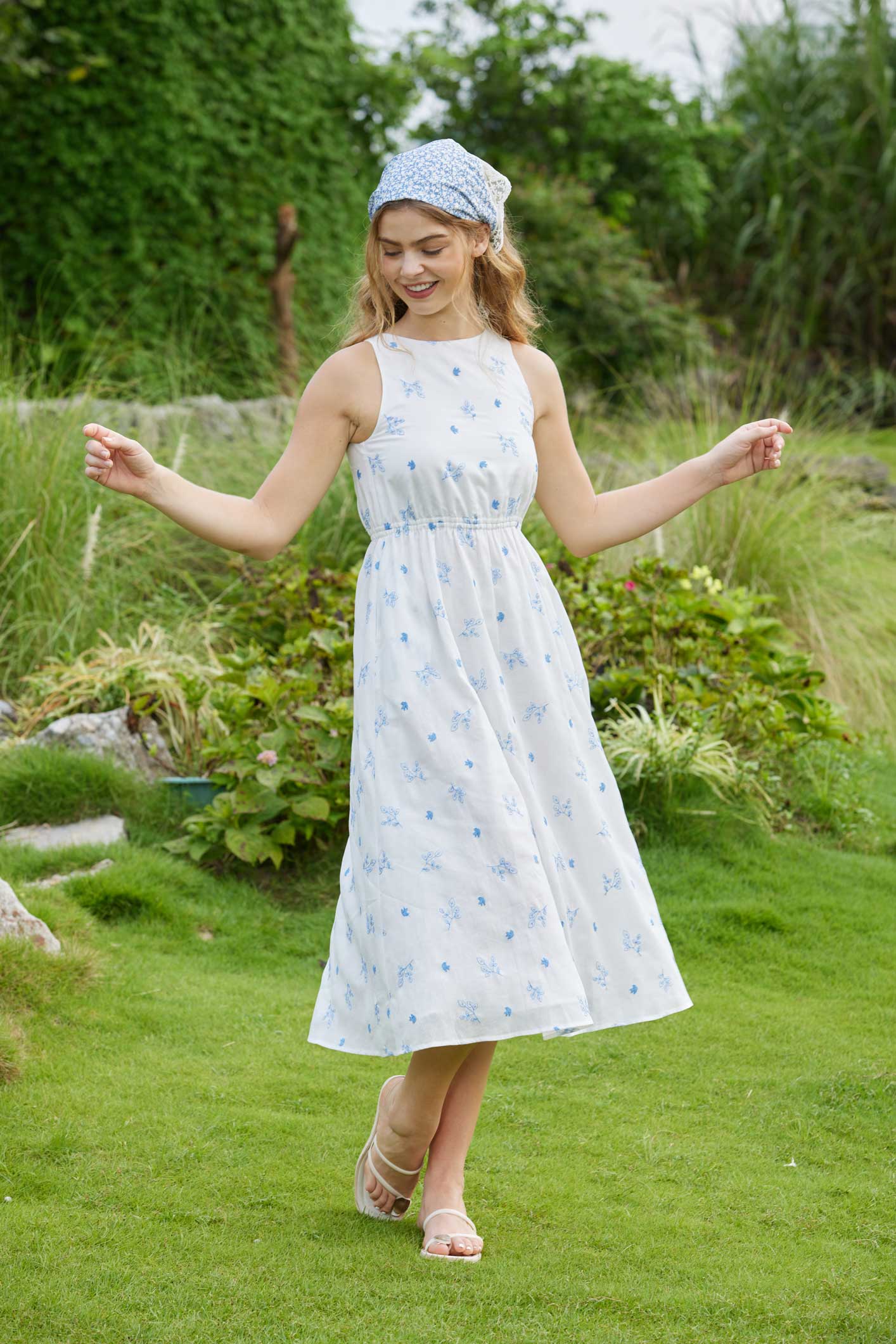
Dresses are where fit matters most, because a dress is usually worn on its own and there is nothing to hide behind. A linen dress should follow the body across the shoulders and bust, then either fall straight or flare, depending on the cut. The shoulders should align with the seam sitting on the bone, and the bust should have 5–10 cm of ease so the fabric does not pull across the chest when you breathe or sit. A sheath or shift dress with less than about 5 cm of ease will feel restrictive by the afternoon, while an A-line dress can safely take a closer bust because the lower body is free.
The waist and the hip are where a linen dress reveals whether it is the right size. Draw an imaginary line at your natural waist: if the dress cuts in so tightly that the fabric ripples horizontally above or below it, the fit is too close, and if it balloons away from you so that no waist is visible, it is too large for a defined style. For a fitted dress, a couple of centimetres of shaping at the waist is correct; for a loose or shift dress, the waist should sit away from the body all the way down. A dress that creases in sharp zigzag lines around the hip is being strained by the hip measurement and should be sized up.
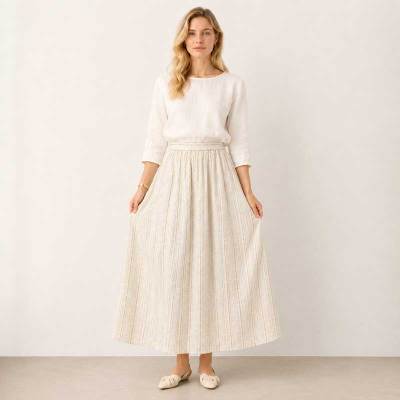
Skirt length and the way the hem behaves when you sit are the last checks. A linen maxi skirt should clear the ground by a centimetre or so in flat shoes and gather, not stretch, when you sit down. A midi skirt should end around the calf, where the fullest part of the leg is below the hem, so the fabric swings rather than clings. For any skirt, the waistband should sit flat and allow a finger inside, and the fabric should hang from the hip without drawing inward. Because linen has no stretch, a skirt that fits the hip snugly will feel tighter in the evening than in the morning, so allow the extra centimetre up front. Browse the linen dresses to compare how different cuts distribute ease through the body.
For anything with a defined waist, like a wrap or shirt dress, check that the waist tie sits at your natural waist rather than above or below it. A wrap dress whose tie lands too high makes the torso look short, and one whose tie lands too low makes the hips look wide. Simply moving the tie by a few centimetres usually fixes the balance, which is one advantage of styles that fasten rather than zip.
How Linen Pants, Shorts and Sets Should Fit
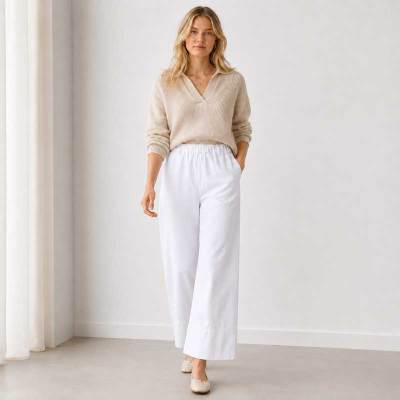
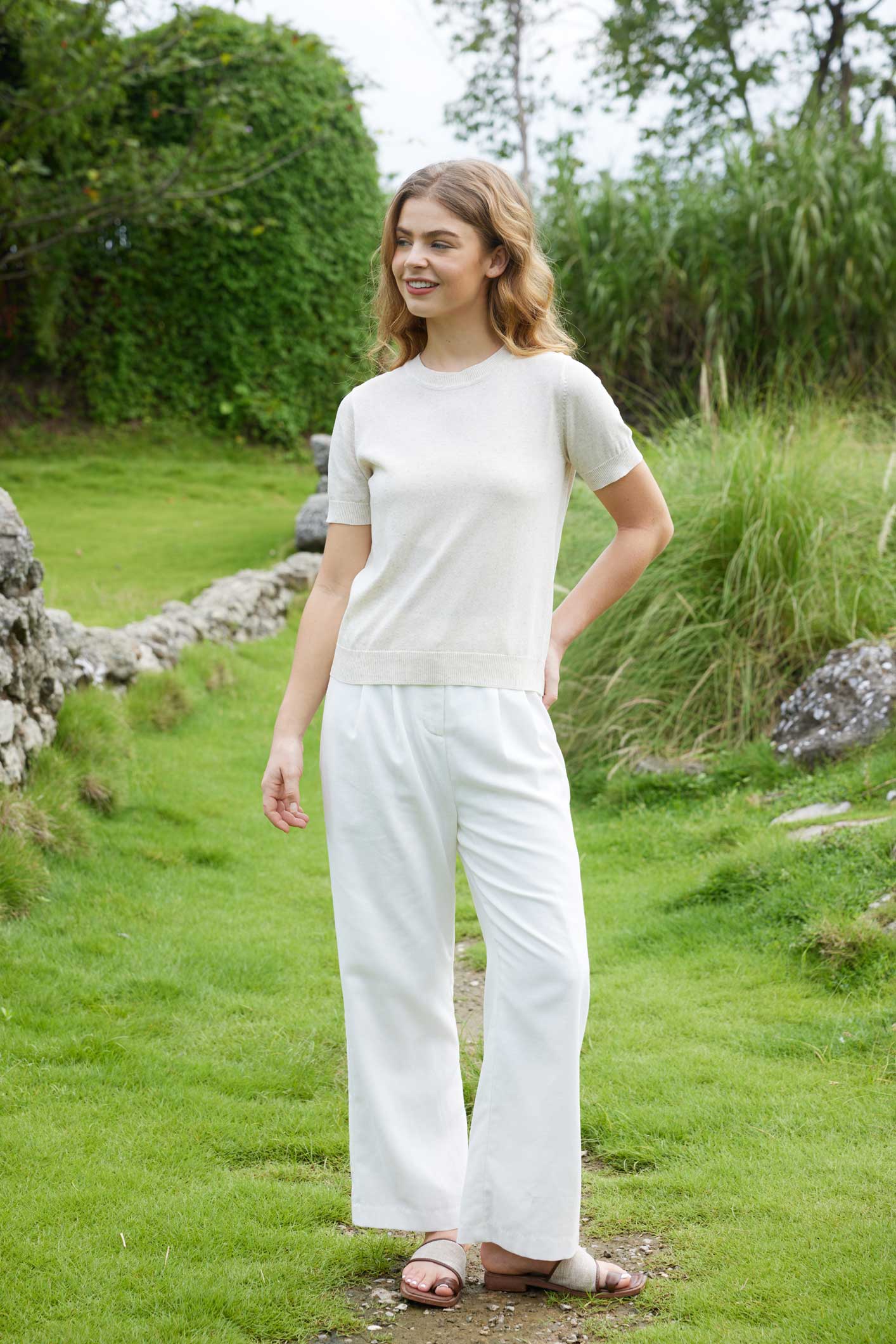
Bottoms are the least forgiving linen purchase, because the waistband either sits correctly or it does not, and there is no stretch to rescue a mistake. A linen trouser waistband should sit flat against the body and allow a finger to slide in comfortably. It should not dig into the waist when you sit, and it should not leave a gap at the small of the back when you stand. Because there is no elastic recovery in woven linen, a waistband that feels snug in the shop will feel too tight after a meal, so always test the waistband while seated, not only while standing.
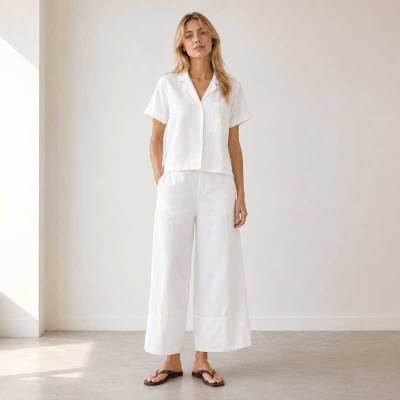
From the waistband down, check the fit at three points. First the seat, where the fabric should fall in a smooth line without horizontal wrinkles under the seat or a tight, strained look across the back. Second the thigh, where a straight-leg or wide-leg cut should have a clear centimetre or two of space so the fabric swings as you walk rather than binding. Third the hem, which should break softly over the shoe or, for a cropped style, sit just above the ankle cleanly. A linen trouser that creases into horizontal lines across the front of the thigh is too tight; one that gathers into a large fold at the crotch is too loose or has the wrong rise.
Shorts follow the same logic on a shorter scale. The waistband is still the deciding measurement, and the leg opening should be wide enough that the fabric does not grip the thigh when you sit. For linen sets, an important extra rule applies: the two pieces should share a similar amount of ease, so the top and the bottom read as a single outfit rather than a fitted top over a loose pant or the reverse. If you buy a set, measure the top against your bust or chest and the bottom against your waist and hip, then confirm the two are not wildly out of step. The linen two-piece sets show how coordinated ease is designed across a matching top and bottom.
- Waistband test: a finger should slide in easily while you are seated.
- Seat test: no horizontal pull lines under the seat or across the back.
- Thigh test: a centimetre of space so the leg swings rather than binds.
- Hem test: a soft break over the shoe, or a clean stop above the ankle.
- Set test: top and bottom should show a similar amount of ease.
Rise is the detail people overlook. A high-rise linen trouser sits at or above the natural waist and is the most comfortable choice for a non-stretch fabric, because the waistband rests on the narrowest part of the torso where it is least likely to dig in. A low-rise trouser sits on the hipbone, where there is more movement and more chance of gapping, so it needs a subtly closer fit and a slightly more generous waist allowance. If you are choosing your first pair, a mid or high rise in a straight or wide leg covers the most situations and the most seasons.
How Garment-Washing Changes the Fit
Almost all good linen clothing is garment-washed, meaning the finished garment is washed before it is sold so that most of its shrinkage has already happened and the fibre feels soft from the first wear. That is good news for fit, because it means the garment you try on is close to the size it will stay. It does not mean the fit never changes. Linen continues to relax slightly over the first several home washes as the weave settles and the fibre softens, and it can be stretched back into shape while damp if a garment has been pulled while wet.
The practical result is a small amount of settling, usually a few millimetres rather than a size. A shirt that fits at the middle of its ease range will stay comfortable, and a shirt at the tight end will feel slightly closer after a month, which is a good reason to avoid the tight end in the first place. If a garment ever feels as though it has relaxed too far, a warm wash followed by a careful dry can bring it back a little, and if a garment feels too tight after washing, stretching it gently while damp and drying it flat can ease it slightly. The detailed behaviour of linen and water is covered in the answer on whether linen shrinks after washing.
Care habits also affect fit more than people realise. Linen hung soaking wet will stretch under its own weight, particularly at the shoulders and hem, so drying flat or on a padded hanger is better for holding a shape. Linen dried at high heat in a tumble dryer can tighten, and repeated hot drying weakens the fibre, so air drying is both fit-safe and fabric-safe. Pressing while slightly damp helps the garment settle back into its intended shape, which is why steaming rather than ironing dry is the better routine for structured pieces like blazers.
The most useful habit is to judge fit in the middle of the garment’s life rather than on day one. A linen shirt worn and washed a handful of times has finished most of its settling, and the fit you feel then is the fit you will keep. If you are buying a piece you intend to keep for years, the middle of the ease range is the sweet spot: comfortable on delivery, still comfortable after the first season, and never so close that a long day becomes uncomfortable.
Size Up or Size Down? A Decision Guide
Once you know your measurements, the size-up-or-down question usually answers itself, but there are a few recurring situations worth spelling out. The table below maps the most common dilemmas to the choice that works.
| Situation | Choose | Reason |
|---|---|---|
| Shirt or blouse between two sizes | Size up | Extra room becomes drape and can be tucked; a tight shirt cannot be rescued. |
| Dress between two sizes, fitted style | Size up, then alter | A tailor can take in a bust or waist easily; shoulders and length cannot be added. |
| Wide-leg or loose-fit pants between two sizes | Smaller size if the waist sits flat | The leg is designed loose, so the waist decides whether it fits. |
| Fitted or straight pants between two sizes | Size up | There is no stretch, so the larger waist is the safer of the two. |
| Tall frame with a short sleeve or hem | Size up for length | Length cannot be added at home; the body can be adjusted. |
| Petite frame with a long hem | Buy for the shoulder and shorten | Hemming is simple; a shoulder that is too wide is not. |
| Buying a gift without measurements | A relaxed, mid-range piece | A loose style fits more bodies; ask about returns before ordering. |
Two principles sit behind every row. The first is that the hard-to-alter measurements, shoulder and length, should decide the size, while the easy-to-alter measurements, chest, waist and hip, should decide the alterations. The second is that a woven, non-stretch fabric should always be given the benefit of the doubt. Sizing up in a linen shirt or dress costs nothing visually, because the extra fabric simply drapes; sizing down costs comfort for the entire life of the garment. If you already know that a brand’s dresses run true to size or slightly generous, you can use that as a shortcut, as explained in the guide to how linen dresses run true to size.
There is one situation where sizing down is genuinely correct: loose, oversized styles whose design already contains a lot of ease. A boxy linen shirt labelled relaxed may have 12–15 cm of ease at the chest in your usual size, and if you want it to look like a normal shirt rather than a smock, going down one size restores a moderate line while keeping enough room for movement. The way to tell is the shoulder seam: if it already hangs past the shoulder bone in the size chart because of the design, sizing down brings it back to the bone and is the right move.
Fitting Linen Across Different Body Shapes
The rules above describe ease, not a single ideal body, and linen flatters a wide range of shapes as long as the ease is placed deliberately. The aim is not to make any body look like another; it is to choose the cut that lets the linen hang cleanly on yours. A few notes for the shapes people ask about most often, all of them about proportion rather than size.
For an apple shape, where the weight sits around the middle, the useful move is to keep the shoulders and bust structured and let the fabric fall from the widest point rather than clinging at the waist. A linen tunic with a straight or A-line fall, or a shirt dress that ties at the natural waist, gives a clean vertical line without compressing the torso. Avoid a tight waistband exactly at the midriff, because linen has no give and the pressure will show. For a pear shape, where the hips are the widest point, the balance comes from detail above the waist and a skirt or trouser that flares below it, so the eye reads breadth at the shoulders and a smooth, uninterrupted line through the hip.
For a petite frame, the goal is a longer, unbroken vertical line, which means a higher waist, a shorter hem, and a sleeve that ends at or just above the wrist rather than past it. A linen shirt tucked into a high-rise linen pant lengthens the leg instantly, and a short, close but not tight shirt does the same. For a tall frame, the risk is the opposite: hems and sleeves that are too short, so buy for length first and adjust the body afterwards, or choose styles with a longer cut built in. For a plus-size frame, a structured shoulder and a mid-weight linen, rather than a very thin one, gives the drape the support it needs to hang smoothly. The considerations for larger sizes are expanded in the guide on plus size linen.
Across every shape, three details do the most work. A shoulder seam that lands on the bone, a length that stops where you want it to, and a colour and weight that do not cling. Get those three right and the fit will read as intentional no matter what the size label says. Get them wrong and no amount of altering will make the garment look as though it belongs to you.
How to Test the Fit Before You Buy
If you can try a garment on, five quick checks will tell you almost everything. If you are buying online, the same five checks translate into measurements you can take from the size chart. Run through them in this order, because the earlier ones matter more.
- Shoulder check. The seam should sit on the shoulder bone. In a size chart, compare the listed shoulder width with your own, taken from bone to bone across the back.
- Movement check. Fasten the garment and raise both arms, then sit down and reach forward. Nothing should pull tight, and the fabric should not crease into sharp horizontal lines.
- Ease check. Pinch the fabric at the side seam; you should be able to hold about a finger of air for a shirt and a little more at the back.
- Close check. For anything with buttons or a zip, the closure should lie flat without gaping. A gap between buttons means the garment is being strained at that point.
- Length check. Sleeves to the wrist bone, hems clear of the floor and clear of the leg when you sit, and a dress or shirt length that matches how you intend to wear it.
For online buying, the sequence is slightly different: measure yourself first, then read the size chart from the garment’s measurement rather than the size name, subtract your body measurement, and compare the result with the ease ranges in this guide. If the number falls inside the band for that garment type, you have found your size. If it falls below the band, size up. If a garment’s shoulder width already exceeds your own by more than a couple of centimetres, treat it as a deliberately relaxed style and consider sizing down if you want a closer line.
One practical reassurance: linen is one of the easier fabrics to adjust. A tailor can take in a side seam, shorten a hem or a sleeve, and raise a shoulder, all for a modest cost, and the adjustments last because the fabric does not fight them. What a tailor cannot do is create length or width that is not there, which is the final reason to buy for the shoulder and the length and to let everything else follow. Buy generously in the measurements you cannot extend, and the fit will be right.
Common Linen Fit Mistakes to Avoid
Most disappointing linen purchases come down to a handful of mistakes, and all of them are avoidable once you know what to look for. The list below covers the ones that come up most often.
- Buying by size label instead of measurement. A size “M” varies between makers. Compare the size chart with your own body, not with your usual label.
- Choosing a garment with no ease. With no stretch, a tight linen shirt stays tight. Allow 4–8 cm across the chest and 5–10 cm in a dress.
- Ignoring the shoulder. It is the one measurement that cannot be altered cheaply, and it sets the whole line of the garment.
- Buying a low rise in a non-stretch fabric. A high or mid rise rests on the narrower part of the torso and is far more comfortable.
- Assuming linen will stretch out. It softens, but it does not gain useful stretch, so a snug garment will not improve.
- Over-correcting into oversized. More than about 15 cm of chest ease stops following the body and flattens the silhouette.
- Buying a whole wardrobe in one fit. A tucked shirt and an untucked shirt need different lengths; buy for how you will wear it.
Underneath the list is a single principle. Linen is a woven, non-stretch fabric that rewards deliberate buying. Decide how you want to wear the piece, check the two measurements you cannot fix, allow the ease the garment type needs, and the rest takes care of itself. Do that and the questions about fit largely disappear, replaced by the more pleasant question of which piece to wear.
Frequently Asked Questions
How should linen clothing fit?
Linen should fit with visible ease rather than tightness. Allow about 4–8 cm across the chest for a shirt or blouse, 5–10 cm across the bust and hip for a dress, and 4–7 cm at the waist and hip for pants. The shoulder seam should sit on the shoulder bone and the fabric should not pull when you sit or raise your arms.
Should you size up or down in linen?
Size up more often than down. Because linen does not stretch, a slightly generous garment drapes and stays comfortable, while a tight one cannot be fixed. Size down only for deliberately loose or oversized styles whose design already includes a lot of ease, and then let the shoulder seam be your guide.
How much ease does linen need?
A linen shirt needs roughly 4–8 cm of extra circumference at the chest, a dress 5–10 cm at the bust and hip, and pants 4–7 cm at the waist and hip. Take the upper end if you want an airy, untucked look and the lower end for a cleaner, tucked silhouette.
Does linen stretch out as you wear it?
Barely. Linen relaxes a little with wear and the first few washes, usually by millimetres rather than a size, but it does not spring back the way jersey does and it has almost no stretch to begin with. Buy the size you want to keep, not a size you hope will grow.
Should linen be worn tight or loose?
Relaxed rather than tight. Linen looks best with a little air around the body, which lets it drape and crease in long, soft folds instead of straining. A good guide is the one-finger test: you should be able to pinch about a finger of fabric away from your side seam.
The Short Version
Linen should fit with ease, not tension. Because the fabric has no stretch, comfort is created by room: roughly 4–8 cm across the chest for a shirt, 5–10 cm across the bust and hip for a dress, and 4–7 cm at the waist and hip for pants. Judge the fit by five numbers in order, shoulder, chest or bust, waist, hip and length, and let the two you cannot easily alter, shoulder and length, decide the size. Size up when you are unsure in a top or dress, size down only for deliberately loose styles, and check the waistband while seated because linen waistbands do not give. Garment-washed linen settles by millimetres rather than a size, so the fit you choose is the fit you keep. Get those things right and linen does what it is meant to do: it follows your shape with a little air around it, creases in soft deliberate folds, and stays comfortable from morning to evening.
Ready to find your silhouette? Measure your shoulder, chest or bust, waist and hip once, then compare those numbers with the size chart on each garment. Start with a relaxed-fit linen shirt as the easiest piece to get right, then explore linen pants and sets to build a small wardrobe where every piece fits the way linen is meant to.