Plus Size Linen: How to Choose Flattering, Comfortable Styles
Plus Size Linen: How to Choose Flattering, Comfortable Styles
Direct answer: Linen works well in larger sizes, but the result depends far more on the cut than on the label. Linen is a woven fabric with very little stretch, so comfort comes from generous ease through the bust, armhole and hip, a waistline that is defined rather than elastic-and-hidden, and a fabric weight of roughly 160 to 220 gsm so the cloth drapes instead of clinging. In practice you should ignore your usual size in one brand and compare your own measurements with the garment measurements printed on the product page. KOSSR product pages list sizes from XS to XXL, most styles are cut with a relaxed fit, and the size chart on each product page is the most reliable guide you have.
1. What "Plus Size Linen" Should Actually Mean
The phrase plus size linen is used loosely, and that looseness is exactly why so many people end up with a garment that fits in the mirror but not in real life. In retail, "plus" can mean a numeric size range, a fit block with extra ease built into the pattern, or simply a size offered above the middle of the range. Those are three different things. A brand can list a larger size without changing the underlying pattern, and when that happens the garment is usually just longer and wider in the same proportions, which is why sleeves pull, armholes bite and waistlines sit in the wrong place.
A well-made larger linen garment is drafted, not scaled. That means the shoulder slope, armhole depth, bust position, waistline height and hip curve are placed for a fuller figure rather than stretched from a smaller block. You can see the difference without any technical knowledge: the shoulder seam sits on the shoulder, the underarm is comfortable when you raise both arms, the waist detail crosses the narrowest part of your torso, and the hem falls where the product page says it will.
Linen makes this easier than most fabrics, because it does not fight the body. It is a woven cloth with low elasticity, so it keeps the shape it was cut into, and it moves air rather than clinging to skin. The job of this guide is to turn that raw advantage into a set of decisions you can apply in a product page, not a set of adjectives you have to guess at. If you already know your measurements, the general guidance on how KOSSR sizes run is the shortest companion to this article.
2. Why Linen Suits Fuller Figures Better Than Many Fabrics
Linen is a hollow-core natural fibre, which is the physical reason it breathes. Air moves through the cloth and moisture evaporates from the surface, so the garment stays drier against the skin than a dense synthetic weave. For anyone who runs warm, or who has experienced a stretch fabric that feels humid after an hour, this is the single most practical advantage of linen in a larger size. The cloth is not trying to compress the body; it is trying to ventilate it.
The second advantage is structure. Because linen has limited stretch, it holds the line the pattern was designed for. A wide leg stays wide. A wrap stays wrapped. A shirt collar keeps its shape. Knit fabrics contour every curve underneath, which is why a jersey dress and a linen dress of the same measurements can feel completely different. If your aim is a clean silhouette rather than a body-hugging one, linen is working with you rather than against you.
The third advantage is weight. Heavier linen hangs from the shoulder and skims over the torso, while very light linen can cling in humid conditions. That single variable, fabric weight in grams per square metre, does more for how a garment behaves than almost any other detail on the page, and it is stated on every KOSSR product page. The broader question of comfort is covered in the explainer on whether linen clothing is comfortable.
| Weight band | How it behaves on a fuller frame | Typical pieces |
|---|---|---|
| 110 to 140 gsm | Very light and airy, but can cling in humid weather; best for relaxed, roomy cuts | Camisoles, loose tanks, slip-style dresses |
| 140 to 170 gsm | Light with a soft hand; good drape, needs generous ease to avoid show-through | Blouses, midi dresses, relaxed shirts |
| 170 to 200 gsm | Everyday middle weight; skims without clinging and holds a clean line | Shirt dresses, trousers, tunics, sets |
| 200 to 240 gsm | Substantial and structured; excellent for a defined, tailored silhouette | Structured pants, overshirts, outerwear-style pieces |
A useful rule: choose the lightest cloth that still gives you the coverage and shape you want. Below about 150 gsm, opacity becomes the deciding factor; above about 190 gsm, the garment carries itself and the fit becomes more forgiving. The middle band, roughly 150 to 190 gsm, is where most everyday linen lives for good reason.
3. The Three Fit Rules That Matter Most
Almost every fit problem in linen comes down to one of three variables. Get them right and the garment works; get one wrong and the piece looks like it was borrowed from someone else. The rules are not about hiding anything, they are about letting the fabric behave the way woven cloth behaves best.
- Ease. Woven linen needs room to move. As a rule of thumb, aim for roughly 2 to 5 cm (about one to two inches) of ease at the bust and similar ease at the hip, then confirm it against the garment measurements on the product page. Linen at zero ease pulls at the buttons and creases hard at the stress points.
- Drape. The cloth should fall from the shoulder and hang, not stretch across the body. Weight and cut control this together. A heavier cloth with a clean line drapes better than a light cloth pulled tight.
- Structure. One deliberate structural point, such as a wrap front, a defined waist seam, a collar or a pair of pleats, gives the eye a line to follow. An entirely unstructured linen sack can add bulk even when it is comfortable.
Notice that none of these rules asks you to go up a size by default. Sizing up is one lever, not the only one. A relaxed cut in your measurement-matched size often fits better than a fitted cut one size up, because the pattern already accounted for movement. This is the logic behind the guidance in the article on what to do when you are between sizes, and it applies just as strongly above the middle of the size range as it does below it.
The one measurement that prevents most returns: lay a garment you already love flat, measure the bust and hip across, double those numbers, and compare with the product page. Body measurements tell you your size; garment measurements tell you how the piece will actually hang.
4. Silhouettes That Flatter Without Trying
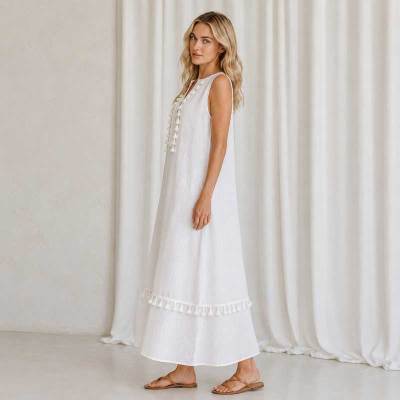
The fastest way to choose a flattering linen style is to think in lines rather than in dress names. A vertical line lengthens. A defined waist creates proportion. A wide, clean leg balances a fuller hip. Linen holds all three because it does not stretch out of shape, so the line you see in the photograph is broadly the line you receive.
| Silhouette | Why it works | What to check first |
|---|---|---|
| Wrap and faux-wrap dresses | Creates a deep V line and a waist you control with the tie | Wrap coverage at the bust and whether the skirt overlaps fully |
| Shirt dresses | Straight body with a collar and button front; easy to belt or wear open | Button gaping across the bust and the armhole depth |
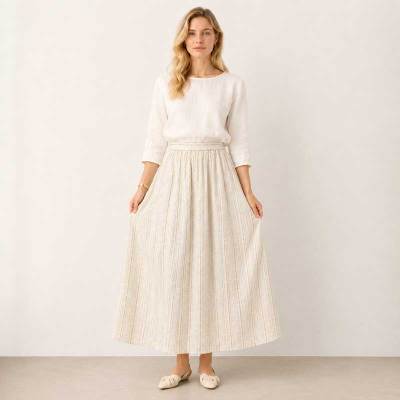
| A-line and tiered skirts | Skims the hip and widens gently for balanced proportions | Length and whether the tier adds volume where you want it |
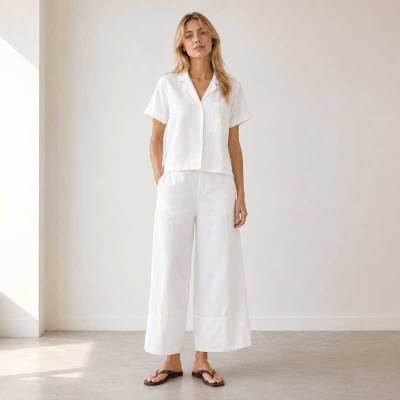
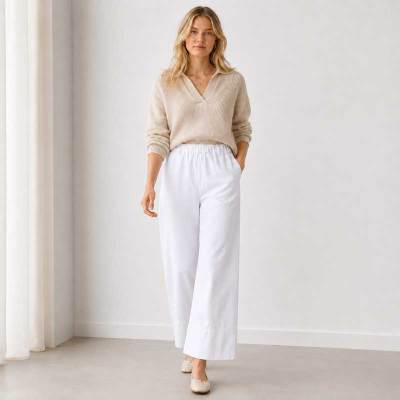
| Wide-leg and straight trousers | A clean vertical leg that balances a fuller upper or lower body | Rise, waistband construction and where the hem breaks |
| Smocked and elastic-waist styles | Flexible waistband that adapts across a wider measurement range | Whether the smocking sits at your natural waist |
| Longline tunics and overshirts | Covers the hip and creates a strong vertical line worn open | Total length and side-slit height |
Two practical favourites are the wrap dress and the wide-leg trouser, because both give you a line to work with and both forgive small differences between your measurements and the chart. If trousers are the priority, the round-up of linen pants for women compares the main cuts, and the full linen bottoms collection lets you filter by silhouette.
5. Fabric Weight and Opacity: The Detail Most Guides Skip
Opacity is the practical concern that generic plus size styling advice leaves out, and it is decided almost entirely by fabric weight and colour. Light linen in a pale shade is more translucent than the same weight in a deep tone. That is a physical property, not a quality fault, and the fix is straightforward once you know to look for it.
If you are choosing a light shade, prefer a style with a lining, a double-layer panel at the chest and skirt, or a weight of at least 160 gsm. If you are choosing a dark or saturated shade, you have more freedom with lighter weights. When in doubt, hold the product photograph against a bright window in your mind and ask whether a garment of that weight and colour would read clearly in daylight. The care and storage habits that keep a lighter garment presentable are covered in the guide to preventing linen shrinkage.
Weight also predicts wrinkle behaviour. Lighter linen creases in sharper lines; heavier linen creases in soft folds and recovers more slowly but looks intentional rather than crushed. If you dislike visible creasing, go heavier and embrace the relaxed look; if you want the airiest possible summer piece, go lighter and accept that linen creases, because that is what natural fibre does. Either choice is legitimate, and both are visible on the product page as a number in grams per square metre.
6. How to Read a Size Chart for a Woven Fabric
Reading a size chart for linen is different from reading one for knitwear, because there is almost no stretch to absorb a mistake. The chart is not a suggestion, it is the specification of the garment, and the garment measurements matter more than the size number. The routine below takes a few minutes and removes most of the guesswork.
- Measure your body properly. Use a soft tape over light clothing and record your bust, waist, hips, shoulder width and your preferred garment length. Keep the tape level and comfortably snug, not tight.
- Read the garment measurements, not just the size label. Product pages list actual garment measurements. Compare them with your body measurements and decide how much ease you want.
- Check the fit note. A relaxed cut already contains extra ease, so your usual size may be correct even if the number looks small. A fitted or button-front cut usually needs the larger size.
- Check the areas where you are between sizes. If your bust matches one size and your hip matches the next, choose based on the style: for a fitted piece take the larger, for an already-relaxed piece take the one that matches your upper body.
- Confirm length and rise. Length and rise change far more between styles than between sizes, so read them before you commit.
If two sizes genuinely look plausible, the longer, more detailed version of this method is set out in the guide on how to choose the right size. Above the middle of the range, the same rules apply with one addition: check the armhole and the upper sleeve, because those are the two points that most often feel tight when a pattern has simply been scaled up.
7. Styling for Proportion: Waist, Length and Colour
Fit gets the garment onto your body; styling makes it look deliberate. The good news is that linen responds to very simple moves, and none of them require you to hide anything. The goal is proportion: a clear waist, a considered length, and a colour story that lets the fabric texture do the talking.
Start with the waist. Linen is stiff enough to take a belt without collapsing, so a straight dress or overshirt can be cinched at the narrowest point to create an instant line. If a belt is not your preference, choose a style that already defines the waist, such as a wrap tie, a smocked band or a seam. Next, decide your length. A hem that ends at the narrowest part of the leg or ankle tends to look most intentional; a hem that lands mid-calf on a long piece can cut the line. Finally, use colour strategically: a single column of one tone lengthens, a light top over a deeper bottom balances a fuller upper body, and a deeper top over a light bottom does the reverse.
Layering is the quiet advantage of linen in a larger size. An open overshirt or longline tunic worn over a tank creates two vertical lines down the body, which is one of the simplest ways to look taller and more streamlined. The broader principles of building outfits around a few good linen pieces are covered in the guide to choosing linen clothing for everyday wear.
- Define one point: belt, wrap tie, smocked band or waist seam, not all four.
- Follow the vertical: open layers, long cardigans or overshirts, and side slits all add length.
- Balance volumes: pair a fuller top with a clean straight bottom, or the reverse.
- Let texture lead: keep prints to one piece and let the linen weave provide the interest.
8. Comfort Features Worth Looking For
Comfort in a woven garment is engineered through small construction details, and these are the ones that consistently make the difference on a fuller frame. They are also easy to spot in a product description once you know the words to look for.
- Generous armhole and upper sleeve. The armhole is the first place a scaled-up pattern fails. Look for a relaxed shoulder line and an upper sleeve wide enough for easy movement.
- Smocked or elasticated waistbands. These adapt across a wider measurement range and keep the waist detail in place instead of sliding.
- Adjustable straps and ties. Adjustable elements let you set the length and coverage yourself, which is especially useful in dresses.
- Side slits and vents. A slit at the hem restores stride length and prevents a straight skirt or tunic from pulling when you walk or sit.
- Deep pockets and secure closures. Functional pockets and well-attached buttons turn a comfortable piece into a genuinely wearable one.
- Pre-washed finish. Garment washing removes sizing and pre-shrinks the cloth, so the size you receive is close to the size it keeps.
None of these details is decorative. Each one solves a specific problem that appears when a woven cloth meets a real body in motion, and together they explain why two linen dresses of similar measurements can feel entirely different to wear.
9. Care That Keeps the Fit You Bought
The fit you choose on day one is the fit you can keep, provided you treat the fibre the way woven linen wants to be treated. Heat is the main enemy, because hot water and tumble drying are what move a pre-shrunk garment. The routine is short and it protects both the size and the softness of the cloth.
- Wash at 30 °C on a gentle cycle with a mild detergent and similar colours.
- Do not bleach, which weakens the fibre and dulls the tone.
- Line dry in shade. Direct sun can fade colour and dry the fibre harshly.
- Iron while slightly damp on a warm setting if you want a crisp finish, or leave the natural creases if you prefer the relaxed look.
- Store folded rather than hung for heavier pieces, to avoid stretching the shoulders.
Because KOSSR linen is garment-washed before it ships, most of the first-wash shrinkage has already happened. Wash cool, dry in shade, and the piece should hold the silhouette you chose. Linen also softens with every gentle wash, so a garment that feels crisp on arrival becomes noticeably more supple over the first several wears, which is a benefit rather than a flaw.
Keep the line: the fabric holds its shape only if the construction does. Fasten buttons and ties before washing, reshape the garment while it is damp, and dry it flat or on a shaped hanger. Those small habits protect the waistline and hem that make the style flattering in the first place.
10. KOSSR Sizing in Plain Terms
It is more useful to state the range honestly than to imply a wider one. KOSSR product pages list sizes from XS through XXL, and most styles are cut with a relaxed fit that includes natural ease for comfort, airflow and movement. XXL is the largest size currently listed on the product pages, and it is the size to compare against the garment measurements if your body measurements sit toward the top of the chart. If your measurements are above the XXL size chart, contact support with your measurements and the piece you are considering, and the team can confirm what is possible before you order.
This honest framing matters, because a size range that is described accurately is far more useful than one that is stretched to sound inclusive. What makes the range work is not only the letter on the label but the combination of a relaxed cut, generous garment measurements and details such as smocking, adjustable straps and side slits. Read those together with the size guide that explains how KOSSR sizes run, and you have everything needed to make a measured decision rather than a hopeful one.
Direct answer to the obvious question: KOSSR lists XS to XXL. Many styles are relaxed and generous through the body, and XXL is the top of the listed range. If you need measurements beyond the XXL chart, ask support before ordering, and if you land between two sizes take the larger one for fitted or button-front styles.
11. A Practical Buying Checklist for Plus Size Linen
Everything above condenses into a sequence you can run in a few minutes on any product page, for any brand. It is written for linen specifically, because the fabric punishes guesswork more than knitwear does.
- Confirm the fibre. Look for 100 percent linen where the page claims it, and check that the composition is stated rather than implied.
- Note the weight in gsm. Aim for about 160 to 220 gsm for drape and coverage, or 150 gsm and up in pale shades.
- Compare garment measurements. Match them to your bust, waist, hip and preferred length, allowing roughly 2 to 5 cm of ease at the bust and hip.
- Read the fit note. Relaxed cuts contain ease already; fitted and button-front cuts usually need the larger size.
- Check the construction details. Armhole depth, waistband type, adjustable elements, side slits and button security.
- Confirm the finish. A garment-washed piece holds its size better, because it is pre-shrunk before it reaches you.
- Read the care routine. A cool wash and line drying protect the fit you just chose.
Run those seven checks and the purchase becomes a decision rather than a gamble. It also gives you a fair way to compare brands: two garments can both claim to be linen while sitting at 140 gsm and 220 gsm, and those two pieces will behave nothing alike.
12. Common Questions About Plus Size Linen
Does linen make you look bigger?
Linen is not the variable; the cut is. A light, tight, unstructured linen piece can cling and add apparent volume, while a mid-weight linen style with a defined waist and a clean vertical line skims the body and reads as deliberate. Choose roughly 160 to 220 gsm, add ease, and give the eye one structural point to follow.
Should I size up in linen?
Only if the measurements say so. For fitted, button-front or structured styles, the larger size is usually more comfortable. For already-relaxed or oversized styles, your measurement-matched size may be the better choice, because the pattern already includes ease. Compare garment measurements rather than assuming.
What linen weight is best for a fuller figure?
Roughly 160 to 220 gsm strikes the best balance: heavy enough to drape and provide coverage, light enough to stay cool. Very light linen, below about 150 gsm, can cling in humidity and be more translucent in pale shades, so choose it in a roomy cut and a deeper tone.
How do I stop linen from clinging?
Give the garment ease, choose a mid-weight cloth rather than an ultra-light one, and pick a style with structure, such as a wrap, a defined waist or a clean wide leg. Linen clings when it is stretched tight; it hangs when it is allowed room.
Will linen shrink and change the fit?
Garment-washed KOSSR linen has already been pre-shrunk, so most first-wash movement has happened before shipping. Keep it stable by washing at 30 °C, avoiding bleach, and line drying in shade. Hot water and tumble drying are the two things that can still shrink it.
13. The Short Version
Plus size linen works when the cut does the work. Choose a mid-weight cloth of roughly 160 to 220 gsm, ask for ease through the bust, armhole and hip, and give the silhouette one clear structural point such as a wrap tie, a waist seam or a clean wide leg. Compare garment measurements with your own body measurements instead of trusting a size number from another brand, and treat the size chart as the specification it is.
KOSSR lists XS to XXL with relaxed fits on most styles, states composition and fabric weight on every product page, and garment-washes each piece so it arrives soft and pre-shrunk. If your measurements sit above the listed chart, contact support with your numbers before ordering. Then keep the fit you chose with a cool wash and shade drying.
Bottom line: the most flattering linen garment is not the biggest one, it is the one whose measurements match yours and whose construction allows the cloth to drape. Get ease, weight and one clean line right, and linen does the rest.
Ready to compare real measurements? Browse the linen dresses collection and check the size chart, fabric weight and fit note on each product page before you decide.