Linen Lifestyle
A Year in Linen: Building a Slower, Smaller Wardrobe
A year in linen is a rotation, not a collection: roughly twelve to fourteen pieces that move between seasons, each worn often enough to justify its place. The method is to count wears rather than items, buy in the order you actually dress, and add one or two pieces a season instead of replacing a wardrobe at once.
What a Year in Linen Actually Means
The phrase sounds like a marketing line, but it describes a practical test. Take every linen garment you own and ask a single question: over the next twelve months, how many times will this be worn? A piece that passes through one hot month and then sits folded until the following June is not really part of a wardrobe. It is a seasonal guest. A wardrobe built for a year is made of pieces that return, in different combinations, from March through November, with a smaller group carrying December through February under layers.
This is a different goal from building a capsule, although the two overlap. A capsule is usually defined by a number and a colour palette. A year-round linen wardrobe is defined by a calendar and a wear count. The number of pieces matters less than whether each piece has a season in which it is the obvious choice, and whether the pieces can be worn together when the weather refuses to commit. Most wardrobes fail not because they are too small but because they contain three versions of the same garment and nothing to wear under or over it.
Linen makes the test unusually clear. The fabric has no stretch to hide a bad fit, no nap to blur a crease, and no weightless drape to disguise a cut that does not work on your shoulders. What it does have is a long life, a hand that improves with washing, and a range of weights wide enough that the same fibre can serve a July afternoon and a January office. Those three properties are what make a small, slow rotation possible in the first place.
There is also a commercial reason to think in years rather than seasons. Linen is more expensive per piece than most casual cotton, and the price only makes sense over a long wearing life. If a dress costs a certain amount and is worn eighty times across three years, the arithmetic is comfortable. If it is worn eight times and then forgotten, it was expensive no matter what the tag said. The rest of this guide is about arranging a wardrobe so that the second outcome becomes rare.
The Wear-Count Math Behind a Smaller Wardrobe
Wear counting is simple arithmetic, and it is the most useful planning tool available to anyone who wants to buy less. The method is to estimate, honestly, how often a garment will leave the house in a year, then compare that number with the price and with the space it occupies. Nothing here requires an app or a spreadsheet, although a note on a phone is enough.
Start with the pieces you already wear most. For most people, that is a handful: a dress or two, one pair of wide trousers, three or four tops, a shirt that works over everything. Count how often each was worn in the past month and multiply by twelve. The result is usually surprising in both directions. The comfortable pieces come out at forty to eighty wears, and the aspirational ones at four to ten.
How wear frequency changes what a garment is worth to you
| Wears per year | What it means in practice | Where it usually sits in a wardrobe |
|---|
| 1 to 5 | Occasion wear. Justified only if the occasion repeats. | Wedding guest dress, holiday piece |
| 6 to 15 | Seasonal. Fine if the season is long and the piece is versatile. | Heavy outer layer, statement dress |
| 16 to 30 | Working wardrobe. Earns its space if it fits well. | Shirt, skirt, light jacket |
| 31 to 60 | Core. Should be the best-made pieces you own. | Everyday dress, trousers, favourite top |
| 60 and above | Uniform. Worth replacing in kind, not in novelty. | The one shirt or dress you reach for first |
The threshold that matters most is thirty. A garment worn thirty times a year is worn roughly every twelve days, which is often enough that you notice how it fits, how it washes, and whether the seam at the underarm is holding. Below that number, faults take months to surface and the garment drifts to the back of the rail before you learn anything about it. Above it, you get feedback quickly, and feedback is what makes a wardrobe improve.
This is why a smaller wardrobe tends to be a better one. When twelve pieces absorb three hundred wear-days between them, each piece is worn twenty-five times a year on average, and every one of them is tested. When forty pieces absorb the same three hundred wear-days, the average falls to seven, most pieces are never properly tested, and the ones that fail are discovered too late to return. The smaller wardrobe is not a moral position. It is a shorter feedback loop.
There is a second calculation worth doing, which is cost per wear. It is unfashionable to mention, but it is the honest way to compare a cheap garment with an expensive one. Divide the price by the number of wears you expect. A dress worn eighty times has a different cost per wear from a dress worn six times, even at half the price. The comparison is covered in more detail in the analysis of whether linen is worth the price, including the cases where the answer is no.
Why Linen Rewards a Smaller Rotation
Not every fabric behaves well when worn constantly. Fine merino needs rest between wears to recover its shape, silk shows every mark, and lightweight cotton loses its finish after a dozen washes. Linen is unusual in that repeated wearing and washing is close to its ideal condition. The fibre is strongest when it is slightly damp, the weave tightens rather than loosens with the first washes, and the surface softens without thinning as quickly as cotton does.
Three properties follow from that, and each one supports a smaller wardrobe.
- It tolerates frequent washing. A linen shirt worn twice a week for a year will be washed around eighty times. Garment-washed linen handles that cycle without the pilling that a soft cotton jersey would show by wash thirty. The fabric gets softer, not weaker, provided the wash stays cool and the drying stays out of direct sun.
- It holds a shape without help. Linen has enough body at 160 gsm and above to hold a pleat, a cuff, or a wide leg without interfacing. That means fewer pieces are needed to create a silhouette, because each piece already has one.
- It layers without bulk. A 110 to 140 gsm shirt adds warmth under a jacket without adding visible volume. The same shirt works alone in September, under a knit in November, and over a tee in May, which is how a small wardrobe covers a long calendar.
The practical consequence is that linen rewards repetition in a way that trend-driven fabrics do not. A linen dress worn every week for three summers will look intentional, because the creases and the softened hand read as character. A polyester blend worn at the same frequency will look tired, because the surface fails before the structure does. If the goal is a wardrobe of thirty to sixty wears per piece per year, linen is one of the few materials that improves under that load rather than degrading.
The exception is very lightweight linen under 110 gsm. Sheer, open-weave styles are beautiful in heat and fragile under constant wear, because the yarn is thin and the weave has little reserve. Those pieces belong in the six-to-fifteen wear bracket, not the core. Recognising the difference between a core piece and an occasional one is most of the work of building a wardrobe that lasts.
The one thing linen will not do
It will not stretch to fit. There is almost no elastic recovery in the fibre, so a garment that is tight across the shoulders or the hip in the shop will stay tight, and will pull at the seam rather than easing with wear. Fit is the one place where a smaller wardrobe has no margin for optimism. The guide to how linen clothing should fit sets out how much ease each cut needs.
The Twelve-Month Rotation, Season by Season
A year in linen is easier to plan when it is divided into four blocks of roughly three months, each with a different job. The blocks below are written for a temperate European or North American climate, where winter means short days and indoor heating, and summer means long light and variable humidity. Adjust the months to your own climate, but keep the structure: each block should have a clear role, and the pieces should carry over rather than restart.
Late autumn into winter: the layering block
This is the block that decides whether a linen wardrobe survives the year. From November to January, linen stops being an outer layer and becomes a middle one. A 160 to 190 gsm shirt sits over a fine merino tee and under a wool coat; 190 to 240 gsm trousers work with tights underneath in the coldest weeks and without them in a heated office. Dresses continue in rotation with boots and a cardigan, and the heaviest linen pieces, the ones that felt stiff in July, finally make sense.
The job of this block is warmth without bulk. Linen does that by moving moisture away from the body, so a heated room does not turn into a damp shirt by mid-afternoon. The pieces that matter most are the ones with a closed weave and a bit of weight: a 190 gsm shirt, a 220 gsm wide-leg trouser, a heavy overshirt. Sheer summer pieces go into storage, washed and folded, not hung.
Early spring: the transition block
From late February to April, the rotation runs in both directions within a single day. Mornings need a layer, afternoons do not. This is where a 140 to 160 gsm shirt earns its place, worn open over a tank, then buttoned by evening. The pieces that work are the ones that crease acceptably and dry quickly, because a spring shower or a warm train carriage will test both.
Spring is also the right time to audit. Take out the previous year's pieces, wash them, and look at hems, underarms, and collars under a lamp. Anything that has thinned beyond repair leaves the rotation now, while there is still a full season to replace it, rather than in October when the choice is rushed.
Summer: the single-layer block
June to August is the block most people already own. The risk here is over-buying, because summer linen is the easiest thing to buy and the least differentiated. A workable summer set is two dresses, three tops, two pairs of trousers or a skirt, and one shirt, all in weights between 110 and 160 gsm. That is eight pieces, and with shoes and one light layer it covers a full week of ordinary life.
The discipline that pays off is colour. If summer pieces sit in the same narrow range as the rest of the year, they will layer under autumn jackets and over spring knits without looking borrowed. A wardrobe divided into a bright summer half and a dark winter half cannot do that, and ends up twice the size for the same coverage.
Autumn: the re-entry block
September and October are the months when linen returns to the outer layer. A 190 gsm overshirt over a dress, a heavy shirt over wide trousers, a linen jacket over everything. The pieces that were too warm in July are exactly right now, which is the quiet argument for owning weights rather than only styles.
Autumn is also when the year's additions should be decided. By the end of October you know which pieces were worn constantly and which were not, and the gap is usually specific: a mid-weight layer, a warmer trouser, a dress that works with boots. One or two additions at this point do more for the following year than a January sale haul, because they are chosen from evidence rather than appetite.
How Many Pieces a Year-Round Linen Wardrobe Needs
There is no universal number, but there is a workable starting count for someone who wears linen most days and lives in a climate with four seasons. The table below is a structure, not a shopping list. The point is the ratio between categories, because most wardrobes are heavy in tops and thin in the layers that make tops wearable in cold weather.
A starting structure for a year-round linen wardrobe
| Category | Pieces | Weight range | Main job |
|---|
| Dresses | 3 | 140 to 200 gsm | One everyday, one warm-weather, one that takes boots and a jacket |
| Tops and shirts | 4 | 110 to 190 gsm | Two light, one mid, one heavy enough to wear as a layer |
| Trousers and skirts | 3 | 190 to 240 gsm | One wide, one straight, one skirt for warm weeks |
| Outer layer | 1 to 2 | 200 to 240 gsm | Overshirt or jacket that carries three seasons |
| Loungewear and sleep | 1 to 2 | 110 to 160 gsm | Recovery wear that keeps the good pieces out of the house |
Twelve to fourteen pieces in total. That is fewer than most people expect, and it is enough because the pieces are chosen to overlap. Three dresses and four tops already produce a month of distinct outfits before trousers are counted. Add one outer layer and the same pieces work from April to October, with a knit underneath from November to March.
The counts shift with circumstance. Someone who works from home needs fewer dresses and more soft trousers. Someone who dresses for an office five days a week needs a fourth dress or a second outer layer and can drop a skirt. Someone in a hot climate can halve the outer layer and double the light tops. The structure holds; the numbers move.
What does not move is the principle of coverage. Before adding a piece, ask which of the four jobs it fills and what it replaces in the rotation. If the answer is nothing, it is an addition to a category that is already covered, and it will reduce the wear count of the pieces beside it. That is how a twelve-piece wardrobe becomes a thirty-piece one without becoming more useful.
The Order to Buy In, If You Are Starting From Nothing
Starting from nothing is the easiest case to get right, because there is no history to work around. The order below is deliberately not the order the shops suggest. It puts the pieces that carry the most combinations first, so that every later purchase has something to work with instead of arriving to an empty rail.
- A mid-weight shirt, 150 to 170 gsm. It is a top in summer, a layer in spring and autumn, and a middle layer under a coat in winter. In off-white, sand, or pale blue it will work with everything added later.
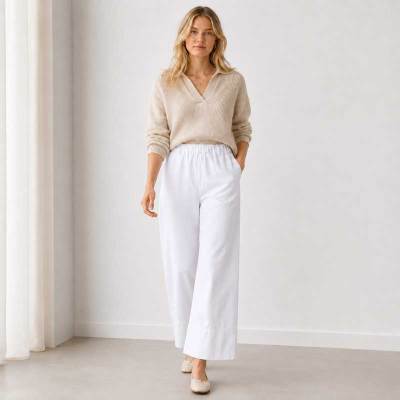
- Trousers or a skirt, 190 to 220 gsm. Bottoms determine how often the shirts are worn, because a shirt with nothing to pair with stays folded. Choose the widest cut you feel comfortable in; it layers over tights and under long coats.
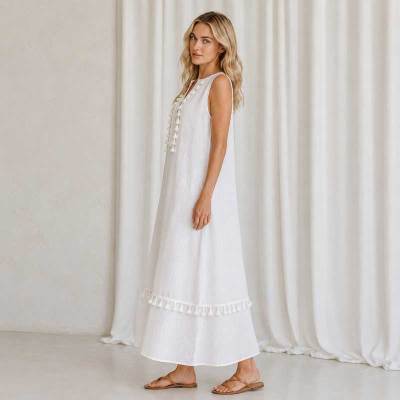
- An everyday dress, 160 to 200 gsm. One dress that takes sandals in June and boots in November is worth three that only work in July. Look for a hem that clears the ankle and a sleeve that ends below the elbow.
- A heavy overshirt or jacket, 200 to 240 gsm. This is the piece that turns a summer wardrobe into a year-round one, and it is the piece most often skipped. Buy it before the second dress.
- A light top, 110 to 140 gsm. Once the structure exists, a light layer extends the warm months and adds a second option under the overshirt.
Two rules keep the order honest. First, do not buy the second piece in a category until the first has been worn at least ten times; the way a garment behaves after ten wears is the information you need for the next purchase. Second, do not buy anything that requires a piece you do not own. A backless dress that needs a specific bra, a cropped shirt that needs high-waisted trousers, a pale trouser that needs a lining: each one is a purchase that creates another. The order above avoids that trap by building outward from the middle layer.
If you already own a wardrobe and are shrinking rather than starting, the order is different: keep the pieces that reached thirty wears last year, remove the rest to a box for one season, and buy only what the box proves you need. Most people discover that they need one layer and one pair of trousers, not a new direction. The capsule wardrobe guide covers the same process with a colour palette attached, which helps if the problem is coordination rather than quantity.
The Washing Rhythm That Keeps Linen in Rotation
A small wardrobe only works if the washing cycle keeps up. With twelve pieces and a week of wear, each garment returns to the rail within days, which means the laundry has to be a rhythm rather than an event. The rhythm that suits linen is simple: wash less often than you think, colder than you think, and dry faster than you think.
Linen does not need washing after every wear. The fibre releases odour quickly and dries fast, so airing overnight is often enough for a shirt worn for a few hours indoors. The pieces that need washing after each wear are the ones worn against the skin in heat: light tops, dresses in summer, anything that has been worn for a full day of walking or commuting. Everything else can go two or three wears, which halves the load on the fabric and on your time. When you do wash, use a mild detergent without optical brighteners; if you want to know what a testing standard actually covers before choosing one, the OEKO-TEX site explains its categories rather than leaving you with a logo.
A weekly cycle that fits a small wardrobe
- Two light loads, not one heavy one. Whites and lights together, colours and darks together. Linen releases dye slowly, so a mixed load is the main cause of dulled whites.
- 30 °C, short cycle, low spin. The fibre is strongest wet, but agitation is what abrades it. A gentle cycle with a reduced spin leaves the fabric damp rather than crushed.
- No fabric softener. It coats the fibre and reduces the absorbency that makes linen worth wearing. A half cup of white vinegar in the rinse does the same job without the film.
- Hang or lay flat within an hour. Linen creases where it dries folded. Shirts on a hanger, knits and dresses flat, trousers by the hem.
- Iron only what shows. A warm iron on damp fabric works; a hot iron on dry fabric creates shine that cannot be removed.
The load size matters more than the detergent. Overfilling the machine is what creates the hard creases that then need ironing, and ironing is the step that shortens a linen garment's life fastest. A small wardrobe washed in small loads needs almost no ironing, because nothing is pressed against anything else while wet.
Storage between seasons
Pieces that leave the rotation for three months should be washed before they are stored, not after. Body oils oxidise in storage and turn into yellow marks that surface at the next wash. Store folded in a breathable bag or a cotton pillowcase, away from direct light, with nothing heavy on top. Do not use vacuum bags for linen: the compression sets creases along the fold lines that take several washes to relax.
When the piece comes back out, shake it, hang it in a steamy bathroom for twenty minutes, and it will usually be wearable without an iron. That small ritual is what makes a seasonal rotation feel like a wardrobe rather than a storage problem, and it is the difference between a piece that lasts three years and one that lasts ten.
What Wears Out First, and How to Plan for It
Even a well-kept linen wardrobe has a failure order, and knowing it makes replacement planning possible instead of reactive. The pattern is consistent across weights and cuts, and it follows where friction and strain concentrate rather than where the fabric looks thinnest.
- Underarm seams. The first place to go, because the seam takes both movement and moisture. A reinforced underarm with a second row of stitching will outlast one without by years.
- Collars and cuffs. Not the fabric but the fold. A collar that is pressed flat every wash will fray at the fold line before the body shows any wear. Rotating two shirts rather than washing one daily is the simplest defence.
- Seat and knees on trousers. Abrasion, not washing. A 220 gsm trouser resists this far better than a 190 gsm one, which is the argument for the heavier weight in the pieces that get sat on.
- Hems. The hem takes the wear of shoes, floors, and bags. A deep hem, 4 cm or more, can be let down once and re-stitched, which adds a year to a dress.
Planning for this is not gloomy; it is practical. If you know the underarm goes first, you buy shirts with a reinforced one. If you know collars fail at the fold, you wash fewer shirts more gently. If you know hems can be let down, you keep the offcuts and a note of the thread colour. None of this requires skill, only the decision to treat a garment as something with a maintenance schedule rather than a disposable.
Repair is part of the rotation, not a failure of it. A snag can be drawn to the back with a needle; a small hole can be darned in matching thread; a split seam can be re-stitched in ten minutes. The guide to repairing and mending linen covers the three repairs that cover most of what happens in a normal year. A wardrobe that includes repair is effectively larger, because pieces return instead of leaving.
A Simple Way to Track One Year
Tracking does not need to be precise to be useful. The goal is not a database; it is a rough record that answers one question at the end of the year: which pieces earned their place? A notebook, a note on a phone, or a mark on the hanger all work. The method below takes about a minute a week.
- Mark the wear. Turn the hanger around, or add a tally mark on a card in the wardrobe. One mark per wear, no detail needed.
- Note the first fault. When something starts to go, write the date and the place. This tells you which constructions to avoid next time.
- Review at the end of each season. Four short reviews beat one annual audit, because you still remember why a piece was skipped.
- Decide one addition per season. Base it on the gap the review exposed, not on what is being promoted.
What a year of tracking usually reveals
| Finding | What it suggests | Next action |
|---|
| Three pieces above sixty wears | You have found your uniform | Replace in kind when they wear out, in the same weight and colour |
| Five pieces under five wears | Fit or occasion mismatch | Sell or donate; do not buy in that category again |
| Nothing warm enough in winter | Weight gap, not style gap | Add one 190 to 240 gsm layer before anything else |
| Constant ironing | Too many light pieces washed in big loads | Smaller loads, fewer light pieces, more mid-weight |
| Seams failing early | Construction, not care | Check stitch density before the next purchase |
The value of the record is that it converts taste into evidence. After a year, you will know your real weight preference, your real colour range, and the number of pieces you actually wear. That knowledge is worth more than any shopping list, because it is specific to you rather than to a generic capsule. It also makes the following year cheaper, since the gaps are known in advance and the temptation to experiment is smaller.
Questions That Come Up When You Shrink a Wardrobe
Three questions recur whenever someone moves from a large wardrobe to a small one. They are worth answering directly, because each one hides an assumption that keeps people buying.
Will twelve pieces really cover a whole year?
Yes, if they are weighted across seasons rather than concentrated in summer. The failure mode is a wardrobe of eight summer dresses and no warm layer, which is small and still unusable in January. Count the layer, not just the garment.
What if I get bored of the same pieces?
Boredom is usually a signal that the pieces do not combine well, not that there are too few. Twelve pieces that work together produce more distinct outfits than thirty that do not. If the combinations feel stale, change the layer or the shoe before adding a garment.
Is a small linen wardrobe only for people who do not work in an office?
No, but the mix changes. Office wardrobes need more dresses or shirts and fewer soft trousers, and one more outer layer. The structure holds; the category counts shift. What does not work is owning both a full office wardrobe and a full weekend wardrobe, because neither gets enough wear to be tested.
The Year Is the Unit, Not the Season
A slower, smaller linen wardrobe is not a restriction; it is a change of accounting. Instead of counting pieces, count wears. Instead of buying for the next three months, buy for the next thirty wears. The pieces that survive that test are the ones worth keeping, and the wardrobe that results is smaller, cheaper over time, and far easier to dress from on an ordinary Tuesday.
Start With the Layer That Carries the Year
If you are building the rotation from the middle outward, begin with a mid-weight shirt and a pair of 190 to 220 gsm trousers. Browse linen tops for the 150 to 170 gsm layer, linen dresses for the piece that takes boots and sandals, and linen outerwear for the 200 to 240 gsm overshirt that makes the other two work in winter.