How Should Linen Clothing Fit?
How Should Linen Clothing Fit?
Direct answer: Linen clothing should fit with a comfortable amount of ease rather than tightly, because linen is a woven fabric with no stretch and does not give as you move. As a general guide, a linen shirt or blouse should sit about 4–8 cm (1.5–3 in) larger than your chest or bust measurement, a linen dress about 5–10 cm larger across the bust and hip, and linen pants about 4–7 cm larger at the waist and hip. The shoulder seam should rest on the shoulder bone, the fabric should lie smooth when you sit and reach, and you should be able to pinch roughly a finger of air away from the body at the side seam. Linen is meant to look relaxed and to crease in soft folds, so a slightly loose fit is correct and a tight fit is a mistake. When you are between sizes, size up for tops and dresses so the extra fabric drapes, and choose the smaller size only for loose styles that already contain a lot of ease, or for wide-leg pants whose waistband sits flat.
The Short Answer for Linen Fit
Most fit guidance you read online assumes a fabric that stretches, and linen does not. That single difference changes the answer. In jersey or knitwear, a garment can be a little close and still be comfortable, because the cloth gives as you move. In linen, the cloth does not give, so every bit of comfort you feel comes from the amount of room sewn into the garment. Fit is therefore about allowance rather than elasticity, and the practical rule is simple: give linen enough room to move, sit and breathe, and let it hang with a little space around the body.
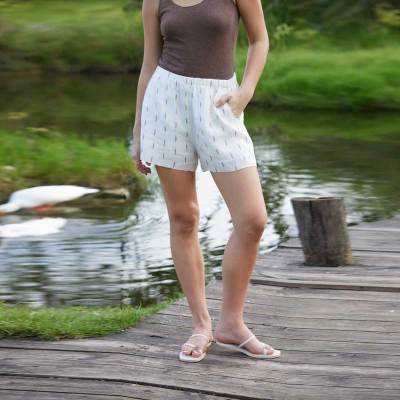
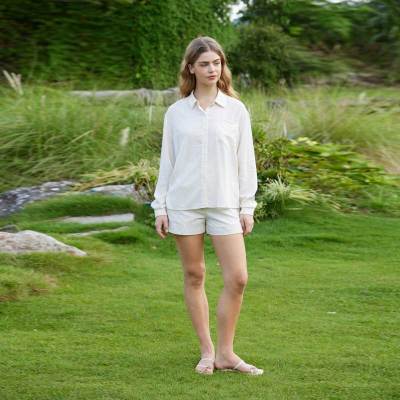
A good way to picture the correct fit is to imagine the fabric resting near the body rather than on it. There should be a visible but small gap at the waist and back, the sleeve should slide over the arm without gripping, and the closure, whether buttons, a zip or a tie, should sit flat with no gapping. Nothing should pull into sharp horizontal creases, and nothing should hang so far away that the body disappears. That middle ground is where linen looks deliberate, feels comfortable and stays comfortable through a long day.
Because linen has no recovery, it is worth stating the rule in the strongest terms: a linen garment that feels slightly too tight when you buy it will not improve. It may soften, but it will not stretch into comfort. If anything, it will feel tighter once you have eaten or been sitting for a while. The safe direction is always slightly generous, and the awkward direction is always slightly close. Buy the size that gives you room, and adjust the body afterwards if you want a closer line. The full method for choosing between sizes is in the guide to how to choose the right size.
Fit rule of thumb: allow about 4–8 cm of ease across the chest for a linen shirt, 5–10 cm across the bust and hip for a dress, and 4–7 cm at the waist and hip for pants. If the fabric pulls into horizontal creases when you sit or raise your arms, the garment is too small. If the shoulder seam drops well past the shoulder bone, it is deliberately oversized rather than relaxed.
Why Linen Needs More Room Than You Expect
The reason linen needs a little more room than a stretch fabric is built into the fibre. Linen is made from the flax plant, and the fibres are long, stiff and low in elasticity, which is exactly what gives linen its crispness, breathability and quick-drying character. Those same qualities mean the woven cloth resists stretching. Denim eases with wear, jersey moulds to the body, and wool recovers its shape, but linen largely keeps the measurements it was cut to. Comfort, then, is not something the fabric supplies later; it is something you choose at the size chart.
That is why the allowance, or ease, matters so much. Ease is the difference between the garment’s measurement and your body measurement, and it is what lets you sit down without the waistband digging in, reach forward without the shoulders pulling, and breathe without the chest seam straining. In linen, a small amount of ease in the wrong place shows immediately. A shirt with no ease at the bust will gape between the buttons. A pair of pants with no ease at the hip will crease across the front of the thigh the moment you sit. A dress with no ease at the shoulder will pull the neckline sideways. Each of these is a sign that the allowance is missing, not that the garment is badly made.
There is also a styling reason to leave room. Linen is meant to drape and to crease in long, soft folds, and it can only do that if there is space for the folds to form. A skin-tight linen shirt cannot drape; it can only strain, and the creases it forms are short and sharp rather than long and soft. Slightly more room therefore improves both the feel and the look, which is a rare case of the comfortable choice also being the attractive one. Men and women both find that a relaxed linen garment photographs better, sits better and wears better across a range of body types.
How Much Ease Each Linen Garment Needs
The table below translates the general principle into numbers for the garments people buy most often. Treat the lower figure as a close, tailored look and the upper figure as a relaxed, untucked look. Both are acceptable; below the lower figure is not.
| Garment | Compare against | Comfortable ease |
|---|---|---|
| Linen shirt or blouse | Chest or bust | 4–8 cm (1.5–3 in) |
| Linen tunic or long top | Bust and hip | 6–12 cm (2.5–5 in) |
| Linen dress, fitted | Bust and hip | 5–10 cm (2–4 in) |
| Linen dress, A-line or maxi | Bust | 5–8 cm (2–3 in) at the bust |
| Linen pants or shorts | Waist and hip | 4–7 cm (1.5–2.75 in) |
| Linen wide-leg pants | Waist and hip | 6–10 cm (2.5–4 in) |
| Linen skirt | Waist and hip | 4–8 cm (1.5–3 in) |
Two adjustments sit on top of the table. If you run warm, prefer airflow, or live somewhere humid, take the upper end of each range, because more air around the body is exactly what makes linen pleasant. If you want a sharp silhouette for an occasion, take the lower end and accept that sitting will crease the fabric at the waist, which is normal. What you should not do is go below the lower figure, because there is nothing in the fabric to compensate and the garment will only become less comfortable as the day goes on.
For a closer look at how the allowances behave in real garments, browse the linen shirts for tops and the linen dresses for one-piece styles, and compare the listed measurements with your own using the ranges above.
Loose, Relaxed or Oversized?
These three words describe different amounts of room, and knowing the difference prevents most fit mistakes. A “relaxed” fit follows the body at a small, consistent distance, so you can still see the shape of the wearer beneath the cloth. A “loose” fit adds more room, especially through the body and sleeve, and hangs straighter from the shoulder with less definition at the waist. An “oversized” fit is a deliberate design decision in which the garment is cut several sizes above the body, the shoulder seam drops past the shoulder bone, and the chest measurement may be 15 cm or more above the body. Relaxed and loose are easy to wear; oversized is a style and should be chosen on purpose.
The most useful single test is the shoulder seam. In a relaxed or loose fit, the seam still lands on or very near the shoulder bone. In an oversized fit, it hangs several centimetres down the upper arm. That visual difference is also practical: once the seam drops, raising your arms lifts the whole garment, so an oversized shirt is less comfortable to move in even though it has more fabric. If you want a relaxed look, buy a relaxed style in your normal size rather than an oversized style in the hope that it drapes well.
For people who are between sizes, this distinction also points to the right answer. If the style is already relaxed or loose, choose the smaller of your two sizes so the garment ends up with a moderate amount of ease rather than a lot. If the style is fitted or tailored, choose the larger of your two sizes, because there is no spare room in the design and the fabric cannot make any. Either way, let the shoulder seam confirm the choice: it should sit on the bone.
The Five Checks That Confirm a Good Fit
Whether you are trying a garment on or reading a size chart online, five checks cover almost every fit question. Run them in this order, because the first two cannot be fixed cheaply later and the last three can.
- Shoulder. The sleeve seam should sit on the shoulder bone, not hanging past it and not pulled in towards the neck.
- Movement. Fasten the garment, raise your arms and sit down. Nothing should pull tight and the fabric should not crease sharply across the chest, bust or hip.
- Ease. Pinch the fabric at the side seam. You should be able to hold roughly a finger of air for a shirt, a little more at the back.
- Closure. Buttons, a zip or a tie should lie flat with no gapping. Any gap means the garment is being strained at that point.
- Length. Sleeves should end at the wrist bone, hems should clear the floor, and a dress or shirt should stop where you intend to wear it.
If you are buying online, the same five checks become measurements. Measure your shoulder width, chest or bust, waist and hip once and write them down, then compare each with the size chart figure for the garment rather than with the size name. A size “M” from one maker can measure several centimetres differently from another, so the numbers, not the label, are what decide the fit. Where a garment sits between two of your sizes, the general rule applies: size up in tops and dresses, and choose the smaller size for loose designs or wide-leg bottoms whose waistband already sits flat.
What Changes the Fit After You Buy
Good linen clothing is usually garment-washed, meaning the finished garment is washed before it is sold so that most of its shrinkage has already happened and the fabric feels soft from the first wear. That is why, unlike some raw woven fabrics, the linen garment you try on is close to the size it will stay. It does not mean the fit never moves at all. Linen relaxes slightly over the first several washes as the weave settles, usually by millimetres rather than a whole size, and it can be stretched back into shape if it is pulled while soaking wet.
Care habits therefore affect fit as much as the initial size does. Linen hung dripping wet can stretch under its own weight, especially at the shoulders and hem, so drying flat or on a padded hanger helps the garment hold its shape. Very hot tumble drying can tighten the cloth and weaken the fibre, so air drying is the safer choice for both fit and longevity. Steaming a garment while it is slightly damp helps it settle back into its intended line, which is why steaming is gentler on shape than ironing a dry garment flat. The way water and heat act on linen is covered in more detail in the answer on whether linen shrinks after washing.
The practical takeaway is to judge fit in the middle of the garment’s life rather than on day one. After a handful of wears and washes, a linen shirt or dress has finished most of its settling, and the fit you feel then is the fit you will keep. Choosing the middle of the ease range rather than the tight end means that small settling never becomes a problem, and the garment stays comfortable across the first season and beyond.
Sizing Up or Down When You Are Between Sizes
Being between sizes is common in linen, because sizing varies between makers and because a non-stretch fabric has no tolerance for error. The simplest way through it is to decide which measurements you can change and which you cannot. Shoulder width and length are difficult and expensive to alter, while the chest, waist and hip can usually be taken in by a tailor for a modest cost. So the rule is to buy the size that gets the shoulder and the length right, and then have the body adjusted if you want a closer line.
In practice that means sizing up more often than down. For a linen shirt, blouse or dress, the larger size gives you the shoulder and length you need, and the extra fabric through the body simply drapes or can be taken in. For loose styles and wide-leg pants that already contain plenty of ease, the smaller size is usually correct, because the design has room built in and the waistband, not the leg, decides whether it fits. If you are unsure, check the shoulder measurement first, then the length, and let those two decide.
- Fitted or tailored styles: choose the larger size, then alter the body if needed.
- Relaxed or loose styles: choose the smaller size so the ease stays moderate.
- Wide-leg pants: let the waistband decide; the leg is designed loose.
- Tucked shirts: choose a length that reaches the mid-seat so it stays in place.
- Untucked shirts: choose a length around the high hip so the silhouette stays visible.
Buying for a gift adds one more consideration: without the wearer’s measurements, a relaxed style in a mid-range size fits the widest range of bodies, and a loose piece with an adjustable waist or tie is safer than a fitted one. Where the return policy allows an exchange, the risk is small; where it does not, it is worth choosing a style with more built-in ease. If you are unsure which of two sizes to send, the general advice is still to favour the slightly larger one, so the recipient can wear the piece comfortably straight away. The specific situations that come up most often are set out in the answer on what to do if you are between sizes.
Frequently Asked Questions
Should linen be tight or loose?
Relaxed rather than tight. Linen has no stretch, so a tight garment cannot become comfortable, while a slightly loose one drapes and breathes. Aim for 4–8 cm of ease across the chest in a shirt and 5–10 cm across the bust and hip in a dress, and check that the fabric does not pull when you sit.
Does linen stretch out with wear?
Only slightly. Linen relaxes a little over the first few washes as the weave settles, usually by millimetres rather than a size, and it has almost no stretch to begin with. Buy the size you want to keep, rather than a size you hope will grow into comfort, because it will not.
How do I know if linen is too small?
The clearest signs are horizontal pull lines across the chest, bust or hip, a gap between buttons, a waistband that digs in when you sit, and a shoulder seam that has been pulled towards the neck. If you see any of those, the garment is too small and there is no stretch to fix it.
Should I size up in linen pants?
Usually, yes, unless the style is deliberately wide or loose. The waistband is the deciding measurement in a non-stretch woven fabric, so choose the size whose waist fits comfortably while you are seated. A waistband that is merely snug when you stand will feel too tight after a meal.
Does garment-washed linen shrink more after buying?
No. Garment-washed linen has already been washed, so most of its shrinkage is done before you receive it. It may settle by a few millimetres over the first washes, but it will not drop a size. Wash cool and air dry to keep the fit as it is.
Find Your Fit in Linen
Measure your shoulder, chest or bust, waist and hip once, then compare those numbers with the size chart on each garment and allow the ease shown in this guide. Start with a relaxed-fit linen shirt as the easiest piece to get right, or explore the full collection of dresses, pants and sets to build a small wardrobe where every piece fits the way linen is meant to.