Linen Lifestyle
Holiday Travel with Linen: Packing for Warm Destinations in December
Pack eight linen pieces for ten days: three tops, two bottoms, one dress, one layer and one set. Linen carries humidity better than cotton, dries in four to six hours in warm air, and weighs less than the knitwear you would pack instead. Wash every third day in a hotel sink, and the eight pieces cover the full ten days without a laundry service.
The Short Answer: Eight Pieces, Three Washes, One Bag
A ten-day trip to a warm destination in December needs eight linen pieces and three sink washes. The eight are three tops, two bottoms, one dress, one long-sleeve layer and one two-piece set. The three washes happen on day three, day six and day nine, and each takes about fifteen minutes of attention. Everything fits in a carry-on because linen at 110 to 145 gsm folds flat, and eight pieces of it weigh less than four cotton shirts and a pair of jeans.
That is the whole method. What follows is the part that decides whether it works: which eight pieces, at which fabric weights, in which order you wear them, and how you wash and dry them in a hotel room without turning the trip into a laundry project. The list is not arbitrary. It is built so that each piece combines with at least three others, which is what lets eight garments produce more than twenty distinct outfits across ten days.
One thing the list is not designed for is a December trip that stays cold. If you are flying to a northern city rather than a warm coast, the weights invert and the piece count rises, because linen layers do not insulate the way wool does. That case is covered separately in packing linen for cooler climates, and the two lists should not be mixed.
The Two-Climate Problem Nobody Plans For
Almost every December warm-weather trip starts in the cold. You leave a house at 4°C, sit in an airport at 21°C, board a plane held at 23°C, and land nine hours later at 29°C with 78 percent humidity. The garments that work at the end of that chain are not the garments that work at the start, and the mistake most people make is packing for the destination while dressing for the departure.
The fix is not more clothing. It is a single layer you can remove and carry. A 160 to 180 gsm linen overshirt over a 130 gsm linen tee handles the airport and the plane, then goes into the day bag on arrival. That combination is warm enough over a tee at 15°C in a terminal, breathable enough at 23°C on the plane, and light enough to carry once you no longer need it. The alternative, a wool coat, becomes a twelve-hour burden that you then have to store in a hotel room for ten days.
There is a second version of the same problem: the air-conditioned interior. A resort in December often runs its restaurants and lobby at 21 to 23°C while the terrace outside sits at 30°C. You cross that boundary four times a day. A long-sleeve linen layer and a light scarf solve it, and both are pieces you would pack anyway.
What the temperature chain actually asks of your clothing
| Stage | Typical temperature | What works | What fails |
|---|
| Home departure, early morning | 2 to 8°C | Linen overshirt over a tee, plus one outer layer you leave in the car | Any linen worn as the only layer |
| Airport terminal | 20 to 23°C | Overshirt open over a tee, trousers, closed shoes | Heavy knitwear you cannot remove gracefully |
| Long-haul cabin | 22 to 24°C, dry air | Loose linen tee, wide trousers, scarf for the neck | Tight waistbands, synthetic blends |
| Arrival, late evening | 26 to 29°C, humid | Same tee and trousers, overshirt carried | Anything that holds sweat against the skin |
| Resort interior | 21 to 23°C | Long-sleeve layer, scarf | Bare shoulders for a two-hour dinner |
| Beach or market, midday | 30 to 34°C | Loose 110 to 130 gsm linen, hat, sandals | Fitted garments, dark dense weaves |
The table is the reason the packing list includes a long-sleeve piece at all. On paper, a long-sleeve linen shirt looks wrong for a beach holiday. In practice it is the piece you wear on the plane, in the restaurant, and on the one evening the sea breeze turns cool, which on a December trip to the tropics happens more often than people expect.
Why Linen Handles Heat and Humidity Better Than Cotton
Linen is a bast fibre from the flax plant, and its structure is the reason it behaves differently from cotton in humid air. The fibre is longer, smoother and less crimped, so a linen fabric holds less air between fibres and passes moisture along the surface rather than trapping it in the gaps. In practice that means a linen shirt feels dry sooner after you sweat in it, and it does not cling the way a cotton jersey does when the air is saturated.
The measurable part is moisture regain, the amount of water a fibre absorbs from the air before it feels wet. Linen takes up moisture readily and releases it quickly, which is why it feels cool to the touch and why it dries faster than cotton of the same weight. The practical consequence for travel is a drying time of four to six hours for a 130 gsm linen shirt in warm moving air, against eight to twelve hours for a comparable cotton shirt in the same conditions. That difference is what makes a three-wash rhythm possible in a hotel room with no dryer.
Two other properties matter on a trip. Linen is strong when wet, so a sink wash and a firm wring do not damage it the way they damage weaker cellulosic fabrics. And it softens with every wash, so the shirt you packed on day one is more comfortable on day ten. That is not a marketing line; it is why garment-washed linen, which has already been through the softening, is the sensible choice for travel rather than a crisp untreated cloth that will finish its shrinking on your holiday.
The fibre itself is traceable. European linen is grown and processed largely in Normandy, Belgium and the Netherlands, and the European Flax standard is the reference most buyers use when they ask where the fibre came from. For a traveller, the useful part of that is consistency: a labelled European flax linen at a stated weight behaves predictably, which is what lets you pack by weight rather than by feel.
The one-line version
Linen absorbs moisture without feeling wet, dries in four to six hours in warm air, and gets stronger when wet. That combination is why eight pieces can cover ten days.
The Eight-Piece List, With Weights and Wear Counts
The list below is the core of this guide. Each row is one garment, the weight it should be, how many times it appears across ten days, and why it earns the space. Eight pieces, one carry-on, no checked bag.
The eight-piece linen capsule for ten days in a warm destination
| Piece | Weight | Wears in 10 days | Why it earns the space |
|---|
| Loose linen tee, crew neck | 120 to 140 gsm | 5 to 6 | Works alone at 30°C, under the overshirt on the flight, and as a sleep layer |
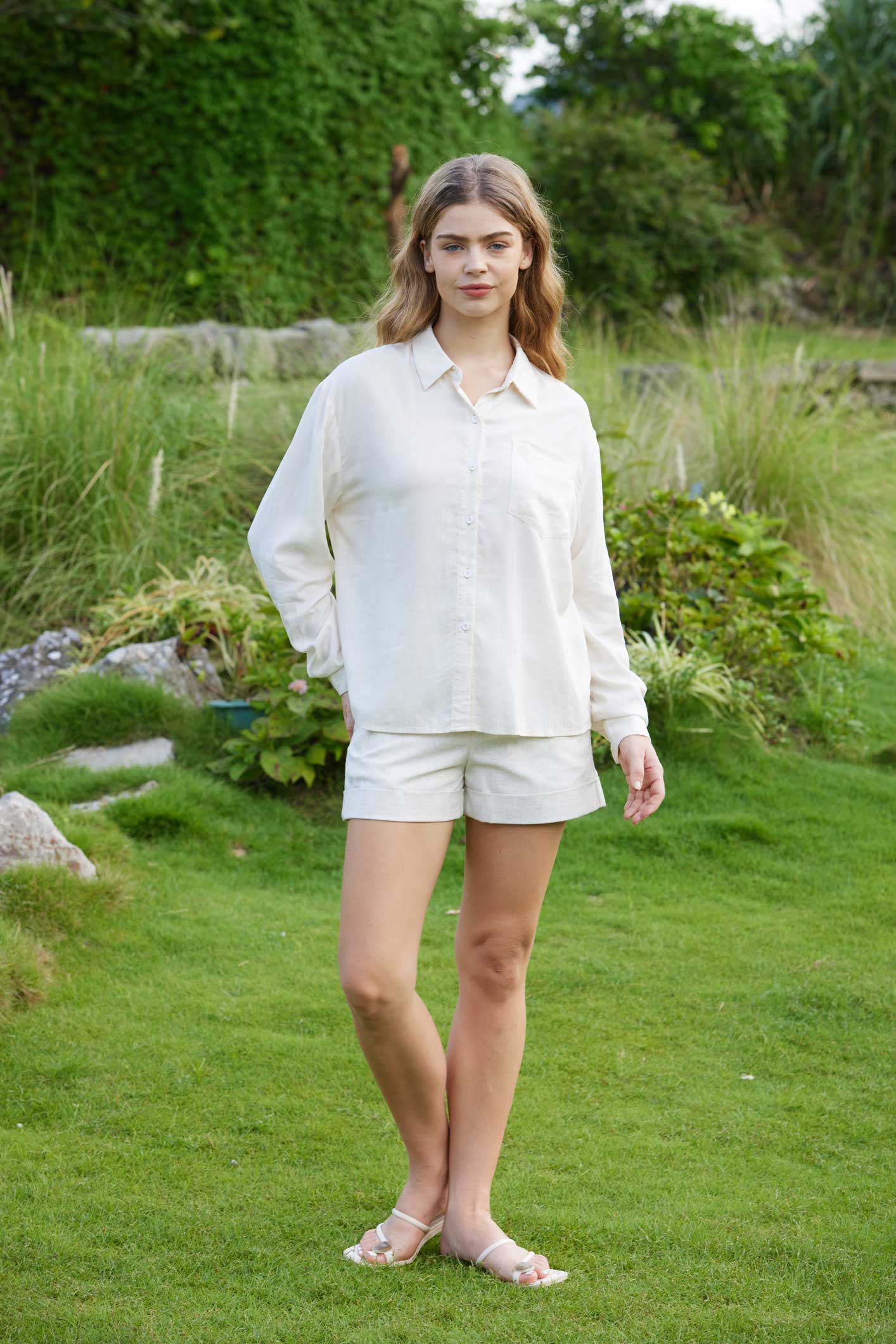
| Short-sleeve linen shirt with a collar | 130 to 150 gsm | 3 to 4 | Lifts shorts to restaurant standard, and covers shoulders in the sun |
| Long-sleeve linen shirt or overshirt | 160 to 180 gsm | 4 to 5 | The flight layer, the air-conditioned dinner layer, the cool-evening layer |
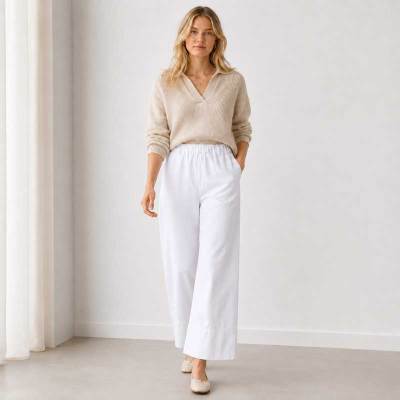
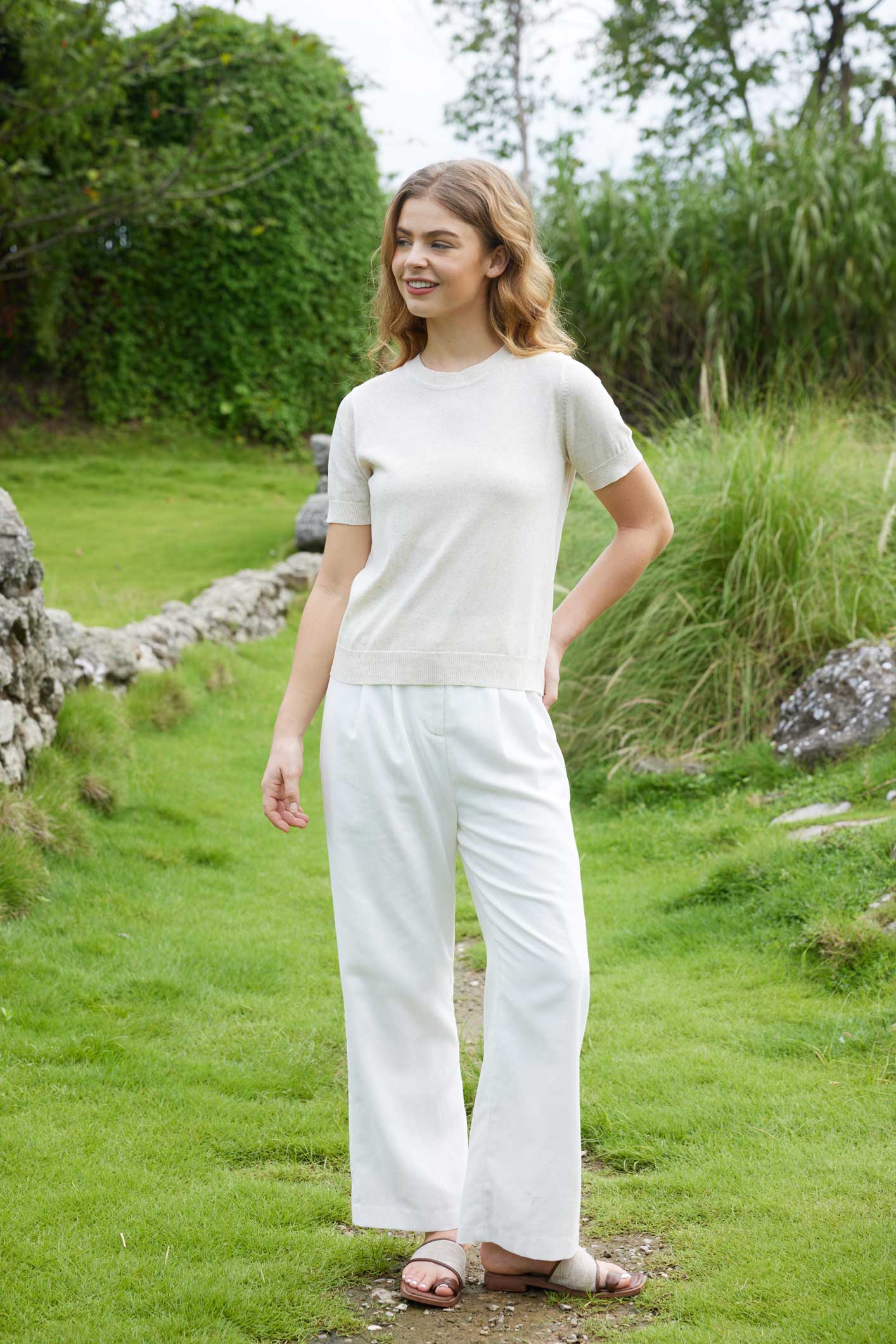
| Wide-leg linen trousers, elastic back | 150 to 180 gsm | 4 to 5 | Dressy enough for dinner, loose enough for a 34°C market, forgiving on a long flight |
| Linen shorts, mid-thigh | 140 to 170 gsm | 3 to 4 | The beach and daytime piece; dries fastest of everything you pack |
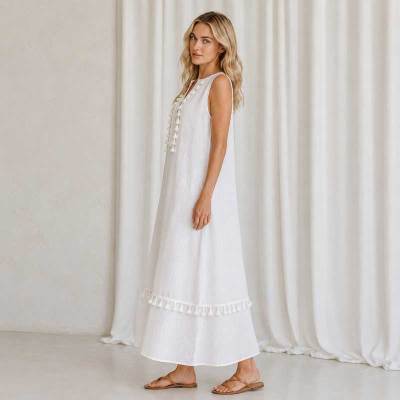
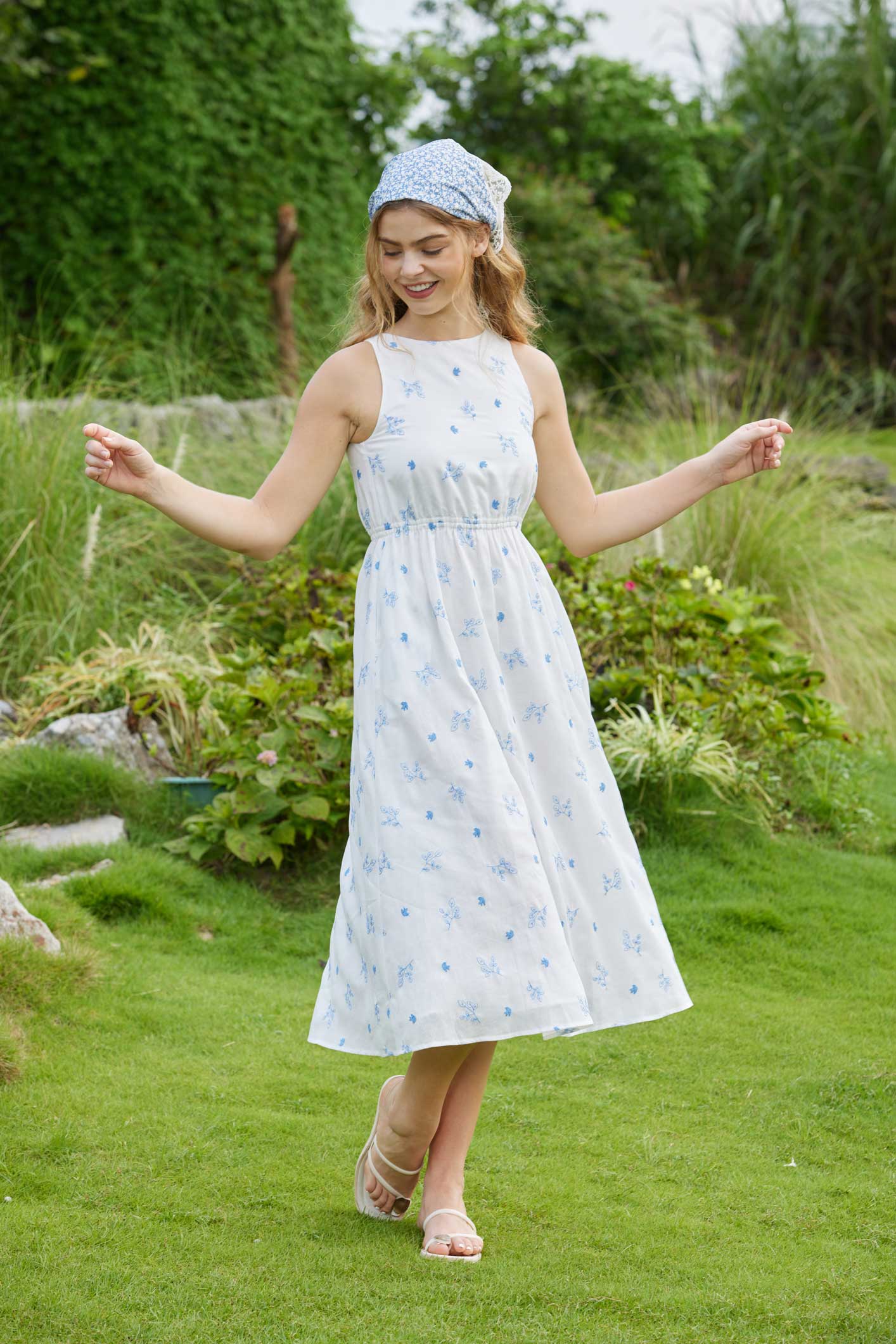
| Linen midi or maxi dress | 120 to 150 gsm | 3 | One garment that resolves an evening with no styling decisions |
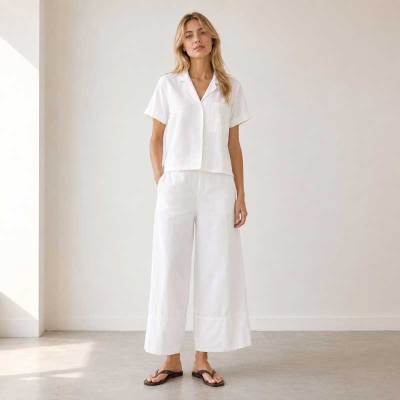
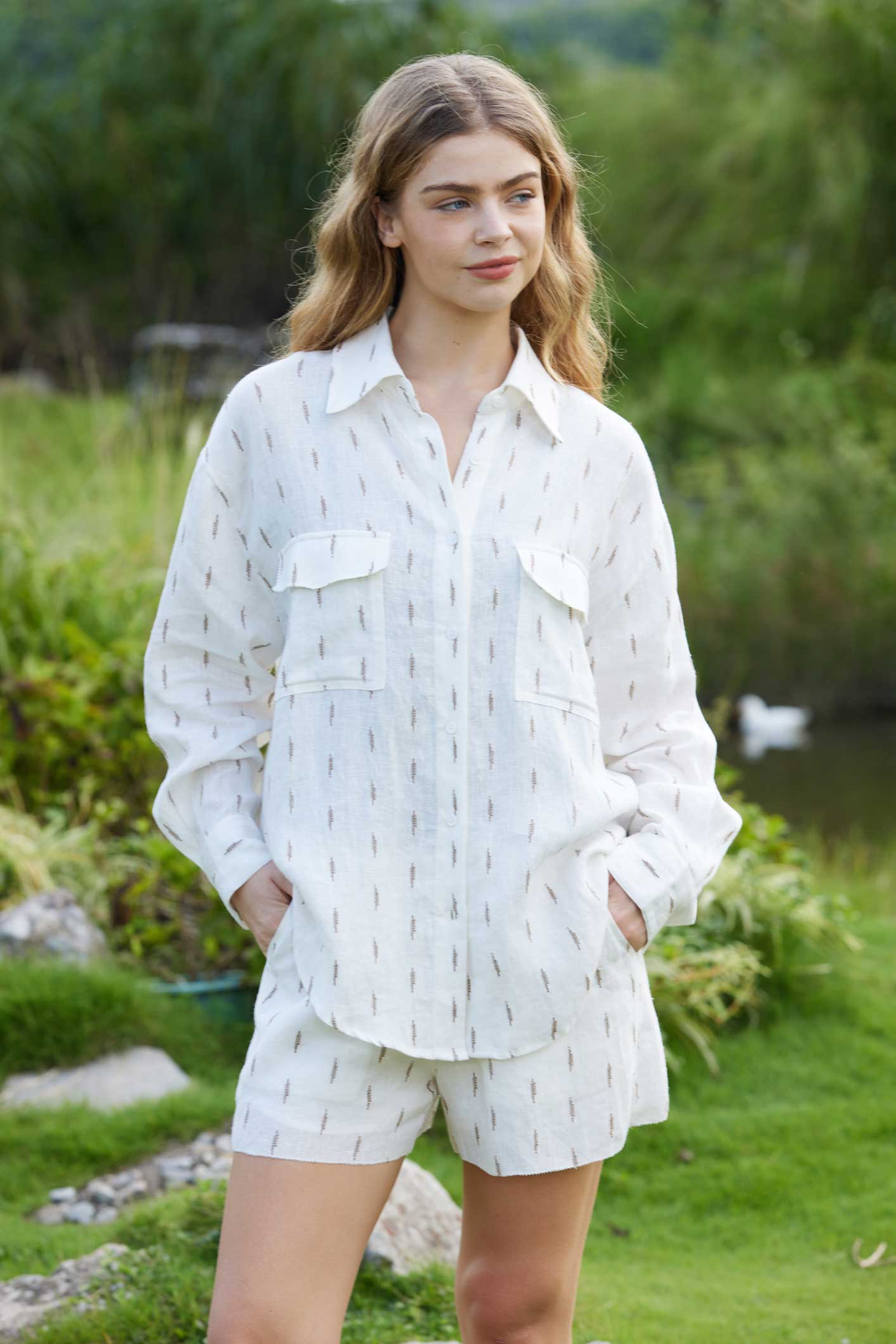
| Linen two-piece set | 150 to 180 gsm | 3 to 4 | Wear together for dinner, separately as backup pieces, which is why a set beats a ninth item |
| Linen scarf or large square | 90 to 120 gsm | Daily | Sun cover, plane blanket, shoulder wrap in an air-conditioned lobby, beach towel in a pinch |
The arithmetic behind eight is simple. Ten days, three washes, and a garment worn once between washes means you need a little over three days of clothing in rotation, plus one spare set that is drying. Eight pieces gives you that spare without a ninth or tenth item. A twelve-piece list does not add outfits; it adds decisions, and it usually means a checked bag.
The set is the piece people question most, and it is the one that earns its place most clearly. Worn together it is the strongest outfit in the bag for a dinner or a hotel bar. Worn separately it becomes a second pair of trousers or a second shirt, which is exactly what you want on day eight when everything else is in the sink. If you are choosing between a ninth top and a set, take the set.
How the Eight Pieces Produce Twenty-Plus Outfits
Eight pieces do not give you eight outfits. They give you combinations, and the count depends on how many pieces share a colour family. The grid below is a realistic ten-day rotation built only from the list above, assuming a palette of two neutrals and two colours that all sit together.
A ten-day rotation built from eight pieces
| Day | Daytime | Evening | Notes |
|---|
| 1 | Tee, wide trousers, overshirt carried | Same, overshirt on | Travel day; nothing new comes out of the bag |
| 2 | Shorts, tee, scarf as sun cover | Dress, scarf as wrap | Beach or pool day, then dinner |
| 3 | Collar shirt, shorts | Set, worn together | First wash in the evening: tee and shorts |
| 4 | Set trousers with tee | Set shirt with wide trousers | The set splits into two outfits |
| 5 | Wide trousers, collar shirt | Dress, overshirt | Second wash: collar shirt and shorts |
| 6 | Shorts, tee | Set, worn together | Excursion day; wash the dress overnight |
| 7 | Dress, scarf | Wide trousers, overshirt | Third wash: tee and wide trousers |
| 8 | Set trousers, tee | Collar shirt, shorts | Everything is back in rotation |
| 9 | Shorts, collar shirt | Dress or set | Final wash: whatever will not be worn on the flight |
| 10 | Tee, wide trousers, overshirt | Travel, no change | The heaviest pieces go on the body, not in the bag |
Two observations from that grid. First, the two bottoms do most of the work, which is why they should be the most neutral pieces in the bag. Second, the dress and the set are the evening anchors, and between them they cover six of the ten nights, which removes the daily question of what to wear after dark.
Colour is what makes this work. If your eight pieces are two neutrals, one warm tone and one deep tone, every top works with every bottom, and the combinations multiply. If they are eight different colours, the same eight garments produce eight outfits and several of them look wrong. Pack a palette, not a wardrobe.
Choosing Weights: What 110 to 145 gsm Buys You, and What It Does Not
Fabric weight is the number that decides whether a linen garment is right for a trip, and it is the number most shoppers ignore. Grams per square metre tells you how much cloth sits in a square metre, and in linen it maps fairly directly onto how the garment behaves in heat, how much it creases, and how long it takes to dry.
Linen weights and where they belong on a warm-weather trip
| Weight | How it behaves | Best use on this trip | Drying time, warm air |
|---|
| 90 to 115 gsm | Very light, semi-sheer in pale colours, creases easily | Scarves, beach cover-ups, sleep shirts | 2 to 3 hours |
| 120 to 145 gsm | Light but opaque, soft drape, the classic summer weight | Tees, dresses, shorts, midi skirts | 3 to 5 hours |
| 150 to 180 gsm | Substantial, holds a collar and a crease, still breathable | Shirts, wide trousers, sets, overshirts | 5 to 7 hours |
| 200 to 240 gsm | Heavy, structured, warm | Outerwear and trousers for a cold destination, not for 30°C | 8 to 12 hours |
The rule of thumb for a December trip to the tropics is to keep the pieces that touch the skin at 120 to 150 gsm and the pieces that provide structure at 155 to 180 gsm. A 110 gsm shirt in white will be transparent in direct sun, which is fine at a beach bar and wrong at a restaurant. A 240 gsm trouser will feel like a mild punishment at 32°C and will still be damp the next morning if you wash it overnight.
There is a common misconception worth correcting: heavier linen is not more durable in a way that matters for a ten-day trip, and lighter linen is not automatically cooler. What matters is weave openness. A 160 gsm plain-weave linen breathes better than a 130 gsm tightly woven one because air moves through the gaps in the weave, not through the fibre. When you are choosing between two shirts at similar prices, hold them to a light: the one you can see through slightly is the one that will be comfortable at 33°C.
Garment washing changes the calculation a little. Pre-washed linen has already shrunk and softened, so the weight you buy is the weight you keep, and the garment will not tighten up after the first hotel sink wash. That predictability is worth paying for on a trip where you cannot afford a shirt that shrinks into a crop top on day four.
The Wash Cadence: Fifteen Minutes Every Third Day
Three washes in ten days is not a compromise. It is the rhythm that keeps eight pieces sufficient, and it takes less time than the alternative of finding a laundry service and waiting two days for it. The method below works in any bathroom with a sink, a towel and a hanging line or a shower rail.
- Wash on day three, six and nine, in the evening. Washing at night gives the garment the whole night plus the next morning to dry, which is enough even in a closed bathroom.
- Use cool water and a small amount of mild detergent. A capful is plenty for two or three garments. Hot water sets creases and can shrink a garment that was not pre-washed.
- Soak for ten to fifteen minutes, then agitate gently by hand. No twisting, no scrubbing. Linen is strong when wet, but the weave can distort if you wring it hard.
- Rinse in cool water until it runs clear. Residual detergent stiffens the cloth and attracts dirt on the next wear.
- Roll in a dry towel and press. This removes most of the water without wringing. It is the single step that cuts drying time in half.
- Hang on a hanger or a rail with space around it. Air movement matters more than heat. A garment bunched against another stays damp at the seams.
- Steam, do not iron. Hang it in the bathroom while you shower, or use a travel steamer. Linen is meant to have a soft rumple; pressing it flat in a hotel room is effort spent on the wrong result.
The drying times in the table above assume warm air and some movement. A closed bathroom at 24°C with no fan will double them, which is why the towel roll matters and why the wash happens at night rather than in the morning before an excursion. If the room has a balcony, hang outside for two hours and finish inside to avoid the salt film that sea air leaves on damp cloth.
The failure case
The one way this rhythm breaks is washing everything on day nine. Two garments dry overnight; six do not, and you spend the last day of the trip in damp linen. Wash in small batches on the schedule and never more than three garments at once.
Humidity Changes the Math: Adjusting for 60 Percent Versus 85 Percent
The eight-piece list assumes moderate humidity. At 60 percent, a 140 gsm shirt dries in four hours and the rhythm above holds without adjustment. At 85 percent, with still air and a closed room, the same shirt can take ten hours, and a heavy trouser may still be damp at breakfast. That is not a reason to pack differently; it is a reason to change the washing sequence.
In high humidity, three adjustments keep the system working:
- Wash one garment per night instead of three every third day. The total number of washes is the same, but nothing is ever waiting for a second garment to finish drying.
- Prefer the lightest pieces for the wash rotation. Wash the tee and the shorts daily if needed; send the trousers and the overshirt to a hotel laundry once, mid-trip, if the budget allows.
- Use the air conditioning as a dryer. A garment on a hanger in front of a cool-air vent dries faster than one in a humid bathroom, because the air is being dehumidified by the unit.
There is a related point about what humidity does to the wearing, not just the washing. At 85 percent, a garment worn for six hours holds moisture and starts to smell if it goes straight into a bag. Hang everything, every night, even the pieces you plan to wear again. Airing a garment for eight hours is often enough to make it wearable for a second day, which quietly cuts the number of washes you need.
If you are travelling somewhere genuinely wet, such as a tropical coast in its rainy season, treat the list as seven days of clothing plus a laundry stop rather than ten days of self-sufficiency. One mid-trip laundry service, budgeted in advance, removes all the pressure from the sink-wash rhythm.
Activity Changes the List More Than Weather Does
Two trips at the same temperature can need different bags. A week of resort lounging and a week of city walking, boats and temples are not the same packing problem, and the difference is in the pieces that need to be smart rather than in the pieces that need to be cool.
Adjusting the eight pieces for the kind of trip
| Trip type | Keep | Swap in | Swap out |
|---|
| Beach resort | All eight | Nothing; add a second scarf | Nothing |
| City and culture | Tee, collar shirt, wide trousers, overshirt, scarf | Second pair of wide trousers | Shorts, beach scarf |
| Boat or sailing | Tee, shorts, overshirt, scarf | Quick-dry sandals, second tee | Dress, set |
| Mixed resort and city | All eight | Closed linen shoe | Second scarf |
| Wedding or event | Dress or set, overshirt, wide trousers | One dressier piece | Shorts |
The pattern is that activity changes the bottom half and the formality of the top half, while the layer and the scarf survive every version. That is why those two pieces are non-negotiable: they are the only items that work in a beach bar, a cathedral and an airport on the same trip.
Footwear is outside the scope of this list, but it interacts with it. Linen trousers at 175 gsm break above a sandal and sit badly on a trainer; wide legs work with both. If you are packing one pair of shoes, choose the one that works with the widest leg you own, and let the hems break where they will. Half an inch of extra length in a wide linen trouser reads as intended; the same extra length in a narrow one reads as a mistake.
Packing Method: Roll, Cube, and the Wrinkle Question
Linen creases. That is a property of the fibre, not a fault in the garment, and the useful question is not how to prevent creases but how to arrive with creases that look deliberate. Three habits do most of the work.
First, roll rather than fold. A rolled linen shirt at 140 gsm occupies less space and creases along soft curves instead of hard lines. Roll from the hem upward with the collar at the outside, so the collar keeps its shape and the front panel stays smooth. Second, use packing cubes by category rather than by day: one cube for tops, one for bottoms, one for the set and dress. That structure lets you find a garment without unpacking the bag, which matters more on a ten-day trip than on a weekend. Third, wear the heaviest piece on the plane. The overshirt and the wide trousers should be on your body at departure, which removes roughly a third of the bag's weight and volume.
On arrival, hang everything for an hour before you judge it. Most of the creasing in a rolled linen shirt relaxes once the garment is hanging in warm air. What remains responds to steam, and a bathroom shower does the job for free. If you are staying somewhere with a kettle, hanging the garment in the bathroom with the door closed for ten minutes after a hot shower will handle all but the sharpest fold lines.
- Do not iron linen flat. A pressed linen shirt looks like a cotton shirt and loses the texture that makes it worth packing.
- Do not pack damp. Even slightly damp linen will develop a smell in a sealed bag within a day, and that smell does not wash out easily.
- Do not overfill the cube. Compression creases are the hard ones; a loosely packed cube arrives in better condition than a tightly packed one.
If wrinkles genuinely bother you, the 160 to 180 gsm pieces crease less visibly than the 120 to 145 gsm ones, because there is more cloth to absorb the fold. That is one reason the overshirt is a heavier weight: it is the piece you will wear to dinner, and it is the piece that needs to look composed after nine hours in a bag.
Sun, Salt and Chlorine: Care on the Ground
Linen is a strong fibre, but a ten-day trip exposes it to three things it does not love: prolonged direct sun, salt water, and chlorine. None of them will destroy a garment in ten days, but all of them will shorten its life if the garment is left wet in them.
Salt water is the least harmful. Rinse the garment in fresh water at the end of the day, because dried salt crystals abrade the fibre at the folds and leave a stiff film that feels like damage. Chlorine is more aggressive: a swimsuit in a chlorinated pool is a different fabric, but a linen shirt worn over one and left damp will take on a bleached patch. Rinse within an hour. Direct sun is cumulative; a white linen shirt left on a lounger for six hours a day for ten days will yellow at the shoulders, and that yellowing is permanent.
The practical rules are short. Rinse after salt or chlorine, dry in shade rather than full sun, and never leave a damp garment in a beach bag. A linen scarf doubles as a towel and dries in under two hours, which is why it is on the list. For anyone with sensitive skin, the finishing matters as much as the fibre, and a certification such as OEKO-TEX on the label is a reasonable thing to look for when a garment will be worn against damp skin all day.
Three rules for the beach bag
Rinse after salt or chlorine. Dry in shade. Never leave damp linen folded in a bag, because the fold lines hold moisture and the smell that comes with it.
What to Leave at Home
The hardest part of packing eight pieces is not choosing them; it is leaving the ninth out. Five categories are almost always a mistake on a warm-weather trip, and each has a specific reason.
- Heavy linen, 200 gsm and up. It will feel oppressive at 30°C and it will not dry overnight. Leave it for the cold-weather trip.
- Fitted linen dresses and shirts. Without stretch, a fitted garment is unforgiving after a long flight and in humid air. Loose cuts are the point.
- A second pair of shorts. Shorts dry fastest and are worn least on a trip that includes dinners. One pair plus the dress and the set covers the same days.
- Anything that needs ironing to look right. If a garment only works pressed, it does not work on this trip.
- Bulk cotton basics. A cotton tee takes twice as long to dry as a linen one and holds odour longer. If you need a backup layer, make it linen.
There is also a category that people over-pack for emotional reasons: the outfit for an event that may or may not happen. If a trip includes one dinner that might be formal, pack the set and let it do that job. A dedicated fourth evening outfit is a garment that travels 6,000 km and stays in the bag.
One more subtraction worth making: toiletries and gadgets do not belong in this calculation, but they compete for the same space. Eight linen pieces at these weights occupy roughly the volume of four cotton shirts, which leaves room for a small toiletry bag and a charger. If the bag is full before the clothing goes in, the clothing is not the problem.
What Eight Pieces Cannot Do, and When to Pack Nine
Honest limits matter more than a tidy list. Eight pieces work for a ten-day trip that mixes beach, city and dinners in a warm climate. They do not work for four situations, and in each of those the correct answer is a different bag rather than a longer list.
If the trip includes a formal event with a dress code, you need a garment that meets that code, and linen at 140 gsm will not. If the destination drops below 12°C at night, you need an insulating layer that is not linen. If you are travelling for work with meetings, the eight-piece list under-serves the top half and you should add a second collar shirt and a third trouser. And if you have no access to a sink or a drying line for three consecutive days, the wash rhythm collapses and the piece count has to rise.
When the list needs to change
| Situation | Does the eight-piece list work? | What to do instead |
|---|
| Beach, city and dinners, 26 to 33°C | Yes, as written | Nothing |
| Nights below 12°C | No | Add a non-linen insulating layer or read the cold-weather packing guide |
| Formal event with a dress code | No | Pack one garment that meets the code, and drop the shorts |
| Business meetings | Partly | Add a second collar shirt and a third trouser, drop the beach scarf |
| No sink or line for three days | No | Pack eleven pieces or budget one laundry service mid-trip |
For the middle cases, the answer is usually a laundry service rather than more clothing. One service wash on day five costs less than a checked bag on most routes and solves the problem completely. The eight-piece list is designed to make that unnecessary, not to make it forbidden.
If you are still deciding whether linen is the right fabric for the trip at all, the case for it in heat and humidity is set out in why linen is the best fabric for travel, and the piece-by-piece selection logic is in how to choose linen clothing for travel. This guide assumes you have already made that decision and are now working out what goes in the bag.
Buying Before You Go: Fit, Weight and the One-Wash Test
Most of this guide is about packing, but the list only works if the garments fit the way the plan assumes. Two fit decisions matter more than the rest on a warm-weather trip: the trouser waist and the shirt chest.
For the trousers, choose an elastic-back or drawstring waist with at least 6 cm of adjustment. Ten days of travel, two long flights and a change in diet all move a waist measurement, and a fixed waistband has no give. For the shirt, choose a chest with 10 to 14 cm of ease over your body measurement. That is enough to keep the cloth off the skin in humidity without looking borrowed, and it is the difference between a shirt that works at 32°C and one you take off at the first opportunity. The exact measurement points for each cut are set out in the size and fit guide.
Before any trip, run one wash on the garment you plan to rely on. Wash it cool, dry it the way you will dry it in a hotel, and time it. If a 140 gsm shirt takes eleven hours to dry in your bathroom at home, it will take longer in a humid hotel room, and the wash rhythm needs adjusting before you leave rather than after. That single test tells you more than any specification on a product page.
Finally, pack the palette deliberately. Two neutrals that match everything, one warm tone, one deep tone. Eight pieces in four colours produce the grid above; eight pieces in eight colours produce a bag of clothes and nothing to wear. For the evening anchors, the quickest route is a midi dress that works with the scarf and a set that splits into two outfits, which is why both are on the list rather than a fourth top.
If you are starting from an empty wardrobe rather than editing an existing one, the pieces that do the most work across the ten days are the wide-leg trousers, the 160 to 180 gsm overshirt, and the set. Those three carry the evenings, the flights and the air-conditioned interiors, and the rest of the list is built around them. Browse the current linen dresses and linen sets with those weights in mind rather than choosing by photograph.
Frequently Asked Questions
Is eight pieces really enough for ten days?
Yes, with three sink washes. Eight pieces give you three days of clothing in rotation plus one set drying, which is the amount you need if you wash every third day. The list fails only if you cannot wash at all for more than three days.
What if the destination is humid and nothing dries?
Wash one garment per night instead of three every third day, roll each piece in a towel before hanging, and hang it in front of an air-conditioning vent. In 85 percent humidity that reduces drying time from roughly ten hours to five or six.
Can I wear the same linen shirt twice between washes?
Yes, if you air it overnight. A garment worn for a few hours and hung in moving air is usually wearable again the next day, which quietly reduces the number of washes a ten-day trip needs.
Should I pack heavier linen for the flight?
Wear it rather than pack it. A 160 to 180 gsm overshirt and 150 to 180 gsm trousers handle an airport at 21°C and a cabin at 23°C, and wearing them removes about a third of the bag's weight and volume.
How do I stop linen from arriving creased?
Roll rather than fold, pack loosely by category, and hang everything for an hour after arrival. Steam the rest in a bathroom after a hot shower. Do not iron linen flat; a soft rumple is the intended look.
Plan the Bag Around Three Pieces
If you are building this list from scratch, start with the wide-leg trousers, the 160 to 180 gsm overshirt and a two-piece set. Those three carry the flights, the evenings and the air-conditioned rooms, and everything else on the list is chosen to work with them. Shop linen bottoms by weight and palette rather than by photograph, and confirm the trouser waist against the size chart before you commit. For the packing method itself, the step-by-step version is in how to pack linen clothing for vacation.