Dressing a Pear Shape in Linen: Cuts That Flatter
Dressing a Pear Shape in Linen: Cuts That Flatter
A pear shape is dressed best in linen by balancing the shoulder line against the hip line. Choose styles that define the waist, add a little visual weight above the waist, and let the fabric skim rather than cling below it. In practice that means structured linen shirts, blouses and tunics, A-line, wrap and shirt dresses from the linen dress collection, and straight or wide-leg linen pants or midi skirts with a clean, flat waistband. Medium-weight linen in the 150-190 gsm range holds its own shape and hides the hip line better than very light 110 gsm fabric, which drapes close to every curve.
What a Pear Shape Actually Means in Linen Terms
A pear shape is a proportion, not a clothing size. It describes a body where the hips and thighs are wider than the shoulders and bust, with the waist sitting somewhere between the two. You can be a UK 8 or a UK 24 and still be a pear; you can be a petite pear, a tall pear or a pear with a fuller bust. What defines the shape is the relationship between the upper and lower halves of the body, not the number on the label.
That distinction matters because the advice a pear-shaped body needs is about balance and cut, not about "slimming" or "covering up". Treating a pear shape as a size problem leads to oversized, shapeless linen that hides the waist as well as the hips and makes the silhouette wider than it is. Treating it as a proportion problem leads to a much more useful set of decisions: where the waistline sits, where the fabric stops clinging, and how much structure the shoulder needs.
In linen specifically, three features of the body matter most:
- The waist position. A pear shape often has a waist that sits a little higher or lower than average, so the "natural" waist seam on a dress or a pair of pants is not automatically the right height.
- The difference between shoulder and hip width. The greater that difference, the more the upper body needs visual weight and the more the lower body benefits from a clean, uninterrupted line.
- Where the body is fullest. Some pears carry more width at the upper thigh, others at the seat, others across the low hip. The best linen cut depends on which of those is most pronounced.
Once you can name those three things honestly, choosing a linen dress or a linen pant stops being guesswork. You are no longer looking for a "flattering" garment in the abstract; you are looking for a waist that lands in the right place, a shoulder that has enough presence and a lower half that keeps its shape without gripping.
Why Linen Reads Differently on a Pear Shape
Linen is a low-stretch fabric. It has almost no elasticity, so it does not mould itself around curves the way a jersey or a knit does. It also has a natural body and a dry, matte surface, and it softens rather than stretches with washing. That combination is good news for a pear shape, but only if the cut and the weight are chosen deliberately.
The weight of the fabric is the single most underestimated variable. Very light linen, in the region of 110-130 gsm, is airy and cool but it drapes tight to the body and reveals every line underneath. Medium linen, around 150-190 gsm, stands slightly away from the body and creates its own silhouette, which is exactly what a pear shape wants below the waist. Heavier linen, up to about 240 gsm, holds a strong shape and works well for structured pieces such as overshirts, blazers and wide-leg pants, though it can feel stiff at first before it breaks in.
KOSSR linen is woven from 100% European Flax and garment-washed before it reaches you, which pre-softens the hand feel and limits the surprise shrinkage that unwashed linen can show after a first home wash. Garment washing does not turn linen into a stretch fabric, though. The fibre still behaves like linen: it creases, it breathes, it gets softer with every wash and it keeps whatever shape the pattern was cut to hold.
| Weight range | How it behaves | Best use for a pear shape |
|---|---|---|
| 110-130 gsm | Very light, fluid, hangs close to the body | Layering pieces, tunics over a firmer bottom, holiday shirts |
| 130-150 gsm | Light with a little body, soft drape | Shirt dresses worn open, blouses tucked at the waist |
| 150-190 gsm | Balanced drape, stands slightly away, hides lines | A-line and wrap dresses, straight and wide-leg pants, midi skirts |
| 190-240 gsm | Firm, structured, holds a defined shape | Overshirts, structured jackets, tailored wide-leg trousers |
A practical test in the fitting room: hold the fabric of a skirt or a pant leg between two fingers and let it fall. If it collapses instantly into a narrow line, it will cling at the hip. If it falls into soft vertical folds that keep a little air inside, it will skim instead of grip. That small difference decides whether a linen bottom flatters a pear shape or fights it.
The Four Proportion Rules That Do the Real Work
Almost every pear-shape linen decision comes back to four principles. They work together, and skipping one usually undoes the effect of the others.
- Mark the waist. A visible waistline gives the eye a narrow reference point between the wider shoulder and the wider hip. A wrap tie, a belt, a waist seam, a tucked shirt or a cropped top over a high-waisted bottom all do this.
- Add presence above the waist. A collar, a boat or scoop neck, a sleeve that ends at a deliberate point, a textured or slightly lighter colour on top, or a structured overshirt all add width where a pear shape is narrowest.
- Keep the lower half calm. Clean vertical lines, one colour, no horizontal seams across the widest point, and no clinging fabric. A quiet bottom half lets the top half do the balancing.
- Stretch the vertical. A longer line reads as a narrower line. Mid-rise to high-rise waists, hems that stop at the slimmest part of the calf or ankle, and tonal top-to-bottom colouring all add height and balance.
Getting the waist point right
Linen is not forgiving about a waist seam that sits in the wrong place. If a dress waistline lands below your natural waist, it visually lengthens the hip; if it lands above, it can look short in the torso. If your waist sits higher than the standard pattern, look for a wrap dress you can tie yourself, a shirt dress cinched with a belt, or linen two-piece sets where the top and bottom can be sized independently. Our KOSSR size and fit guide shows where each style's waistline is designed to sit, which settles most waistline problems before you order.
Shoulder width without shoulder pads
You do not need structure to widen the shoulder in linen. A shirt with a proper collar and a set-in sleeve already creates a horizontal line at the top of the body. A boat neck or a slight puff at the sleeve head adds a little more. A linen blazer or overshirt worn open adds a strong vertical frame down each side, which balances a wider hip without adding bulk in the middle.
The hem line is a design decision
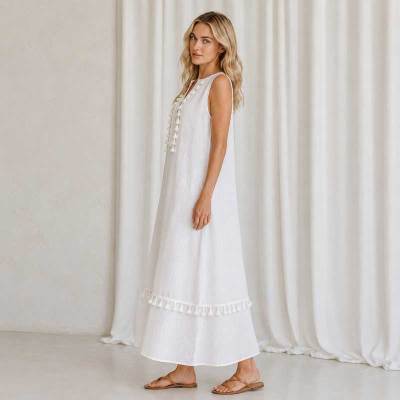
For dresses and skirts, the hem is as important as the waist. A midi length that ends just below the calf keeps the line long while showing the slimmest part of the lower leg. A maxi length creates one unbroken vertical column, which is one of the most balancing options for a pear shape. A hem that cuts across the widest part of the thigh or the calf usually does the opposite, breaking the line at the point you would rather not highlight.
Shirts, Blouses and Tops That Balance the Hip
The top half of a pear-shape outfit is where the balancing happens, so it is worth choosing it first and building the rest of the look around it. A linen shirt with a real collar and a relaxed but not oversized body is the most reliable starting point. Wear it tucked at the front only, so the waist reads while the sides stay soft, or wear it open over a fitted base layer for a vertical frame.
A linen blouse adds a little more movement and a softer shoulder. Look for a neckline that sits wide rather than high and tight: a boat neck, a soft V, an open collar or a shirt-style notch. A high, closed crew neck on a very light fabric tends to minimise the upper body, which is the opposite of what a pear shape needs.
A linen tunic top is a useful mid-length piece because it covers the hip while keeping a straight, uninterrupted line. Worn over straight-leg pants or a midi skirt, it creates a single vertical column down the body. The main rule is that the tunic should skim, not flare, and it should not end at the widest point of the hip.
- Best necklines: boat, soft V, open collar, scoop. They add width and light to the upper chest.
- Sleeves that work: elbow-length, bracelet-length, a wide three-quarter sleeve or a rolled cuff, all of which stop at a deliberate point.
- Sleeves to use with care: a very short cap sleeve that ends right at the widest part of the upper arm, and a sleeve that ends at the widest part of the bust.
- Detail to look for: a placket, a seam or a pocket on the chest, which adds a little structure and draws the eye upward.
- Length to prioritise: a top that ends either just above the hip bone or well below the widest point, never exactly at it.
If you prefer a looser, more relaxed look, a lightweight linen shirt worn open over a fitted rib or camisole works well because the open placket creates two long vertical lines down the front of the body. Those lines do most of the slimming and lengthening work, and they cost nothing in terms of comfort.
Dresses: A-Line, Wrap, Shirt and Slip
Dresses are where a pear shape gains or loses the most. The good news is that the three cuts that suit a pear shape best are also the three most common linen silhouettes, so choice is rarely a problem.
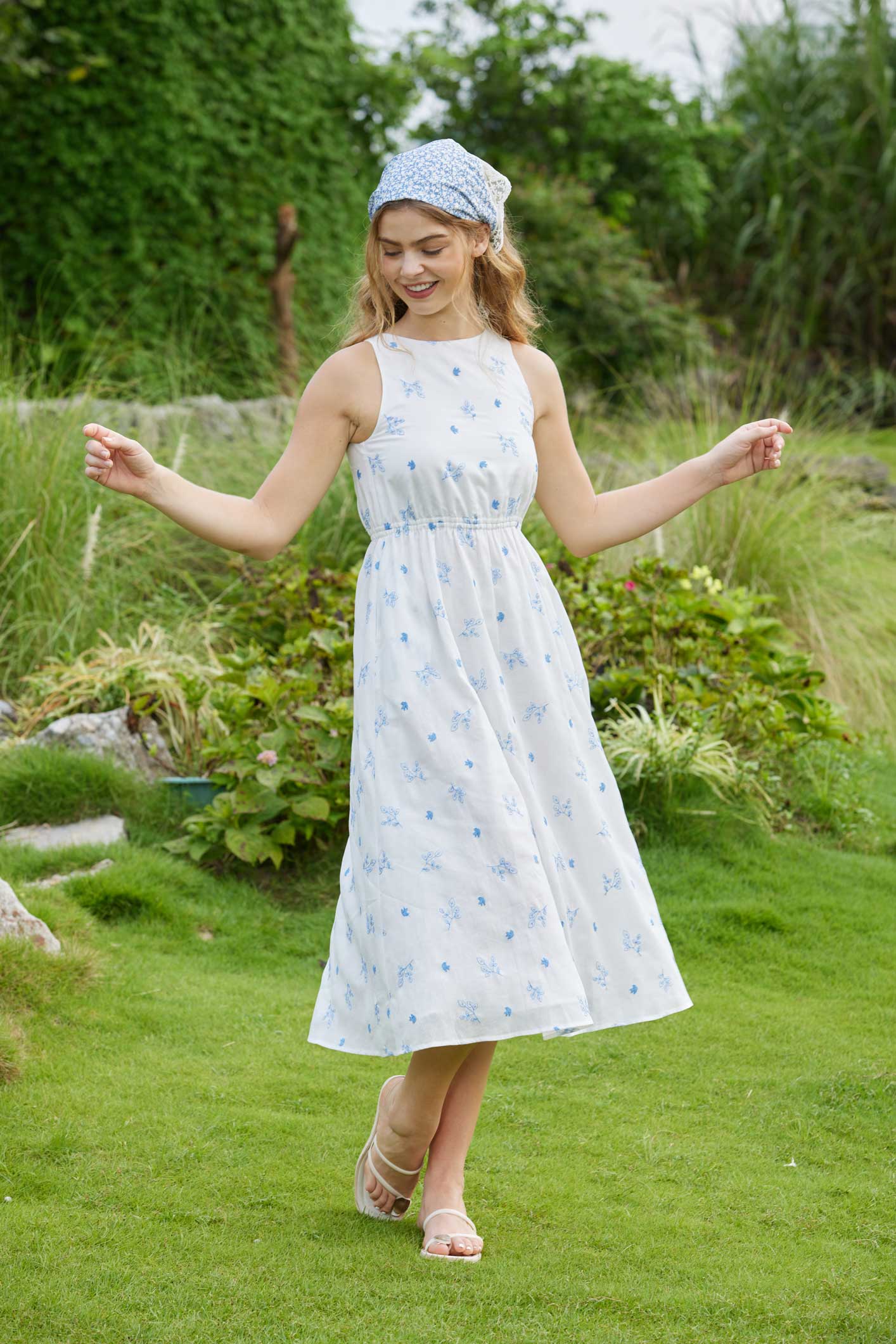
An A-line dress is the simplest answer: fitted or semi-fitted down to the waist, then falling away in a straight diagonal to the hem. It defines the waist, clears the hip entirely and creates a clean triangular line that balances a wider lower half. Look for a fabric in the 150-190 gsm range so the flare holds rather than collapsing.
A wrap dress adds an adjustable waist and a V neckline, both of which help. Because you tie the waist yourself, a wrap can be positioned exactly where your waist sits, and the crossover front creates a diagonal line that breaks up the width of the torso.
A shirt dress works if it is belted or sized so that the waist can be marked. Worn open over a slim base layer, it becomes a long vertical layer rather than a closed shape. A slip dress is the most demanding of the four, because it has no structure; it works when the linen is heavier and the cut is bias or straight rather than body-hugging, and it is best layered with a shirt, a cropped knit or an overshirt on top.
| Cut | Waist definition | Below the waist | Best when |
|---|---|---|---|
| A-line | Seam or fitted bodice | Falls away in a straight diagonal | You want the simplest balancing shape |
| Wrap | Tied by you, fully adjustable | Soft skirt with a diagonal front | Your waist sits off the standard pattern line |
| Shirt dress | Belt or self-tie | Straight, can be worn open | You want one piece that works open or closed |
| Slip | Minimal | Follows the body closely | You plan to layer over it with structure |
For any of these, check the shoulder seam first. If the seam sits inside your natural shoulder line, the dress will look narrow on top and unbalanced against the hip. If it sits on or just outside the shoulder point, the proportions are working in your favour.
Pants, Skirts and Sets for a Pear Shape
The lower half of a pear-shape outfit should be calm, clean and supportive. That does not mean dark and shapeless; it means choosing cuts that keep their line instead of wrapping around the body.
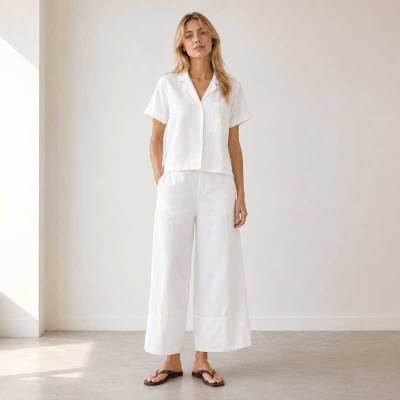
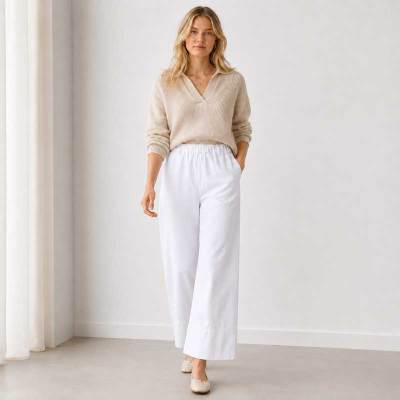
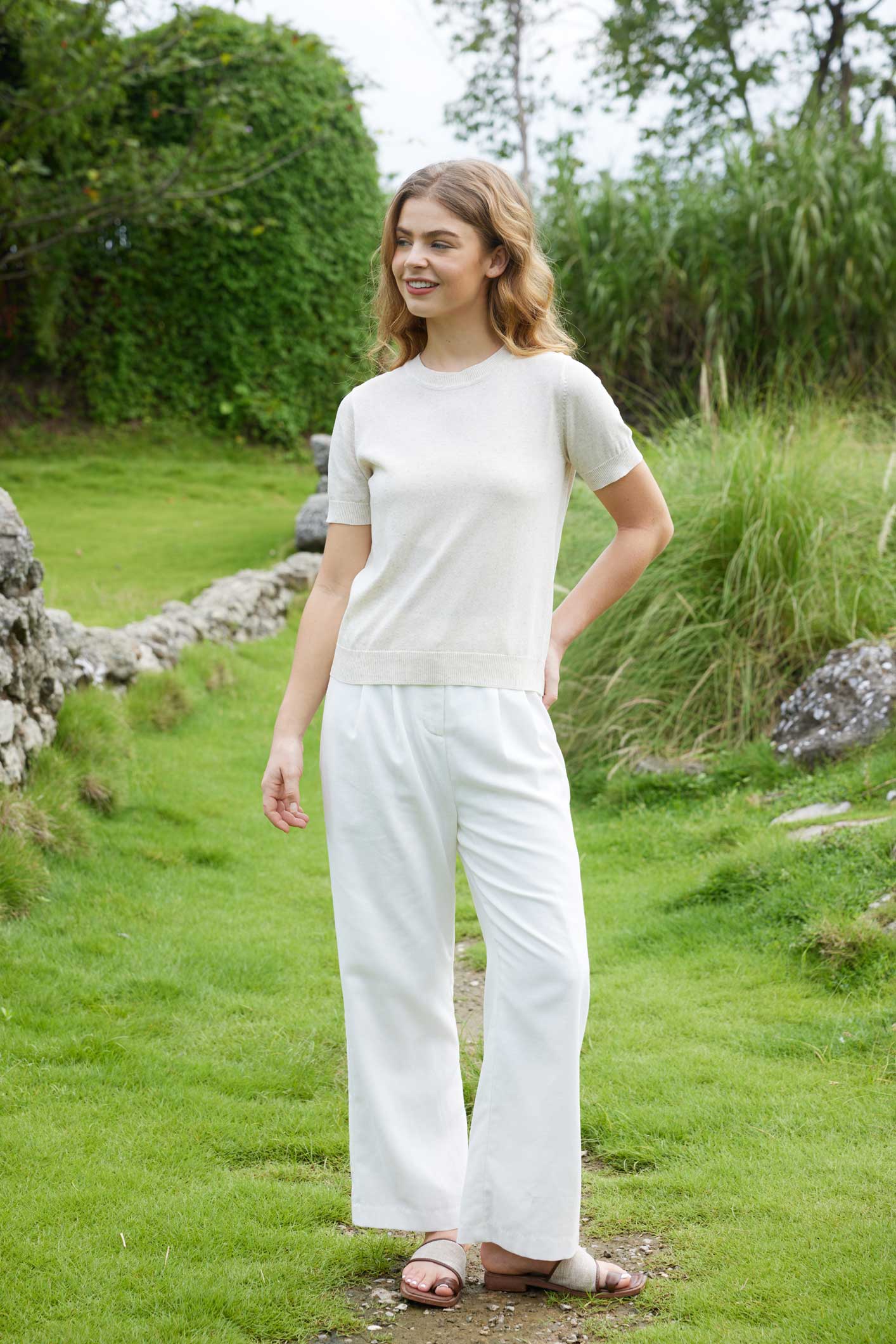
Wide-leg linen pants are the strongest single choice. They fall straight from the hip, so the fabric never has to travel around the thigh, and the vertical line from waist to hem lengthens the leg. A flat front and a clean waistband matter more than the width of the leg: pleats and bulky waistbands add volume exactly where a pear shape has enough already. Straight-leg linen pants are the neater alternative and work well in the 150-190 gsm range with a high or mid rise.
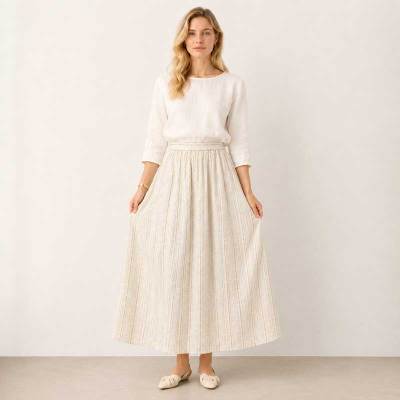
For skirts, a maxi skirt creates one unbroken vertical column, which is one of the most balancing silhouettes available. A midi skirt that ends just below the calf keeps the line long while showing the slimmer part of the leg. An A-line or slightly flared skirt in medium-weight linen clears the hip; a straight pencil skirt in light linen does the opposite and is best avoided in this shape unless the fabric is firm enough to hold its own line.
- Waistband: flat front, no gathered or elasticated bulk across the belly, rise high enough to sit at or above the natural waist.
- Fly and pockets: vertical detail such as a fly front and a side seam pocket adds line; horizontal detail across the hip adds width.
- Length: full length or ankle-length for pants; below the calf or full length for skirts.
- Fit through the seat: snug enough not to bag, loose enough to slide a hand between fabric and body without pulling the seam.
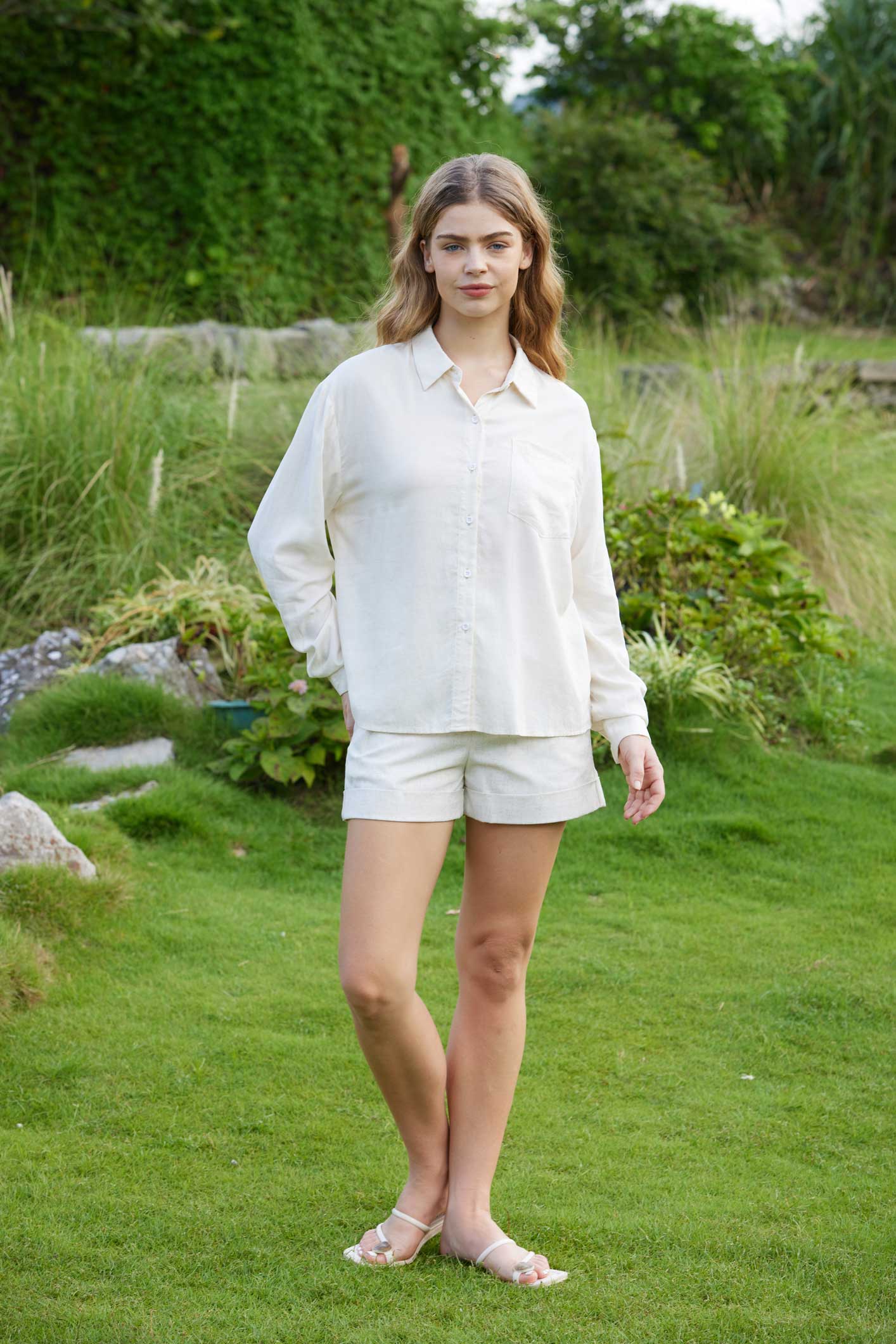
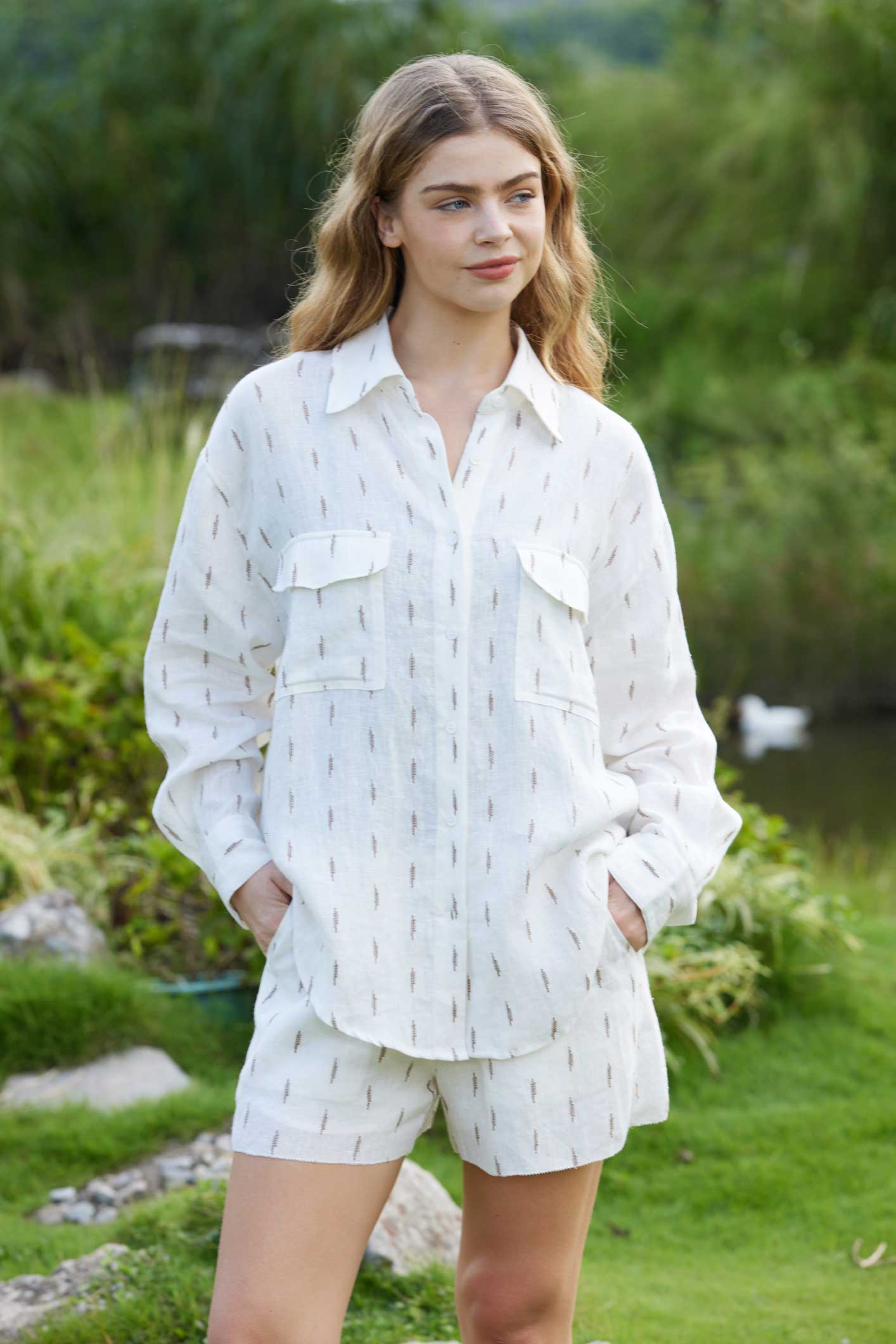
Linen two-piece sets deserve a special mention because they let you size the top and the bottom separately, keep one colour running from shoulder to hem, and remove the question of matching altogether. A straight or wide-leg pant with a collared shirt in the same tone is the easiest version of the vertical-column approach, and it works for work, travel and weekends without changing shape.
Colour, Print and Texture as Balancing Tools
Colour does some of the work that cut cannot. Because the eye reads lighter areas as closer and larger, a pear shape benefits from lighter or brighter tones on the upper half and calmer, deeper tones on the lower half. A white or natural linen shirt over darker linen pants uses that effect automatically.
Tonal dressing, where the whole outfit sits within two or three shades of the same family, is the most reliable option of all. Natural, sand, clay, olive and soft black all work together, and a continuous tone from top to bottom makes the body read as one long line rather than two blocks. This is not a rule about hiding; it is a rule about not breaking the vertical.
Texture is the third tool. Linen already carries a visible weave, and mixing weights adds depth without adding colour. A crisp 190 gsm overshirt over a fluid 130 gsm shirt creates two distinct surfaces, which draws the eye to the upper body. Prints behave in much the same way: a smaller, denser print on top and a solid below keeps attention high, while a large bold print on a skirt or a wide-leg pant tends to expand the lower half.
- Most balancing: tonal top and bottom, light on top and deeper below, small print above a solid.
- Workable: one statement piece, as long as it sits above the waist.
- Handle with care: large horizontal stripes, heavy all-over pattern below the waist, and high-contrast colour blocking across the hip line.
None of this is a prohibition. If you love a bold print, wear it; the cut and the fabric weight will still do most of the balancing work on their own.
Layering Linen Through Cooler Months
Linen is not only a summer fabric, and layering is where a pear shape can gain extra structure. A medium-weight linen overshirt or blazer worn open over a fitted top adds two vertical lines and a little width at the shoulder, which is exactly the balance a pear shape wants. Worn buttoned, the same piece should be chosen with a defined waist or belted so the line does not become a closed rectangle.
The layers closest to the body should be the smoothest and lightest, because they are the ones that show through. A fine rib or a smooth cotton base layer under an open linen shirt reads cleanly; a bulky textured knit underneath does not. On top, a knit should end above or well below the hip, never at the widest point.
Care matters here as well, because linen that has been washed and dried carelessly loses the crisp line that makes layering work. Gentle washing, a low spin, drying flat or on a padded hanger and a light press keep the shape of a collar, a waistband and a hem intact. If you want to keep your layering pieces looking structured, this linen care guide on washing and shrinkage covers the temperature and drying settings that protect the shape of the garment.
How to Check the Fit Before You Buy
Because linen has almost no stretch, a fit check in the fitting room tells you very reliably how the garment will behave at home. Work through these checks in order.
- Shoulder seam first. The seam should sit on or just outside the shoulder point. If it sits inside, the top is too narrow for a pear shape and the balance is lost immediately.
- Waist position second. Fasten or belt the garment and look at where the waistline lands. It should sit at your narrowest point, not below the hip bone.
- Hip clearance third. Slide your hand under the fabric at the widest point of the hip. It should pass without pulling the seam or lifting the hem. If the fabric pulls taut across the hip, size up or choose a different cut.
- Sit and reach fourth. Sit down, then reach forward. Linen with too little ease will pull across the back and the thigh. If it does, the garment is cut too closely for the fabric.
- Length last. Check the hem against the widest part of the leg. Move it up or down in your mind until it clears that point, then decide whether the length can be altered.
If the size chart puts you between two sizes, our guide to choosing between sizes explains which measurements to trust for a loose-fitting linen piece.
Common Mistakes When Dressing a Pear Shape in Linen
Most of the frustration people feel with linen comes from a small number of avoidable choices rather than from the fabric itself.
- Going oversized everywhere. An oversized top and an oversized bottom remove the waist and make the silhouette wider. Balance needs one fitted reference point.
- Choosing the lightest linen available. Thin linen clings and shows every line. Medium weight hides the line and holds a shape.
- Ignoring the shoulder seam. A narrow shoulder beside a wide hip is the imbalance the whole outfit is meant to solve.
- Cutting the line at the widest point. A hem, a seam or a stripe placed across the widest part of the thigh or calf draws the eye exactly there.
- Buying unwashed linen and expecting the fit to stay the same. Choose pre-washed, garment-washed pieces and follow the care instructions so the shape you bought is the shape you keep.
- Believing only dark colours work below the waist. A calm mid tone in the same family as the top will balance better than a hard contrast.
Frequently Asked Questions
What linen dress suits a pear shape best?
An A-line dress is the most straightforward choice because it marks the waist and then falls away in a straight diagonal, clearing the hip entirely. A wrap dress is equally effective and more adjustable, because you tie the waist yourself and can position it exactly at your narrowest point.
Should a pear shape wear light or heavy linen?
Medium-weight linen, roughly 150-190 gsm, usually works best below the waist because it stands slightly away from the body and keeps its own line. Very light linen at around 110-130 gsm drapes close and reveals the shape underneath, so it is better used for tops and layering pieces.
Are wide-leg linen pants good for a pear shape?
Yes. A wide leg that falls straight from a flat waistband keeps the fabric away from the thigh and creates one vertical line from waist to hem. A flat front matters more than the width of the leg, because pleats and bulky waistbands add volume at the hip.
How do I stop linen clinging to my hips?
Choose a slightly heavier fabric, check that the cut falls away from the body below the waist, and make sure there is enough ease. If you can slide a hand under the fabric at the widest point without the seam pulling, the garment is unlikely to cling when you sit or walk.
Is a linen two-piece set a good option for a pear shape?
It is one of the best, because the top and bottom can be sized independently and a single tonal colour continues the vertical line from shoulder to hem. A collared shirt with straight or wide-leg pants in the same tone is the simplest version.
Does garment-washed linen still shrink?
Garment washing pre-shrinks the fabric and softens it before it reaches you, which reduces but does not eliminate shrinkage. Washing at a low temperature and air-drying flat protects both the size and the shape of the garment.
The Short Version
Dressing a pear shape in linen comes down to proportion rather than size. Mark the waist with a wrap tie, a belt or a tucked shirt. Add presence at the shoulder with a collar, a boat neck or a structured overshirt. Keep the lower half calm with a flat waistband, a straight or wide leg, and a hem that clears the widest point of the leg. Choose medium-weight linen around 150-190 gsm so the fabric skims rather than clings, and keep the colour tonal from top to bottom so the body reads as one long vertical line. A-line and wrap dresses, wide-leg and straight-leg pants, maxi and midi skirts and tonal two-piece sets cover almost every occasion a pear shape needs.
Explore the matching linen two-piece sets, all cut in 100% European Flax and garment-washed for a softer start.