How Many Linen Pieces for a 10-Day Warm-Weather Trip?
How Many Linen Pieces for a 10-Day Warm-Weather Trip?
Short answer: eight pieces. Three tops, two bottoms, one dress, one long-sleeve layer and one two-piece set cover ten days in a warm climate if you wash every third day. Eight is the count that gives you three days of clothing in rotation plus one set drying, with nothing left over to carry.
The Short Answer, Restated
Eight linen pieces is the working number for a ten-day trip to a hot, humid destination. The mix matters as much as the count: three tops, two bottoms, one dress, one long-sleeve layer and one set. That combination produces more than twenty outfits, survives three sink washes, and fits in a carry-on because linen at 120 to 180 gsm folds flat and weighs little.
The count is driven by laundry, not by fashion. If you can wash every third day, eight pieces are enough. If you cannot wash at all, no realistic number of pieces covers ten days, and the answer becomes a laundry service rather than a larger bag. Everything below works through that arithmetic, then adjusts it for humidity, activity level and trip length, because the honest answer to "how many" depends on those three variables.
Two boundary conditions are worth stating early. Eight pieces assumes the destination stays above roughly 20°C at night. If the trip includes cold nights, the linen count rises or a non-linen insulating layer is added, and the packing logic in packing linen for cooler climates applies instead. And eight pieces assumes a wash option, whether that is a hotel sink, a line on a balcony, or one service wash mid-trip.
The Eight Pieces, Item by Item
The table below is the list itself, with the weight each piece should be and the job it does. The weights are not decorative: a 130 gsm tee and a 180 gsm overshirt behave differently in the same humidity, and the list only works if both are present.
| Piece | Weight | Job on the trip |
|---|---|---|
| Loose linen tee | 120 to 140 gsm | Daytime base layer, sleep layer, flight layer |
| Collar shirt, short sleeve | 130 to 150 gsm | Turns shorts into a restaurant outfit; covers shoulders in sun |
| Long-sleeve shirt or overshirt | 160 to 180 gsm | Flight, air-conditioned interiors, cool evenings |
| Wide-leg trousers, elastic back | 150 to 180 gsm | Dinner, travel, long days; the most versatile bottom |
| Linen shorts | 140 to 170 gsm | Beach, market, midday heat; dries fastest |
| Midi or maxi dress | 120 to 150 gsm | An evening resolved with no styling decision |
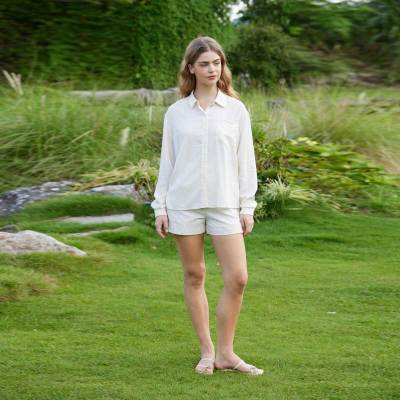
| Two-piece set | 150 to 180 gsm | Worn together for dinner, split into two backup pieces |
| Linen scarf or large square | 90 to 120 gsm | Sun cover, plane blanket, shoulder wrap, beach towel |
If you are shopping for these rather than editing a wardrobe, the pieces that do the most work are the wide-leg trousers, the 160 to 180 gsm overshirt and the set. Choose those three first and let the tee, collar shirt, shorts and dress fill in around them. Current weights and cuts are listed under linen tops, and the matching bottoms are cut to the same weight bands.
Why Eight, and Not Five or Twelve
The number comes from a simple equation: days in the trip, divided by days between washes, plus one set drying. Ten days with a wash every third day means you need a little over three days of clothing in active rotation. Eight pieces supply that with a spare, and a spare is what stops the schedule from breaking when a garment is still damp.
Five pieces would work only if you washed every single day, which is possible on a resort trip with a good drying line and much harder on a city trip where you are out from morning to night. Twelve pieces would remove the need to wash at all, but twelve linen garments at these weights fill a checked bag, and a checked bag on a ten-day trip usually costs more in time and money than three sink washes.
| Wash rhythm | Pieces needed for 10 days | Realistic on this trip? |
|---|---|---|
| Daily sink wash | 4 to 5 | Only with fast-drying light pieces and reliable air movement |
| Every second day | 6 to 7 | Workable, but leaves no margin for a damp morning |
| Every third day | 8 | Yes, and it is the balance this list is built around |
| One service wash mid-trip | 8 to 9 | Yes, with more comfort and less sink work |
| No washing at all | 12 or more | No, not in a carry-on |
The margin matters more than the arithmetic. A eight-piece list where one garment stays damp for an extra day still functions, because there is a ninth combination available from the set. A six-piece list where one garment stays damp does not. That is the practical difference between a plan that survives humidity and one that looks fine on paper.
What Counts as One Piece
The count is easy to inflate without noticing, so the definition is worth fixing. One piece is one garment worn on the body as a separate layer or as a complete outfit component. A set counts as one piece even though it is two garments, because the two halves work as a unit and splitting them does not add a ninth item to the bag.
- A set counts as one. It occupies the space of one outfit and produces three: together, top half alone, bottom half alone.
- A scarf counts as one. It is a garment with several jobs and it displaces a beach towel, a plane blanket and a wrap.
- Underwear and swimwear do not count. They are not linen pieces in this sense and they pack into the gaps.
- A second pair of shoes does not count, but it costs more space than a garment. Pack one pair plus sandals and treat the sandals as part of the beach outfit.
This definition is why eight works. If a set counted as two, the list would be nine pieces and the bag would be fuller for no gain in outfits. Keeping the count honest is what makes the plan usable rather than aspirational.
The Men's Version of the Same Eight
The count holds, but the composition shifts, because the evening piece for most men is a shirt rather than a dress. The eight pieces become three shirts, two bottoms, one overshirt, one set or a second trouser, and the scarf.
| Piece | Weight | Job |
|---|---|---|
| Linen tee | 140 to 160 gsm | Base layer and beach piece |
| Short-sleeve linen shirt | 140 to 160 gsm | Daytime shirt that reads as smart enough for lunch |
| Long-sleeve linen shirt | 160 to 180 gsm | Dinner shirt and flight layer |
| Wide-leg or relaxed linen trousers | 160 to 180 gsm | Dinner, travel, air conditioning |
| Linen shorts | 150 to 170 gsm | Beach and daytime heat |
| Linen overshirt | 170 to 190 gsm | Layer for the flight and for cool evenings |
| Second trouser or a linen set | 150 to 180 gsm | Backup bottom, or a matched top-and-bottom option |
| Linen scarf or bandana | 90 to 120 gsm | Sun, sweat, and a wrap on the plane |
Men's linen shirts are often cut with less ease than women's, which changes the fit advice slightly. On a warm-weather trip, choose a chest measurement with 10 to 14 cm of ease; anything closer will cling in humidity. The measurement points for each cut are in the size and fit guide.
The Wash Cadence, Day by Day
The schedule below is the one that makes eight pieces sufficient. It assumes a sink, cool water, mild detergent, a towel and somewhere to hang. Each wash takes about fifteen minutes of attention, plus soaking time you spend doing something else.
| Day | Wear | Wash in the evening | Drying window |
|---|---|---|---|
| 1 | Tee, wide trousers, overshirt | Nothing | Not applicable |
| 2 | Shorts, tee, dress for dinner | Nothing | Not applicable |
| 3 | Collar shirt, shorts, set for dinner | Tee and shorts | Overnight plus morning, 8 to 10 hours |
| 4 | Set trousers with tee | Nothing | Not applicable |
| 5 | Wide trousers, collar shirt | Collar shirt and dress | Overnight, 7 to 9 hours |
| 6 | Shorts and tee again | Nothing | Not applicable |
| 7 | Dress or set | Tee and wide trousers | Overnight, 8 to 10 hours |
| 8 | Set trousers, tee | Nothing | Not applicable |
| 9 | Shorts, collar shirt | Shorts and collar shirt | Overnight before the flight |
| 10 | Tee, wide trousers, overshirt | Nothing | Not applicable |
Three washes, six garments washed, and everything has been worn at least twice. The garments that are never washed are the ones worn once or twice for a few hours, which is exactly what airing handles. Hang every garment every night, including the ones you plan to wear again, and a surprising number of pieces stay in rotation without water.
The one rule that keeps this working
Never wash more than three garments at once. More than that and the drying space is insufficient, the garments bunch together, and the schedule slips by a day, which is the only way an eight-piece bag fails.
Adjusting for Humidity
Humidity is the variable that changes the schedule most, and it changes drying time rather than the piece count. At 60 percent relative humidity with air movement, a 140 gsm shirt dries in three to five hours and the schedule above holds without modification. At 85 percent in a closed room, the same shirt can take ten hours, and the plan needs three adjustments.
| Weight | At 55 to 65 percent RH | At 80 to 90 percent RH | What to do |
|---|---|---|---|
| 120 to 140 gsm | 3 to 5 hours | 7 to 9 hours | Wash at night, hang near moving air |
| 150 to 170 gsm | 5 to 7 hours | 9 to 12 hours | One garment per night, never two |
| 175 to 190 gsm | 6 to 8 hours | 11 to 14 hours | Send to a service wash or wear longer between washes |
In high humidity, switch from three garments every third day to one garment every night. The total amount washed is the same, but nothing is ever waiting for a second garment to finish drying, and the rotation never stalls. Roll each piece in a dry towel before hanging to remove most of the water, and hang it in front of an air-conditioning vent if the room has one, because the unit is dehumidifying the air as it cools it.
The second adjustment is behavioural rather than technical: air garments rather than washing them. At 85 percent humidity, a shirt worn for four hours and hung overnight is usually wearable again, while the same shirt left in a bag is not. Airing costs nothing and reduces the number of washes, which is the real constraint.
Adjusting for Activity Level
Two trips at the same temperature can need different bags. A resort week and a city week with temples, boats and long walks do not put the same demands on clothing, and the difference shows up in the bottom half of the list rather than the top.
- Resort or beach: the eight pieces as written. Shorts and the dress do most of the work.
- City and culture: keep all eight but swap the shorts for a second wide-leg trouser, because walking and sitting on public transport favour a longer hem.
- Boat or sailing: swap the dress and set for a second tee and quick-dry sandals; spray and wind make a long garment a liability.
- Mixed trip: keep the list intact and add a closed linen shoe, which costs space but resolves the one outfit the sandals cannot.
- Event or wedding: the dress or the set becomes the anchor and the shorts come out of the bag entirely.
There is a version of this question that is really about sweat rather than activity. If you know you will sweat heavily, add a second tee rather than a second shirt: tees are the cheapest piece by weight and the fastest to dry, and two of them extend the wash interval by a full day. That single substitution is more useful than any other change to the list.
What Changes for 14 Days, or for 7
The eight-piece list scales in one direction cleanly and in the other direction not at all. For a seven-day trip, keep eight and wash once; the extra garment is lighter than the risk of a damp morning. For a fourteen-day trip, keep eight and plan two laundry stops rather than adding pieces.
| Trip length | Pieces | Washes | Note |
|---|---|---|---|
| 4 to 5 days | 6 | 0 to 1 | Drop the set or the dress, keep the layer |
| 7 days | 7 to 8 | 1 | Eight is easier than seven; the spare earns its space |
| 10 days | 8 | 3 | The list as written |
| 14 days | 8 to 9 | 4 to 5, or 2 plus one service wash | Do not add more than one piece; add laundry instead |
The instinct on a longer trip is to pack more, and it is almost always wrong. Fourteen days of clothing does not fit in a carry-on in any fabric, and a heavier bag makes the trip worse in a way that a mid-trip laundry stop does not. Add one piece at most, then add laundry capacity.
Common Mistakes With the Count
Most people who pack twelve pieces for ten days are not over-packing clothes; they are over-packing decisions. Four habits account for most of the excess.
- Packing eight tops and two bottoms. Bottoms carry the outfit and dry slower. The correct ratio is roughly three tops to two bottoms, with the dress or set as the swing piece.
- Packing eight different colours. A palette of two neutrals and two tones makes every top work with every bottom. Eight colours produce eight outfits.
- Counting the flight outfit separately. The overshirt and trousers you wear on the plane are pieces one and two, not extras.
- Adding a just-in-case outfit. If a formal dinner might happen, the set covers it. A dedicated fourth evening outfit travels and stays in the bag.
For the packing method itself, including how to roll linen so it arrives with soft creases rather than hard folds, the step-by-step version is in how to pack linen clothing for vacation. The two guides are meant to be used together: this one sets the count, that one sets the method.
Frequently Asked Questions
Is eight pieces enough without any washing?
No. Eight pieces covers ten days only with three washes, or two washes plus one service wash. Without any washing, ten days in a warm climate needs twelve or more pieces, which no longer fits in a carry-on.
Should I pack heavier linen for the flight?
Wear it rather than pack it. A 160 to 180 gsm overshirt over a 130 gsm tee covers an airport at 21°C and a cabin at 23°C, and wearing it removes roughly a third of the bag's weight.
How long does linen take to dry in a hotel room?
Three to five hours for a 130 gsm piece in warm moving air, seven to nine hours at high humidity, and up to twelve for a 180 gsm trouser. Rolling the garment in a towel before hanging cuts those times substantially.
Can I wear the same linen tee two days in a row?
Yes, if you hang it overnight in moving air. A tee worn for a few hours and aired is usually wearable again, which is how eight pieces stretch across ten days without a fourth wash.
Does the count change for men?
No, but the composition does. Men typically swap the dress for a second shirt and keep the overshirt, which gives the same eight pieces with the same evening coverage.
Build the Eight Around Three Pieces
Start with the wide-leg trousers, the 160 to 180 gsm overshirt and the two-piece set. Those three cover the flights, the dinners and the air-conditioned rooms, and the rest of the list is chosen to work with them. Confirm the trouser waist against the size chart before ordering, and browse linen sets with the split-wearing idea in mind rather than the photograph.