Size Questions
Which Linen Styles Fit Most Body Types?
Short answer: a relaxed shirt, wide-leg pants and a straight or A-line skirt fit the widest range of bodies. Each one tolerates 6 to 14 cm of measurement difference at the chest, waist or hip, because the cut is drafted with ease and the waist can be adjusted rather than fixed.
Why These Three Styles Do Most of the Work
Linen is a woven cloth with very little stretch. That single fact decides which garments are forgiving. A knit can stretch 20 percent and recover; a woven linen garment cannot. So linen patterns are drafted with ease built in, and the garments that use that ease most deliberately are the ones that fit the most people.
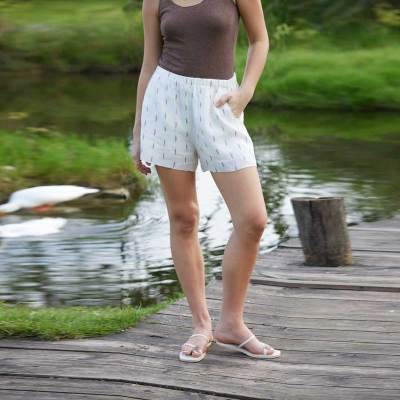
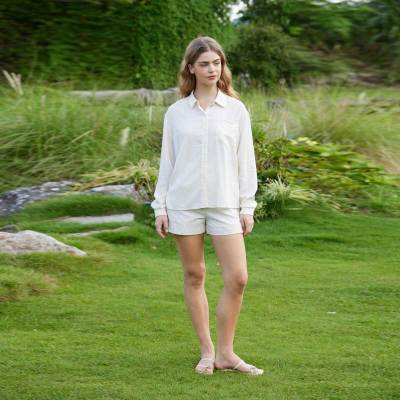
Three shapes sit at the top of that list. The relaxed shirt puts tolerance in the chest and shoulder, where bodies vary most. The wide-leg pant puts tolerance in the leg and, when it has an elastic back, in the waist. The straight or A-line skirt puts tolerance in the hip and hem while asking for only one real number at the waist.
Everything else in a linen wardrobe asks for more precision. A fitted dress needs bust, waist and hip to agree at once. A tailored blazer needs shoulder width and sleeve length to be nearly exact. Those garments are not worse; they simply need measurements you may not have.
What Fit Tolerance Actually Means
Tolerance is the range of body measurements a garment can absorb before it stops looking intentional. It is not the same as looseness. A very oversized shirt has a lot of room but a narrow band of acceptable fit, because at some point it stops reading as relaxed and starts reading as borrowed.
The useful measure is ease: the difference between the garment measurement and the body measurement at the same point. For linen, a garment needs more ease than an equivalent knit because the cloth does not give. These are the working windows that most linen patterns and production blocks use.
Fit tolerance by linen garment type
| Garment | Key measurement | Working ease | Who it covers |
|---|
| Relaxed shirt or tunic | Chest | 10 to 14 cm | Most builds, including broad shoulders and full bust |
| Wide-leg pants, elastic back | Waist | 6 to 8 cm of adjustment | Waist variation, most heights with a hem adjustment |
| Straight skirt | Hip | 4 to 6 cm | Straight and hourglass builds, less so pear shapes |
| A-line skirt | Waist | 2 to 4 cm, flare below | Most builds, because the hip is not constrained |
| Fitted dress | Bust, waist, hip | 2 to 3 cm | Only a close measurement match |
| Tailored blazer | Shoulder, sleeve | 1 to 2 cm | Precise shoulder width required |
Read the table as a risk map rather than a ranking. The top two rows are where you can buy with confidence from a single number. The bottom two rows are where a size chart is not enough and you need a tape measure.
Relaxed Linen Shirts: Why They Fit the Widest Range
The shirt wins because it is the only common garment where a loose fit is the intended look. That gives the cut permission to stand away from the body at the chest, waist and hem, and permission is what creates tolerance.
Four details do most of the work.
- Chest ease of 10 to 14 cm. A body that measures 4 cm under or 6 cm over the block still sits inside the intended silhouette. Below 8 cm of ease, the shirt starts to pull at the button placket on a full bust.
- A drop shoulder. When the shoulder seam sits 2 to 4 cm down the arm, the garment stops depending on exact shoulder width. Set-in shoulders are the least forgiving part of any shirt.
- A hem that covers the hip. A body length of 72 to 76 cm clears the widest part of the hip on most adults between 165 and 180 cm, which keeps the shirt wearable untucked.
- Short or roll-up sleeves. Sleeve length is the one measurement you cannot fake. If you are unsure, remove the variable rather than guess it.
Weight changes how much the shirt forgives. At 110 to 150 gsm, garment-washed linen drapes and moves, so a two-centimetre error disappears into the fold of the cloth. At 200 gsm and above, the shirt holds a crisp line and shows every centimetre of excess. For an unknown body, choose the lighter weight in the looser cut.
The one body type the relaxed shirt serves least well is a very petite frame with narrow shoulders, where a drop shoulder can swallow the arm. In that case, a shorter body length and a narrower shoulder width matter more than extra chest ease.
Wide-Leg Linen Pants: Waist and Hip Tolerance
Wide-leg pants are the most tolerant trouser shape because they remove the leg from the fit equation. There is no taper at the calf, no thigh constraint and no knee break to get wrong. What remains is the waist, the rise and the length, and two of those three can be adjusted.
The waist is where the tolerance is created or lost. A flat-front waistband with an elastic back panel covering 12 to 15 cm of the back circumference will absorb 6 to 8 cm of waist measurement without visible gathering at the front. A full drawstring achieves a similar range but reads casual, which suits lounge and vacation pants better than a tailored wide leg.
The rise decides where the pant sits, and where it sits decides how stable the fit is. A rise of 28 to 32 cm places the waistband at the natural waist, the narrowest and most consistent point on the torso. A low rise sits on the hip, where every 3 cm of hip measurement shifts the whole garment.
Length is the variable to solve last. A wide leg that is 2 to 3 cm long can be worn with a heel or taken up; one that is short cannot be fixed. If you are between two lengths, take the longer one.
Practical check. Measure the flat waistband of a pair of pants that already fits, double it, and compare that number to the size chart. Pants charts almost always list the flat measurement, not the body measurement, and mixing the two is the most common sizing error in linen.
Straight and A-Line Linen Skirts: The Proportional Middle
Skirts split into two behaviours. A straight skirt is tolerant at the waist but depends on the hip, because a woven tube has to clear the widest point of the body to walk in. An A-line skirt is tolerant at both, because the flare begins below the waist and the hip is never constrained.
A straight skirt needs 4 to 6 cm of ease at the hip plus a vent or slit at the back hem. Without the vent, the wearer takes short steps and the skirt reads as tight even when the measurements are correct. With it, the same skirt feels generous.
An A-line skirt needs almost no hip ease because the flare provides it. The waistband becomes the only real number, and a side tie or a partially elasticated back adds a further 3 to 5 cm of adjustment.
Length is more forgiving here than on pants. A midi length of 75 to 85 cm from waist to hem lands below the knee on most heights between 160 and 175 cm, and a hem that is 3 cm long can be taken up without changing the line. That makes the skirt a better gift or a better first purchase than a pair of pants when only the waist is known.
Three Body-Shape Scenarios and Which Style Leads
Body shape language is imprecise, so treat these as starting points rather than categories. What matters is which measurement is hardest to fit, because that is the measurement the garment has to tolerate.
Which tolerant style leads, by fitting pressure point
| Scenario | Hardest measurement | Lead with | Avoid |
|---|
| Full bust, narrower hip | Chest and button gap | Relaxed shirt with 12 cm ease, A-line skirt | Fitted shirt dresses, straight skirts |
| Full hip and thigh, narrower shoulder | Hip | Wide-leg pants, A-line skirt | Straight skirts, tapered pants |
| Tall with long torso | Body and sleeve length | Long-line shirt, wide-leg pants with a long inseam | Cropped tops, short jackets |
| Petite with short torso | Overall length | Cropped shirt, midi skirt, high-rise wide leg | Oversized tunics, maxi lengths |
The pattern in the table is consistent: the tolerant style is the one that removes pressure from the hardest measurement. It is not about hiding a body part. It is about choosing a cut where the cloth does not have to be exact.
Where High-Tolerance Styles Still Fail
Honesty matters more than an unqualified recommendation. These three styles cover the widest range, not every range, and there are situations where the tolerance runs out.
- Petite frames under about 158 cm. A relaxed shirt at 74 cm body length can read as a dress, and a wide leg at 30 cm rise can reach the ribs. Length, not width, is the constraint, so look for cropped or short-length versions.
- Very tall frames over about 182 cm. Standard body lengths and inseams run short. The fit at the chest or waist may be perfect while the sleeve and hem are visibly wrong, and those cannot be adjusted downward.
- Pregnancy and post-partum. A wide-leg pant with an elastic back works for a while, but the waistband sits where the body changes fastest. A wrap or drawstring style with a longer rise is more adaptable than a fixed waistband.
- Broad shoulders with a full bust. A drop shoulder helps, but a shirt with a narrow back yoke will still pull across the shoulder blades. Check the back width, not only the chest.
If any of these describes the person you are buying for, the honest move is to ask for one measurement or to move to an accessory, where fit does not enter the decision at all.
How to Confirm Tolerance Before You Order
You can test all of this without the recipient present. The method is to compare garment measurements to a garment, not to a body.
- Take a shirt that already fits well. Button it, lay it flat, and measure straight across the chest 2 cm below the armhole. Double the number.
- Measure the shoulder seam to seam across the back, and the body length from collar seam to hem.
- Measure a pair of pants at the flat waistband, double it, then measure the rise from crotch seam to waistband top and the inseam from crotch to hem.
- Compare those four numbers to the size chart on the product page. Charts list garment measurements; if a number looks like a body measurement, it is probably labelled as such.
- Allow for residual shrinkage. Garment-washed linen has usually done most of its shrinking, so expect roughly 2 to 3 percent rather than the 5 to 8 percent typical of loom-state cloth. On a 110 cm chest that is about 2 to 3 cm, which is inside the tolerance of a relaxed cut but not of a fitted one.
If the comparison lands between two sizes on a relaxed shirt or a wide-leg pant, choose the larger. If it lands between two sizes on a fitted dress, choose the smaller only when the fabric is light and the cut is bias-free; otherwise do not buy it without a measurement.
For the step-by-step version of this method, including how to measure the body rather than the garment, see how do I choose the right size. If the numbers land between two sizes, what if I am between sizes covers the tie-break rules by garment type.
Fabric Details That Change How a Style Fits
Two garments can share a pattern and fit differently because of the cloth. Weight and finish are the two variables that matter most, and both are listed on a good product page.
At 110 to 150 gsm, linen is light enough to drape and collapse into folds. That movement absorbs small fit errors and makes a relaxed shirt or a wide leg look softer. At 180 to 240 gsm, the cloth holds structure: hems stand straight, waistbands keep their shape, and every measurement error becomes visible. Heavier cloth is better for skirts and tailored shapes, lighter cloth for shirts and pants that need to move.
Finish matters just as much. Garment washing softens the hand and pre-shrinks the cloth, which is why a washed linen shirt feels broken in on the first wear and changes little after the first wash. The fibre itself is usually 100 percent European Flax, a traceable flax standard; the specification is published at European Flax. Dye testing is usually referenced through OEKO-TEX Standard 100, a mill-level certification for harmful-substance testing rather than a claim about an individual garment, documented at OEKO-TEX.
Quick Answers
What linen style fits the most body types?
A relaxed shirt with 10 to 14 cm of chest ease, followed by wide-leg pants with an elastic back and an A-line skirt. These three tolerate the widest measurement range because the cut supplies the ease rather than the body.
Is a loose linen shirt flattering on everyone?
No. It suits most builds, but a very petite frame can be swallowed by a 74 cm body length and a narrow shoulder. In that case, choose a shorter length and a narrower shoulder rather than more chest room.
Do wide-leg linen pants work if I am short?
Yes, if the rise and inseam are right. A high rise of 28 to 32 cm with an inseam cut for your height keeps the line long; the common failure is a standard inseam that pools at the ankle.
Which linen skirt is most forgiving?
An A-line skirt with a side tie or a partially elasticated back. The flare removes the hip from the equation, and the tie adds 3 to 5 cm of waist adjustment.
What if the style fits but the size is wrong?
Most eligible items can be exchanged within the published window if they are unworn, unwashed and still tagged, subject to stock. Contact support before shipping anything back; the process is described in can I exchange for another size.
Five-minute fit check before you order
- Chest: flat measurement doubled, compared to a shirt that fits.
- Shoulder: seam to seam across the back, plus 2 to 4 cm if the shoulder is dropped.
- Waist: flat waistband doubled, not body circumference.
- Length: body length 72 to 76 cm, inseam matched to height, midi 75 to 85 cm.
- Cloth: 110 to 150 gsm for drape, 180 to 240 gsm for structure.
Start With the Three Tolerant Shapes
Browse relaxed linen shirts and wide-leg linen pants, then add a straight or A-line skirt in the same logic. If you are still deciding how much ease a garment should have, the fit rules garment by garment are set out in our guide to how linen clothing should fit.